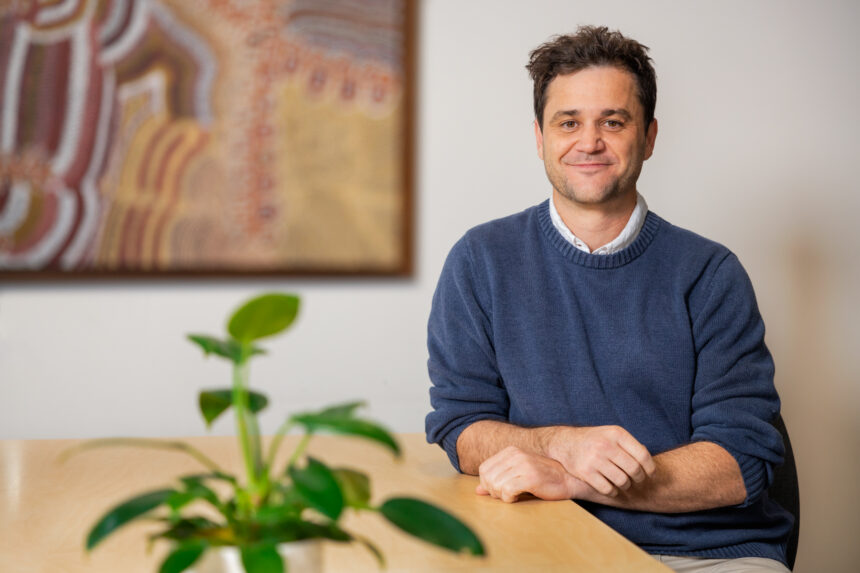
Australia’s first comprehensive report to examine the future impact of artificial intelligence (AI) on First Nations communities warns that the technology could either widen inequality or help close the gap, depending on who holds the power to shape it.
The report by Wiradjuri researcher and Paul Ramsay Foundation Fellow Dr Kyle Turner draws on Australia’s 17 Closing the Gap targets to systemically assess how AI may influence outcomes across health, education, employment, justice and culture.
The report finds that while AI has the potential to improve lives, it also carries significant risks, particularly when communities are excluded from design and governance.
“AI’s promise is real. It can improve health outcomes for families, support learning across distance, assist rangers on Country and help strengthen languages at risk,” said Dr Turner, who previously created world-first AI technology to scan photos of teeth and gums for common dental problems, improving access to free dental check-ups and oral health education.
“But we must proceed with caution, because the dangers of AI are just as real. Predictive policing models trained on historic datasets can amplify discrimination rather than address it. In child protection, automated systems risk mistaking surveillance for safety, turning families into data points instead of people.
Even housing tools meant to improve maintenance can unintentionally exclude those already struggling to secure shelter. Efficiency can come at the cost of equity if systems aren’t culturally safe and community governed.”
The report’s release comes as governments work to establish national AI guardrails and the Senate Select Committee on Adopting AI calls for stronger protections for marginalised communities. The latest Australian Digital Inclusion Index shows that a digital gap persists between First Nations people and other Australians as well as a considerable affordability gap.[i]
The report sets out a roadmap for responsible AI adoption, emphasising Indigenous Data Sovereignty to ensure First Nations peoples control their data. It calls for accelerating AI in health, education, and environmental management, adapting it for employment and housing, and pausing its use in justice and child protection until cultural safety, consent, and accountability are guaranteed – reminding us that responsible technology must be shaped by fairness, inclusion and the voices of First Nations communities.
Dr Turner, who completed his PhD in Epidemiology at the University of Oxford and has published widely on the burden of chronic diseases, highlighted the stark unevenness of AI’s future impact, warning that technology will almost always advantage those who hold the power to shape it.
“Every AI initiative should pass a simple test: does this shift power, benefits, and decision-making towards First Nations communities? If the technology cannot clear that bar — no matter how sophisticated — then it has no place in closing gaps that colonisation opened.
Where First Nations communities shape the brief, set the boundaries, and retain the right to walk away, AI can amplify existing strengths. Where those conditions are absent, it becomes another vector for extraction and control.”
PRF’s Chief First Nations Officer Michelle Steele said Dr Turner’s work is a crucial reminder that technology must be guided by fairness and inclusion.
“This report reminds us that technology is never neutral,” she said. “When First Nations peoples lead, AI can strengthen self-determination. When they’re excluded, it risks repeating the mistakes of the past.”
Despite these challenges, the report offers hope, identifying strong examples of community-controlled AI in action, from telehealth services and ranger programs to language centres building their own digital archives under strict cultural protocols.
Dr Turner was hosted by the Brotherhood of St Laurence during his Fellowship.
The Future Impact of Artificial Intelligence on First Nations Communities: Opportunities and Risks is available now here.
[i] Thomas, J., McCosker, A., Parkinson, S., Hegarty, K., Featherstone, D., Kennedy, J., Ormond-Parker, L., Morrison, K., Rea, H., & Ganley, L. Measuring Australia’s Digital Divide: 2025 Australian Digital Inclusion Index. Melbourne: ARC Centre of Excellence for Automated Decision-Making and Society, RMIT University, Swinburne University of Technology, and Telstra.
About us:
About the Paul Ramsay Foundation
PRF is a philanthropic foundation.
The late Paul Ramsay AO established the Foundation in his name in 2006 and, after his death in 2014, left most of his estate to continue his philanthropy for generations to come.
At PRF, we work for a future where people and places have what they need to thrive.
With organisations and communities, we invest in, build, and influence the conditions needed to stop disadvantage in Australia.
Find out more about how we work at www.paulramsayfoundation.org.au
Contact details:
Pia 0412 346 746