
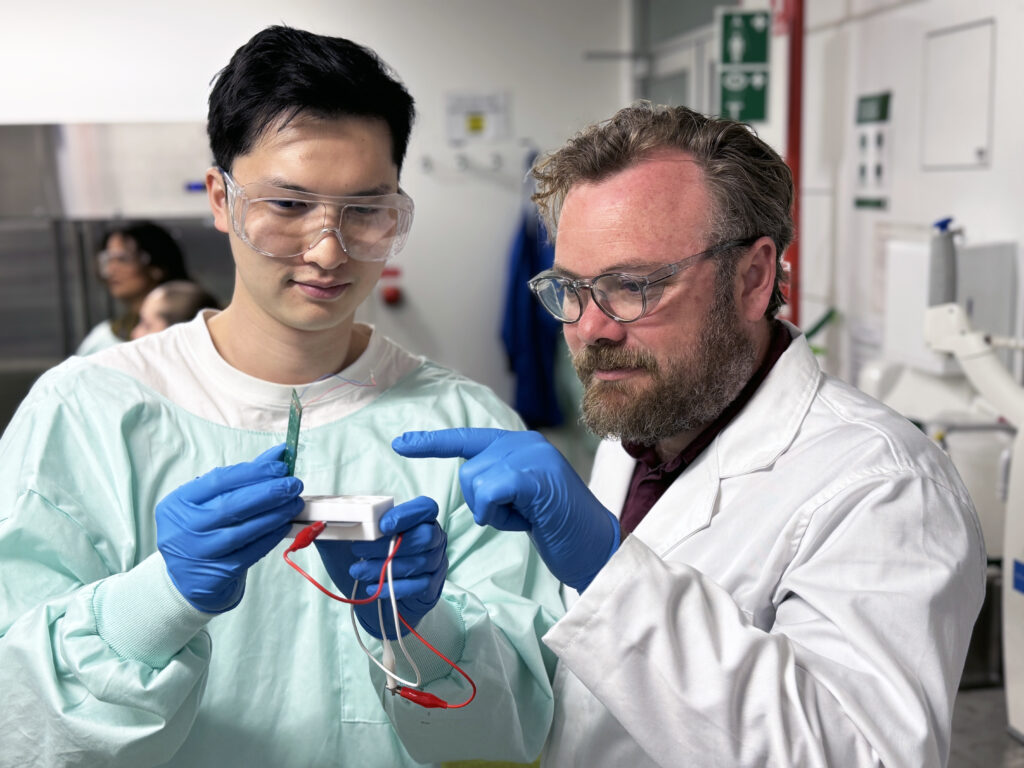

Scientists in Melbourne have discovered how tiny electrical pulses can steer stem cells as they grow, opening the door to new improved ways of creating new tissues, organs, nerves and bones.
Dr Amy Gelmi, a Senior Lecturer at RMIT University's School of Science, led the work using advanced atomic force microscopy to track how stem cells change their structure when exposed to electrical stimulation.
The study reveals, for the first time, how living stem cells physically respond to external signals in real time – reshaping themselves within minutes and setting off changes that influence what type of cell they eventually become.
“Stem cells are part of us all – even as adults – in our bone and in our fat tissue,” said Gelmi, who is also affiliated with Aikenhead Centre for Medical Discovery (ACMD) at St Vincent’s Hospital in Melbourne.
“These tiny cells are our own little healing super-power, able to form many different parts of our body – if only we can figure out how to tell them to change.”
One area which the team is working on is understanding how stem cells respond to physical and electrical cues rather than traditional chemicals. This could help researchers create materials that better mimic the body’s natural environment – a critical step towards engineered tissues and organs.
“Most researchers use chemicals to control the development of stem cells – for example, feeding the cells special solutions to make muscle or bone,” Gelmi said.
“This can work – but has its limitations.”
The team’s research focuses now on showing that stem cells do not just react chemically, by showing the cells sensing and responding to tiny electrical signals, co-researcher Dr Peter Sherrell said.
“By controlling those signals precisely, we can start to guide how the cells behave and what they might turn into, whether that’s bone, nerve or muscle tissue,” said Sherrell from the School of Science.
“That’s really promising for tissue engineering and regenerative medicine.”
The research shows that even subtle electrical changes can alter the stiffness and shape of a cell’s internal skeleton, which in turn affects how it develops.
The RMIT team worked with Dr Joseph Berry, from the University of Melbourne, to model how the cells convert physical stimulation into biological responses. Other co-researchers are Kaiwen Zhang, Chayla Reeves and Aaron Elbourne from RMIT’s School of Science and Kate Fox from the School of Engineering.
“By combining the experimental data with computer modelling, we can predict how a cell will respond to different electrical patterns,” Berry said.
“That gives us a roadmap for designing materials or devices that talk to cells in a language they understand.”
Gelmi said the work highlighted how physics and biology are increasingly intertwined in regenerative medicine.
“The future of tissue repair isn’t just about chemistry – it’s about designing materials that can sense, communicate and adapt,” she said.
Next steps for industry and medtech
The research team wants to collaborate with industry partners in biotechnology and medical devices to translate the discovery into practical applications.
Potential uses include:
- smart implants that use built-in micro-electrodes to encourage bone or nerve regrowth
- bioreactor systems that use electrical signals to pre-condition stem cells before implantation
- next-generation materials that adapt dynamically to the body as healing progresses.
“Our improved understanding of how electrical cues drive cell behaviour gives us a foundation to engineer responsive materials,” Gelmi said.
“With the right industry partnerships, that could transform how we approach wound healing, implant integration and even organ regeneration.”
Organisations that want to partner with RMIT researchers can contact [email protected]
The study, ‘Live quantitative characterization for stem cell biomechanics’, was published in Advanced Materials Interfaces (DOI: 10.1002/admi.202500403).
Contact details:
Will Wright and the RMIT media team
RMIT University
m: +61 417 510 735
e: [email protected]
e: [email protected]