
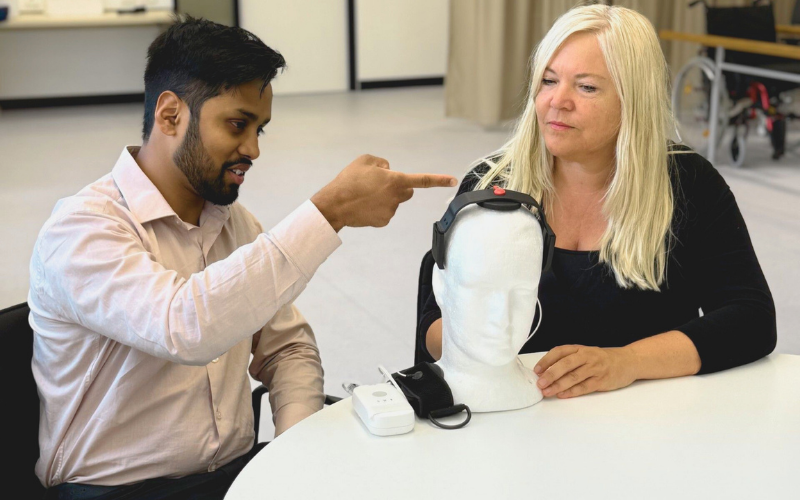
Transcranial direct current stimulation – or tDCS – has shown promise as a safe and non-invasive treatment for chronic pain and now researchers have outlined next steps to achieve definitive evidence of clinical efficacy.
NeuRA Research Fellow at the Centre for Pain IMPACT and UNSW Sydney, Dr Nahian Chowdhury, said chronic pain – or pain lasting for three months or longer – affects more than 1.5 billion people worldwide, and while tDCS was a promising treatment, more evidence was required.
“tDCS involves a low-intensity current being applied across the scalp and has gained attention for being a potential chronic pain treatment as it’s non-invasive, well-tolerated and can be delivered at home,” Dr Chowdhury said.
“However, its efficacy is also clinically inconclusive at present.”
“We developed a two-part road map to strengthen the evidence-base and help us understand the full therapeutic potential of tDCS for chronic pain”, said Professor Sylvia Gustin, Co-director of the Centre for Pain IMAPCT and UNSW Sydney.
“Firstly, we need to improve the methodological quality of the trials. Secondly, we need to look at optimal doses of electrical current, including comparing standard approaches with alternatives.”
Need to improve study methodologies
Researchers found that keeping participants “blind” in tDCS studies needs extra care, because if you keep asking people how it feels during the session, the real stimulation can feel different to the sham, making it easier to guess which one they’re getting.
“Research that compares tDCS to a sham, or ‘pretend’, treatment is crucial for proving whether it truly works,” Dr Chowdhury said.
“We found this is a weak point in some studies, so we need to test other sham methods, such as using a topical cream to reduce sensation in both groups so the experiences feel more similar.
“We also found that in some cases research had looked at groups of individuals with different pain conditions, which will impact response to tDCS and means analyses don’t accurately reflect treatment efficacy for any specific condition.”
Determining doses and studying specific pain
Researchers also found many trials may not have delivered an optimal tDCS “dose” to give people the best chance of pain relief. They say the stimulation settings, like intensity, duration and number of sessions, may need to be rechecked and tailored for different types of pain.
“Future trials should look at the intensity of the treatment, the focality – or area being targeted – and electrode placement,” Prof Gustin said.
Next Steps for tDCS
Dr Chowdhury, who specialises in non-invasive brain stimulation for pain treatment, said this paper was the next step in investigations into the potential of tDCS as a chronic pain treatment.
“The paths we’ve laid out in this roadmap need to be completed before we can assess definitive efficacy of this treatment for chronic pain,” Dr Chowdhury said.
Dr Chowdhury and Prof Gustin aim to test the new approaches outlined in their roadmap, including improved electrode placement, with a focus on home-based tDCS that is simple and practical for people to use.
“We are at the forefront of developing novel home-based tDCS approaches for chronic pain, including cutting-edge electrode montages, so everyone in Australia can access safe and effective treatment in their own homes,” said Prof Gustin.
‘A roadmap for transcranial direct current stimulation for chronic pain’ was published in Pain and the full paper can be found here.
About us:
Neuroscience Research Australia (NeuRA) is an independent, not-for-profit research institute based in Sydney aiming to prevent, treat and cure brain and nervous system diseases, disorders and injuries through medical research. To learn more about NeuRA: www.neura.edu.au
Contact details:
Katana Smith
Senior Media and PR Advisor
0452 140 477
[email protected]