A team of scientists has overcome a major challenge in predicting how Antarctic life will fare under future climate scenarios, revealing five scenarios for the future of Antarctic life.
The research, published in Nature Biodiversity Reviews, was led by Monash University researcher Professor Melodie McGeoch from Securing Antarctica’s Environmental Future (SAEF) and will guide research and support conservation planning efforts at national and international levels, including through the Antarctic Treaty System.
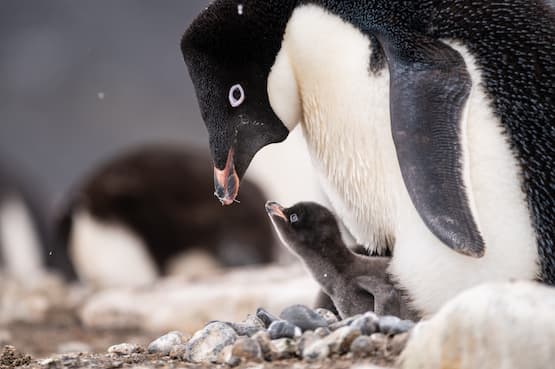
Professor McGeoch said the extreme cold, windy, dry and isolated conditions that Antarctic species such as penguins, moss and microbes are adapted to, have also made the continent difficult for scientists to access, limiting the data available to forecast future change.
“Rather than saying we need more data, we used what we already know about the five core ecological processes that shape biodiversity and applied these ideas to the Antarctic context. This helped us develop five possible outcomes for how life across the continent is likely to respond to climate change and other environmental pressures,” Professor McGeoch said.
If any speculative fiction writers are looking for “what if” scenarios to explore, then this study is ripe for exploration.
Antarctica has 2,100 known terrestrial (land-based) plants and animals, which mostly live in the ice-free regions that cover less than 1 per cent of the continent. The encroaching change prompting thoughts of “what if” includes climate change, pollution, invasive species, disease (e.g. most recently H5N1 bird flu) and land-use changes (e.g. building research stations).
To look into the future, the five ecological processes the team considered were abiotic filtering (physical conditions which impact survival, such as water availability), dispersal (ability to reach new habitats), adaptation (ability to evolve), biotic interaction (interactions between lifeforms, such as predator-prey relationships) and stochasticity (loss of life due to unpredictable events, such as heatwaves).
Future Antarctic life’s five scenarios are:
- Constrained: Antarctica’s cold, dry, windy, isolated conditions will continue to limit Antarctic life, slowing range expansion and change.
- Dynamic: Antarctica’s isolation will limit the ability of species to spread to new ice-free areas and the ability of invasive species to arrive and establish.
- Diversifying: Antarctic species will adapt to new conditions, such as warmer temperatures and larger ice-free areas, and new species arrivals will enrich life on the continent and its surrounding islands.
- Interactive: the frequency and diversity of species interactions will increase through a release from physical constraints such as cold and dry conditions, increasing the complexity of Antarctic biodiversity.
- Disordered: extreme events such as heatwaves and flooding will cause local losses of many species and a decline in biodiversity.
“Antarctica will continue to be cold, dry, windy and isolated, and this will slow the response of life on the continent to otherwise changing conditions. At the same time, how species adapt to change, the unpredictable nature of extreme events, and the complexity of species interactions mean that the response of Antarctic life will vary across the region.
Looking for evidence of these emerging scenarios and predicting where in the region each is most likely will fast-track our understanding of its future,” Professor McGeoch said.
To further clarify this picture of the future for Antarctic life, the team has identified knowledge gaps that they recommend should be prioritised for further research and monitoring. These include better understanding how far and how often species move across the region, their capacity to adapt, where new species are most likely to arrive, and how communities are responding to extreme events.
Since Securing Antarctica’s Environmental Future was established in 2021, its scientists and collaborators have transformed our understanding of Antarctic terrestrial biodiversity, bridging long-standing data gaps with ecological theory and modelling to build a more coherent picture of the future of life on the continent. It is progress that now underpins both further scientific research and that strengthens the foundations for more confident, evidence-based decisions to protect the continent’s unique ecosystems.
About Securing Antarctica’s Environmental Future
Securing Antarctica’s Environmental Future is a Monash-led research and workforce development program, funded by the Australian Research Council. SAEF is delivering leading Antarctic and Southern Ocean science to benefit Australians, our neighbours in the Asia-Pacific, and society around the globe in the context of a changing climate.
FURTHER INFORMATION
Read the research paper: https://doi.org/10.1038/s44358-025-00113-1
ASSETS AVAILABLE
Vision and images available here.
MEDIA ENQUIRIES
Hande Cater
Media and Communications Manager
P: +61 456 428 906
E: [email protected]
GENERAL MEDIA ENQUIRIES
Monash Media
P: +61 3 9903 4840
E: [email protected]
For more experts, news, opinion and analysis, visit Monash News.