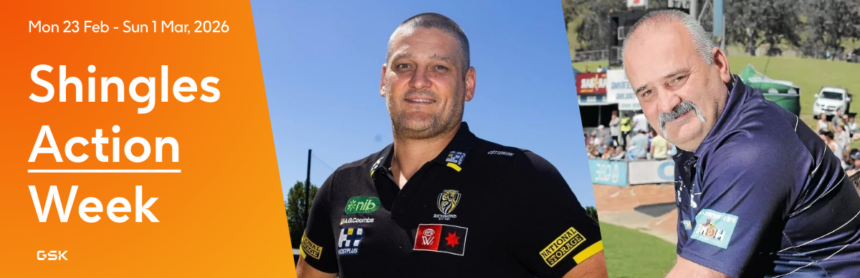
- Former AFL star Brendan Fevola and his father, Angelo, share their shingles experiences for Shingles Action Week (23 February – 1 March 2026).
- Almost all Australian adults carry the inactive varicella zoster virus that causes shingles, from a previous chickenpox infection.1-3
- ‘Shingles Action Week’ (23 February – 1 March 2026) refocuses Australia’s annual shingles awareness campaign on the need to take action, especially for the millions of adults aged over 50 living with long-term health conditions that can increase shingles risk, including cardiovascular disease (>3 million), diabetes (>1.1 million), asthma (>1 million) and rheumatoid arthritis (around 400,000).4
- New global research* indicates that 83% of Australian adults aged 50–70 who are living with long-term health conditions are worried shingles could disrupt everyday life, yet almost half (44%) have never discussed it with their GP or pharmacist.1

This comes as new global research* commissioned by GSK shows that while many adults living with long-term health conditions are concerned about shingles, few are actually discussing it with a healthcare professional.5
In Australia alone, there are potentially millions of adults aged 50 and over living with long-term health conditions that can increase shingles risk, including cardiovascular disease (over 3 million), diabetes (over 1.1 million), asthma (over 1 million) and rheumatoid arthritis (around 400,000).4
The survey of over 6,000 adults aged 50–70 across 10 countries, including Australia, found that among the 501 Australians surveyed, 83% worried shingles could disrupt everyday life and 74% were concerned it could lead to serious complications or long-term hospital stays, yet almost half (44%) said they had never discussed shingles with a healthcare professional.5
Shingles has had a significant impact on the Fevola family. Brendan was hit unexpectedly during the peak of his career, forcing him to pause training. More recently in 2025, he watched his father, Angelo, experience shingles while also managing an autoimmune condition that can affect the immune system. Both father and son describe shingles as among the worst pain they’ve ever experienced, significantly disrupting their day-to-day lives.
The former AFL star hopes that by sharing his experience, he can encourage at-risk Australians to take shingles seriously and take action by speaking to their general practitioner (GP) or pharmacist to understand their personal risk.
“It’s one of those things you hear about and think, ‘yeah, that won’t be me’, but it really knocked me around. It was incredibly painful and unlike anything I’d felt before. I felt constantly exhausted and I had to put my life and career on pause,
“What really opened my eyes was seeing it hit my dad later as well, especially while managing rheumatoid arthritis. It is so important not to ignore your risk and take action by starting a conversation with your doctor.”
Angelo Fevola says that he didn’t fully understand his personal risk, including how age and long-term health conditions like rheumatoid arthritis may increase risk.
“I didn’t realise that my condition could be one of the factors that increases risk for shingles. Living with rheumatoid arthritis already comes with its challenges, so experiencing shingles on top of that was incredibly tough – my mobility, independence, and my ability to manage my overall health was impacted.
“Looking back, I wish I’d had a conversation earlier. I want people with long-term health conditions to understand that shingles can affect them too, and that taking action starts with asking the right questions.”
Dr Geoff Lester, Director of Hearts4heart, echoed the call for action, saying shingles is a risk for almost all Australian adults and can add further burden for people living with long-term health conditions.
“For people already managing an ongoing health issue, shingles can add an extra layer of physical and emotional strain. Shingles Action Week is the time to take action and speak with your healthcare professional, whether that’s your GP, pharmacist or specialist," said Geoff.
Professor Paul Van Buynder, Public health physician and Professor at the School of Medicine at Griffith University in Queensland, says Shingles Action Week is a timely reminder for at-risk Australians to check in on their shingles risk.
“We know awareness isn’t enough, many people don’t connect shingles to their own risk until it hits close to home. Shingles Action Week is about changing that. If you’re over 50 and especially if you’re living with a long-term health condition, now is the time to take action and have an informed conversation with a GP or pharmacist about your risk,” he said.
Shingles can be a painful and potentially debilitating condition, that typically presents as a painful blistering rash on one side of the body or face.1,2 Almost all Australian adults carry the varicella zoster virus that causes shingles from a previous chickenpox infection, even if they don't remember having it. Shingles risk increases with age as immune function naturally declines and risk is higher for people living with certain long-term health conditions, which can weaken their immune systems. Those with a family history of shingles may also be at increased risk.1,2,6,7
Further research commissioned by GSK Australia^ (among a nationally representative sample of Australians aged 50-69) shows that awareness doesn’t always translate into initiating a conversation.8 While most Australians aged 50–69 recognised shingles can cause a painful rash (80%) and long-term nerve pain (79%), almost one in four (24%) said they do not believe it is their responsibility to raise shingles with a doctor.8
Australians aged 50 years and over, particularly those living with long-term health conditions should learn more about the signs, symptoms and risk factors for shingles. For more information about shingles, speak to a GP or pharmacist and visit knowshingles.com.au
ENDS
The Shingles Action Week campaign is sponsored by GlaxoSmithKline Australia Pty Ltd (GSK).
Patient stories contained within this media release are not representative of all patients’ experience with shingles.
About GSK
GSK is a global biopharma company with a purpose to unite science, technology, and talent to get ahead of disease together. Find out more at gsk.com.
*About the global research
Conducted online by Human8 between 30 September and 30 October 2025 and funded by GSK, the study engaged 6,103 adults living with certain long-term medical conditions across 10 countries, including an Australian sample of 501 respondents. In Australia, respondents reported living with cardiovascular disease (CVD) (42%), chronic kidney disease (CKD) (9%), diabetes (type 1 or type 2) (45%), chronic obstructive pulmonary disease (COPD) or asthma (24%), other conditions that may weaken the immune system (19%), and multiple chronic conditions (multi-conditions) (27%). Surveys were issued in 8 languages (English, Japanese, Mandarin Chinese (simplified), Hindi, French, German, Arabic and Polish.) The survey included 15 questions covering shingles awareness, perceptions of immunity and underlying medical condition–related risk, perceived shingles disease burden, and triggers for initiating proactive health patient/HCP conversations.
^About the Australian data
An online, nationally representative survey of 1,551 Australian adults aged 50-69 years old, was conducted between 12 August and 18 August 2025 by YouGov, on behalf of GSK Australia. Data was collated from seven questions covering shingles awareness and misconceptions with all participants agreeing to participate in full transparency on both the source of the survey commissioning, and to the use of their anonymised data.
About shingles
Shingles typically develops as a painful, itchy and blistering rash, on one side of the body or on the face.1,2 Shingles also comes with the risk of post-disease complications, the most common being post-herpetic neuralgia (PHN).1,2
Complications from shingles, like PHN, occur more often in older people, and in people with a suppressed or deficient immune system compared to those who are not.2,3
For people who are immunocompromised, the risk of developing shingles can be up to double that of a non-immunocompromised individual.6
Registered Office:
4/436 Johnston Street
Abbotsford
VIC 3067
References
-
CDC. Shingles. Available at: https://www.cdc.gov/shingles/about/index.html. (accessed December 2024).
-
Health Direct. Shingles. Available at: https://www.healthdirect.gov.au/shingles. (accessed December 2024).
-
Gidding HF, et al. The seroepidemiology and transmission dynamics of varicella in Australia. Epidemiology and Infection 2003;131:1085-9
-
Australian Bureau of Statistics. “National Health Survey, 2022. Available at: https://www.abs.gov.au/statistics/health/health-conditions-and-risks/national-health-survey/latest-release. [Accessed February 2026]
-
Human8 on behalf of GSK. Shingles Action Week 2026 Survey (China, G., India, France, Canada, Australia, Poland, Austria, Japan, and UAE). Data on file 2026. REF-302867
-
Marra F et al. Risk factors for herpes zoster infection: A meta-analysis. Open Forum Infectious Diseases 2020;7:ofaa 005.
-
Steinmann et al. Risk factors for herpes zoster infections: a systematic review and meta-analysis unveiling common trends and heterogeneity patters. Infection. 2024;52(3):1009-1026. doi: 10.1007/s15010-023-02156-y
-
YouGov Shingles Consumer Survey August 2025. GSK Data on File 2025 [REF-292507]