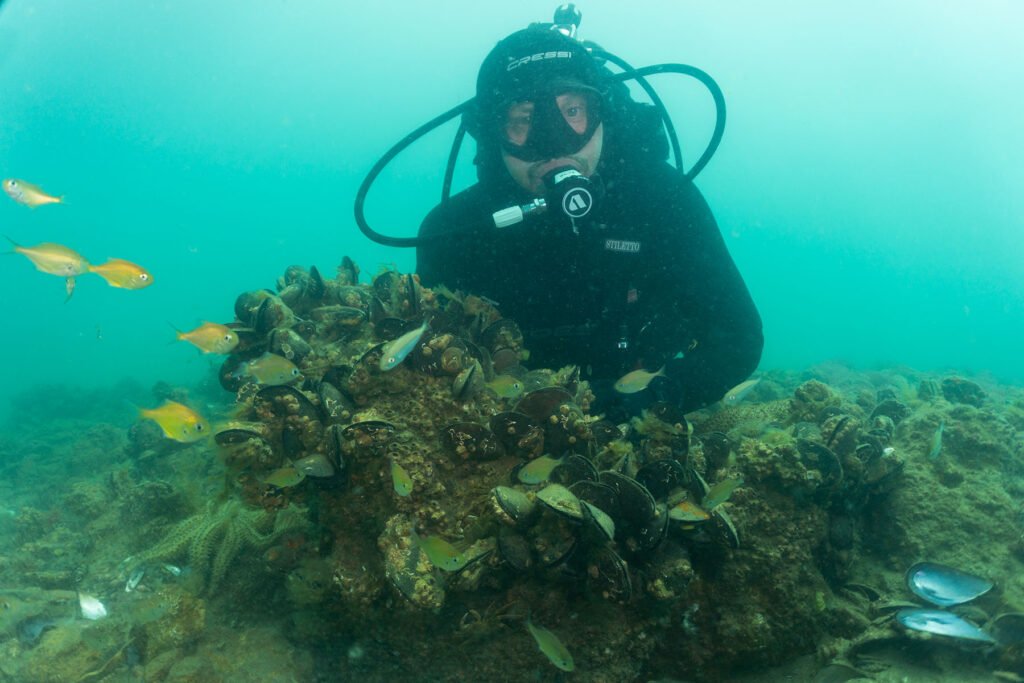

- Restored shellfish reefs in Gippsland Lakes show significant recovery after three years, with mature mussels, native oysters and diverse marine life flourishing
- Project spans 17 reef patches across 2.5 hectares and has become the first Australian initiative recognised as a UN World Restoration Flagship
- More than 95% of Victoria's shellfish reefs have disappeared due to overharvesting, pollution and waterway changes
Shellfish reefs restored in the Gippsland Lakes are thriving just three years after reestablishment, with underwater surveys revealing carpets of mature mussels, large native oysters and abundant marine life.
The reefs near Nyerimilang were restored in 2022 by The Nature Conservancy (TNC) Australia, with support from the East Gippsland Catchment Management Authority, as part of TNC’s national ‘Reef Builder’ project.
The positive results follow Reef Builder earning international recognition as a UN World Restoration Flagship, the first Australian project to receive this honour.
The designation recognises “the planet’s most ambitious, science-based and inspiring examples of large-scale ecosystem restoration” and highlights TNC and partners’ work to restore Australia’s threatened shellfish reefs at 21 locations around the country. The project was made possible with support from the Australian Government.
In the Gippsland Lakes, 17 reef patches have been restored across 2.5 hectares, an area larger than the MCG’s playing field.
TNC returned to the water to see how the Gippsland reefs, built with locally sourced limestone rock, were performing three years on.
Surveys revealed a thriving underwater ecosystem, with mature mussels carpeting the seafloor, large Australian flat oysters growing alongside, and a diverse mix of marine life including fish, sea stars, crabs and nudibranchs.
“Seeing these reefs become functioning shellfish reefs after less than four years is incredible,” said TNC Conservation Officer, Scott Breschkin.
“These reefs are now providing important habitat for marine life while helping to filter millions of litres of water every single day.”
Shellfish reefs once played a vital role in keeping the Gippsland Lakes healthy. Shellfish including blue mussels and Australian flat oysters were once abundant, cleaning water and supporting fish populations before being lost to overharvesting, pollution and waterway changes. Today, more than 95 per cent of Victoria's shellfish reefs have disappeared, making the recovery underway in the Gippsland Lakes particularly significant.
The success reflects strong local involvement throughout the project, with more than 150 local residents and school children participating in community engagement and citizen science activities, with support from Friends of Nyerimilang, Nungurner Primary School and the Gippsland Lakes Fishing Club.
The UN recognition marks the second major award for the project, which last year received a Distinction in Biodiversity and Ecosystem Conservation at the Victorian Marine and Coastal Awards for its work in the Gippsland Lakes and Port Phillip Bay.
While the results are encouraging, TNC says continued investment and partnerships will be essential to restore shellfish reefs at scale across Australia. For the Gippsland Lakes, however, the message is clear: with the right science, partners and level of commitment, lost ecosystems can be brought back to life.
-ENDS-
Images available to download here, please credit photos to Scott Breschkin, The Nature Conservancy.
About us:
About The Nature Conservancy
The Nature Conservancy is a global conservation organisation dedicated to conserving the lands and waters on which all life depends. Guided by science, we focus on getting things done efficiently and with the greatest positive impact for conservation. We’re a trusted organisation working in more than 81 countries and territories on innovative solutions to our world’s toughest challenges so that nature and people can thrive together. To learn more about The Nature Conservancy in Australia, visit our website or follow us on Facebook, Instagram and LinkedIn.
About the UN World Restoration Flagship Awards
The World Restoration Flagship awards are part of the UN Decade on Ecosystem Restoration – led by the UN Environment Programme (UNEP) and the Food and Agriculture Organization of the UN (FAO) – which aims to prevent, halt, and reverse the degradation of ecosystems on every continent and in every ocean. The awards track notable initiatives that support global commitments to restore one billion hectares – an area larger than China. Reef Builder is the only Australian conservation project to be acknowledged as a 2025 Flagship, and one of only three in the Flagship’s history.
Contact details:
Ally Catterick, Director of Marketing & Communications
[email protected] | M: 0407 50 132 | natureaustralia.org.au