
Skip to content
Indigenous, Medical Health Aged Care

Community led Aboriginal health practitioner training begins

Aboriginal Medical Services Alliance Northern Territory (AMSANT) and Sunrise Health Service 2 mins read

The Aboriginal Medical Services Alliance Northern Territory (AMSANT) and Sunrise Health Service Aboriginal Corporation are celebrating a major milestone for the Big Rivers Region, with the first cohort of trainee Aboriginal health practitioners commencing training through Dijan Training.


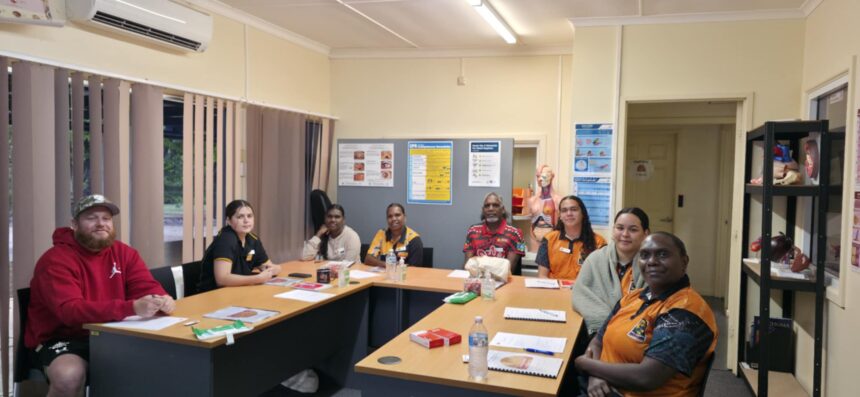
Ten trainees from across the region have enrolled in the Cert IV in Aboriginal and/or Torres Strait Islander primary health care practice—including four from Wurli-Wurlinjang Health Service, four from Sunrise Health Service and two from Katherine West Health Board.


The 52-week program will be delivered in Katherine and in community, supported by mentors and supervisors within each trainee’s home service to ensure strong cultural, clinical and workplace support throughout the year.


Dijan Training (East Side Kriol for “this one”) is a community-controlled registered training organisation and a wholly owned subsidiary of Sunrise Health. It was established following a 2022 concept developed by Sunrise Health’s directors and was formally registered in September 2025.


Sunrise Health CEO Rebecca Bond said the launch of the training marks a proud moment for the region.


‘This is something our directors have worked towards for years—building our own training pathway, in our own region, for our own people,’ she said. ‘These trainees are the future of primary health care in the Big Rivers. They will deliver culturally strong, clinically skilled care in their own communities.’


The Cert IV course is delivered by two senior Aboriginal health practitioner trainers—one male and one female—supported by a further four senior Aboriginal health practitioner trainers delivering sessional topics, alongside experienced clinical educators.


AMSANT Chair Rob McPhee said the program strengthens the long-term sustainability of the Aboriginal community controlled health sector in the NT. The collaboration between Sunrise, Wurli-Wurlinjang and Katherine West reflects a strong, united regional approach to workforce development.


‘Aboriginal health practitioners are at the heart of culturally safe, community-controlled care,’ Mr McPhee said. ‘Growing our own workforce—locally, in region, and under community control—is one of the most powerful ways to improve health outcomes and close the gap.’


The program is now underway, with trainees beginning classroom-based learning in Katherine before continuing supervised practical training within their home communities.


ENDS


Contact details:

Amy Price, 0437 027 156

Media

More from this category

  • Medical Health Aged Care
  • 06/03/2026
  • 12:06
Royal Australian College of GPs

TGA ignored as Victorian Government ‘shortcut’ puts women at risk: RACGP

The Royal Australian College of GPs (RACGP) has expressed disappointment that the Victorian Government has overridden repeated warnings from the Therapeutic Goods Administration (TGA) by allowing pharmacists to prescribe the contraceptive pill, undermining established medicines safety safeguards. The Victorian Government has, contrary to repeated TGA assessments, weakened its medicines safety regulations by enabling pharmacists, rather than medically trained prescribers, to initiate prescriptions for the oral contraceptive pill. RACGP Victoria Chair Dr Anita Muñoz said the announcement prioritises political expediency and industry lobbying over evidence‑based public health. “We are deeply disappointed that the Victorian Government appears to be listening to lobbyists…

  • Contains:
  • Indigenous, Oil Mining Resources
  • 06/03/2026
  • 10:11
House of Representatives

Critical minerals: have your say

TheHouse of Representatives Standing Committee on Primary Industriesis conducting an inquiry into factors shaping social licence and economic development outcomes for critical minerals projects across Australia and is seeking written submissions to guide the inquiry’s findings. The inquiry has already received over fifty submissions from a range of stakeholders, but the Committee is keen to hear from more individuals and organisations, especially those operating directly in the critical minerals field and communities with an interest in or who are impacted by critical mineral developments. Committee Chair,Meryl Swanson, said: ‘We have heard from miners, farmers, local governments, community organisations, Indigenous organisations…

  • Government Federal, Medical Health Aged Care
  • 06/03/2026
  • 06:00
Health Services Union

HSU urges federal government to make reproductive health leave a national employment standard

HSU urges federal government to make reproductive health leave a national employment standard The Health Services Union has used its submission to the Inquiry into the operation and adequacy of the National Employment Standard to argue for universal reproductive health leave. HSU, along with other unions, has been campaigning for 12 days of paid leave for reproductive health issues. The leave would cover speciality appointments and treatments relating to reproductive organs, including screenings for breast and prostate cancer, or the management of symptoms related to reproductive health, including periods, perimenopause, PCOS, endometriosis, vasectomy and hysterectomy, miscarriage and medical pregnancy terminations…

Media Outreach made fast, easy, simple.

Feature your press release on Medianet's News Hub every time you distribute with Medianet. Pay per release or save with a subscription.