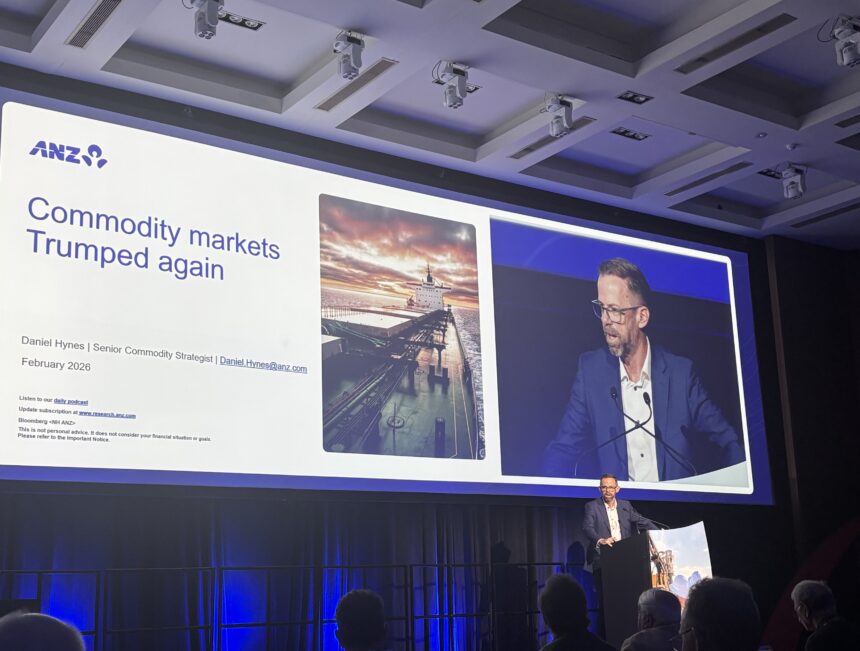
Rising government intervention is fundamentally reshaping global commodity markets, compressing supply responses, distorting pricing signals and lifting capital risks across the resources sector, according to ANZ Senior Commodity Strategist Daniel Hynes.
Speaking on the second day of the 25th RIU Explorers Conference in Fremantle, Hynes said markets are adjusting to what he described as a structural shift in trade, energy and critical minerals policy.
“There’s been a broader shift towards government intervention in commodity markets,” Hynes said. “I’m not saying that’s good or bad — government support can be critical — but it absolutely changes how markets behave.”
Energy markets provide the clearest example. Coordinated releases of strategic reserves by the International Energy Agency and the United States following Russia’s invasion of Ukraine, alongside production cuts from OPEC, price caps and mandated gas storage levels in Europe, have all increased state influence over supply.
The metals sector has followed a similar path, with US tariffs, Indonesia’s expanded nickel export ban and tighter Chinese controls over rare earth exports.
“This has materially increased policy interference in commodity markets,” Hynes said. “And it’s something the industry will have to get used to.”
One consequence is what Hynes described as “supply elasticity compression” — a reduced ability for markets to respond efficiently to supply shocks. Indonesia’s nickel export ban initially triggered a squeeze, yet supply continued to expand despite falling prices.
“Price signals didn’t work the way they normally would,” he said.
Volatility has also increased around disruption events. After force majeure at the Grasberg mine operated by Freeport-McMoRan, copper prices rallied sharply.
“Normally that would be viewed as manageable,” Hynes said. “Instead, the market reacted aggressively. That reflects how sensitive markets have become to supply risks.”
He also highlighted the rise of “midstream bottleneck pricing”, particularly in lithium and aluminium, where processing dominance — especially in China — increasingly dictates global pricing dynamics.
Greater reliance on spot markets is amplifying volatility.
“Greater reliance on the spot market essentially means greater volatility,” Hynes said. “That’s challenging for explorers seeking stability, but it’s something we’re going to have to get used to.”
However, Hynes argued the longer-term structural impact is supportive for prices.
“What this environment is doing is lifting the structural floor under commodity prices,” he said. “I don’t think we’ll see the same depth of downturns we’ve experienced historically. The dips are likely to be shallower.”
At the same time, premiums are emerging for secure supply, processed products and low-emissions production.
“We’re moving into a market where premiums matter more,” Hynes said. “It’s no longer just about tonnes in the ground — it’s about where you sit in the supply chain and how you align with end-market requirements.”
“This isn’t cyclical,” he added. “It’s a regime shift in how commodity markets function.”
Contact details:
David Tasker
Chapter One Advisors
(m) +61 433 112 936