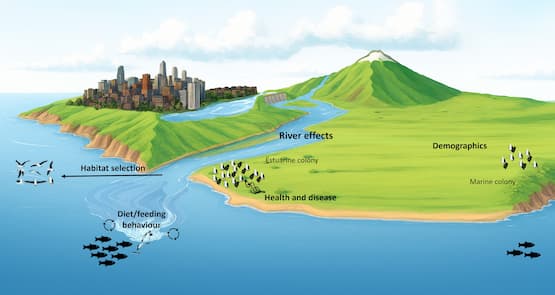

New research from Monash University, in collaboration with Phillip Island Nature Parks, has found conclusive evidence that rivers are vital drivers of food and habitat for seabirds around the world.
The research, published in Biological Reviews, examined 51 scientific studies that looked at how river water flowing into the sea affects seabird behaviour, diet, health and population trends. The results revealed that nearly 9 out of 10 studies reported a clear link between river-influenced ocean environments and seabird ecology, from where birds feed to how healthy they are and how successfully they breed.
Project lead Julia B Morais, a veterinarian and PhD student from the School of Biological Sciences, said rivers shape coastal conditions by delivering nutrient pulses that sustain prey species and create foraging hotspots many seabirds depend on.
“Rivers act like arteries, fuelling coastal food webs where seabirds feed. Our research shows that rivers influence seabirds not only by increasing food availability, but also by guiding where birds choose to forage and how they survive environmental changes,” Ms Morais said.
The work highlights the importance of rivers like the Yarra on seabird populations, including the penguin population at the St Kilda breakwater.
Andre Chiaradia, penguin scientist at Phillip Island Nature Parks and Adjunct Professor at the Monash School of Biological Sciences said the findings of the study identifies how changes in river flow, such as from Melbourne’s Yarra River, can influence penguin foraging behaviour.
“Research that began at St Kilda, where nutrients from the Yarra River boost fish numbers for little penguins, has grown into a global analysis showing rivers are far more important to seabirds than once was thought,” Professor Chiaradia said.
Professor Richard Reina, Head of the Ecophysiology and Conservation Research Group said the research highlights the need for scientists and policymakers to consider both terrestrial (freshwater) and marine environments together when planning conservation actions.
“As freshwater systems shift under climate change and human pressures, understanding these river-sea links will be critical for conserving seabirds and coastal ecosystems,” Professor Reina said.
Keeping rivers healthy, including maintaining natural flows and good water quality, may be just as crucial for seabird wellbeing as protecting marine habitats.
Read the research paper: https://doi.org/10.1002/brv.70143
ASSETS AVAILABLE
Images available here.
MEDIA ENQUIRIES
Hande Cater
Media and Communications Manager
P: +61 456 428 906
E: [email protected]
Silvia Dropulich
Marketing, Media & Communications Manager, Monash Science
T: +61 3 9902 4513
M: +61 435 138 743
Email: [email protected]
Lisa Gilbert, HeadlinePR
Phillip Island Nature Parks
M: 0412 822 673
E: [email protected]
GENERAL MEDIA ENQUIRIES
Monash Media
P: +61 3 9903 4840
E: [email protected]
For more experts, news, opinion and analysis, visit Monash News.