
Skip to content
Agriculture Farming Rural, Environment

What lies beneath: tapping into Australia’s hidden waters

UNSW Sydney < 1 min read
Key Facts:

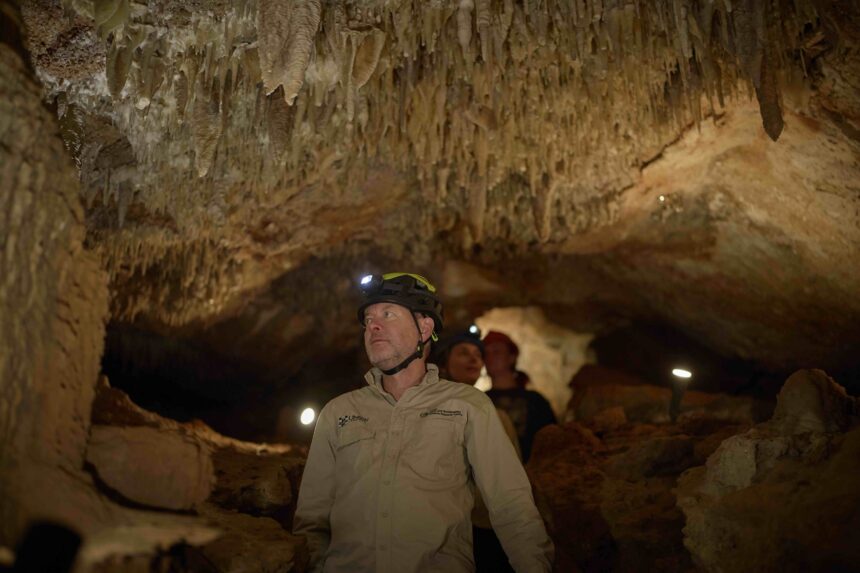
It runs from our taps, keeps crops alive and rivers flowing – yet no one knows exactly how much groundwater we have, or how often it’s renewed. UNSW researchers are venturing underground to find out.


UNSW research is looking at when groundwater recharges, and how climate change is affecting that process.

Groundwater supplies the majority of Australia’s drinking and irrigation water, but scientists still don’t fully understand how rainfall translates into recharge below the surface – particularly as climate change shifts rainfall patterns toward fewer, more intense events.

Our combined engineering and science teams are tracking how water moves from the surface into aquifers – and also how disturbances like severe bushfire can fundamentally change that process.

Water is a limited resource, so what happens when it's 'out of sight, out of mind'? And are we overestimating the security of our underground water reserves?

“We’re tackling this big question of ‘how does water get underground – and how much rainfall is needed to replenish it? That’s not only poorly understood, it’s also hard to measure.”—UNSW Professor Andy Baker.

“This work can help people – decision makers, managers and, importantly, community – see that groundwater is not an endless backup. It is a system that depends on specific rainfall events, land use and long-term care.” —UNSW Associate Professor Marilu Melo Zurita.

We have strong multimedia assets (field footage and visual explainers) to accompany this story. Please see our multimedia feature for an idea of what vision is available for your story: 

https://www.unsw.edu.au/newsroom/news/2026/02/what-lies-beneath-tapping-into-australias-hidden-waters 


Contact details:

Melissa Lyne, UNSW news & content
e: [email protected] 

More from this category

  • Energy, Environment
  • 30/03/2026
  • 16:17
Schneider Electric

The next challenge for Australia’s energy transition is coordination

By ThomasDeschler, Vice President, Power Systems at Schneider Electric Australia and New Zealand’s electricity networks are entering a new phase of the energy transition.…

  • Contains:
  • Environment, Government Federal
  • 27/03/2026
  • 16:04
NALSPA

Coalition’s call to scrap Electric Car Discount during fuel crisis doesn’t make sense

Australia’s peak body for novated leasing said the Coalition’s call to scrap the Electric Car Discount during a fuel crisis makes no sense.The Coalition wants to end the EV discount, which is helping Australians avoid petrol and its price shocks for good, in order to fund a short three-month halving ofthe fuel excise.“Any proposal to cut or reduce the EV Discount during the middle of a fuel crisis is irrational,” National Automotive Leasing and Salary Packaging Association (NALSPA) CEO Rohan Martin said.“It makes no sense to cut a policy that is helping Australians avoid petrol forever purely to fund a…

  • Agriculture Farming Rural, Environment
  • 27/03/2026
  • 10:31
Charles Darwin University

Green thumbs up: Project combines YouTube and AI to boost biosecurity

Gardening videos attract millions of views on YouTube each year, but an innovative research project has showed how this content could be critical in protecting Australia’s biosecurity. The project by Charles Darwin University (CDU), supported through the Northern Australia Biosecurity Strategy, combined YouTube gardening content and OpenAI to map urban green spaces and detect previously unregistered community gardens across northern Australia. Researchers fed a dataset of YouTube content into detailed large language model (LLM) prompts. The prompts classified whether a video related to community gardens and extracted the name of the garden, its address and a summary of the clip.…

Media Outreach made fast, easy, simple.

Feature your press release on Medianet's News Hub every time you distribute with Medianet. Pay per release or save with a subscription.