FOR IMMEDIATE RELEASE: 13 MARCH 2025
$2.1b battery recycling sector critical to Australia’s sovereign capability
Industry urges national battery stewardship framework
Australia’s battery materials recovery ecosystem already contributes $2.1 billion to the economy each year, supports 19,450 jobs, and includes more than 45 facilities nationwide, according to a new industry profile released by the Association for the Battery Recycling Industry (ABRI). The sector is projected to grow to $6.9 billion and 34,650 jobs by 2050.
Battery Stewardship Council CEO Libby Chaplin said these figures demonstrate why battery stewardship should be recognised as a strategic industrial priority, not simply a waste management issue.
“Used batteries are not just a disposal challenge - they are a strategic domestic resource stream that can help Australia build sovereign capability in critical minerals recovery, metals processing and circular manufacturing,” Ms Chaplin said.
Ms Chaplin said Australia has a genuine comparative advantage. “We have the mineral endowment, industrial capability, research expertise and national collection networks to recover more value onshore and strengthen our position in global battery supply chains.”
The discussion comes as Ms Chaplin joined national industry leaders at Parliament House in Canberra on Thursday 12 March for an Association for the Battery Recycling Industry panel on the future of Australia’s battery materials recovery sector.
A clear message of the Panel was the need for urgent nationally aligned mandatory product stewardship with a single Product Stewardship Organisation for all battery products. “It is imperative that Environment Ministers move decisively to agree on an urgent pathway to nationally aligned regulation, leveraging the substantial foundational work led by the NSW EPA. Failure to achieve national consistency will result in fragmentation that threatens the viability and success of battery stewardship outcomes”.
“If Australia is serious about building more value onshore, improving energy security and growing advanced manufacturing, battery stewardship has to be part of the equation.”
“This work aligns directly with the Albanese Government’s Future Made in Australia agenda and National Battery Strategy,” Ms Chaplin said.
Battery materials are essential for future energy and resource security. The United States Geological Survey has identified battery minerals such as lithium, graphite and nickel as essential to the economy and national security.
“Australia is well-positioned to lead in this space. Effective stewardship creates a powerful opportunity to integrate our world-class raw-materials capability with emerging urban-mining pathways,” Ms Chaplin said.
“It is the front end of a stronger circular battery economy, helping secure feedstock, improve safety, reduce waste, and create the conditions for more domestic processing, reuse, repurposing and materials recovery.”
Ms Chaplin said Australia cannot afford to overlook the productivity and industry-building opportunity sitting in the circular economy.
“The Productivity Commission has made clear that Australia lags on materials productivity and that circular economy reform can support productivity, growth, economic diversity and national capability. That is exactly why battery stewardship matters. It helps turn a growing waste and safety challenge into industrial value, regional jobs and greater resilience in the energy transition.”
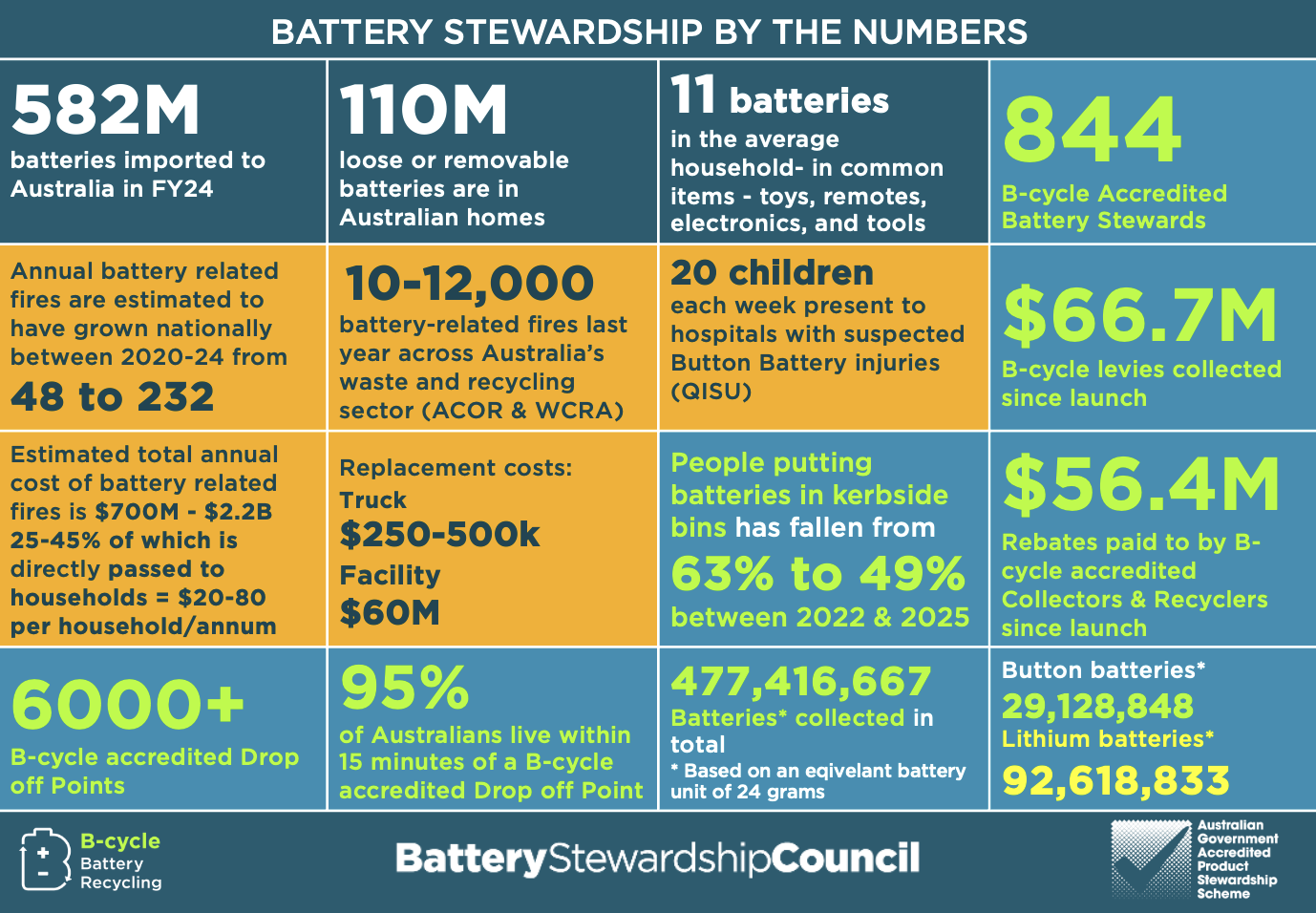
Through B-cycle, the Battery Stewardship Council is already building the infrastructure, data and market foundations for a stronger domestic battery recovery industry. Since launch in 2022, the scheme has:
-
collected $66.7 million in levies,
-
returned $56.4 million to participants collecting, sorting and recycling batteries, and
-
supported the recovery of 11,458 tonnes of batteries - including an estimated 477.4 million individual batteries and more than 92.6 million lithium-ion batteries that might otherwise have posed a significant fire risk across the waste and recycling system.
“But voluntary stewardship alone will not realise the full national opportunity,” Ms Chaplin said.
“To unlock sovereign capability, industrial growth and energy security at scale, Australia now needs a nationally harmonised, mandatory battery stewardship framework that extends across all battery scopes. That is how we secure feedstock, address free-riders, improve safety, give industry the confidence to invest in onshore recovery and processing, and build the circular critical minerals and metals capability needed to capture more value from the energy transition here at home.”
ENDS
AVAILABLE FOR INTERVIEW:
Libby Chaplin, CEO, B-cycle
About us:
ABOUT BSC AND B-CYCLE
The Battery Stewardship Council (BSC), established in 2018, aims to build and sustain a strong battery stewardship community, supporting Australia’s transition to a circular economy. Its flagship initiative, the B-cycle Scheme, is Australia’s first nationwide, government-backed battery stewardship scheme, facilitating safe and accessible battery recycling for consumers across metropolitan, regional, and remote areas. Launched in 2022, B-cycle is authorised by the Australian Competition and Consumer Commission (ACCC) and supported by the Federal, State and Territory Governments. It unites industry, government, and everyday Australians under BSC’s vision to ensure the responsible management of batteries across their entire lifecycle while conserving Australia’s finite resources.
Contact details:
Rachel Harrison | 0487 288 144
Claire Maloney | 0431 279 785