
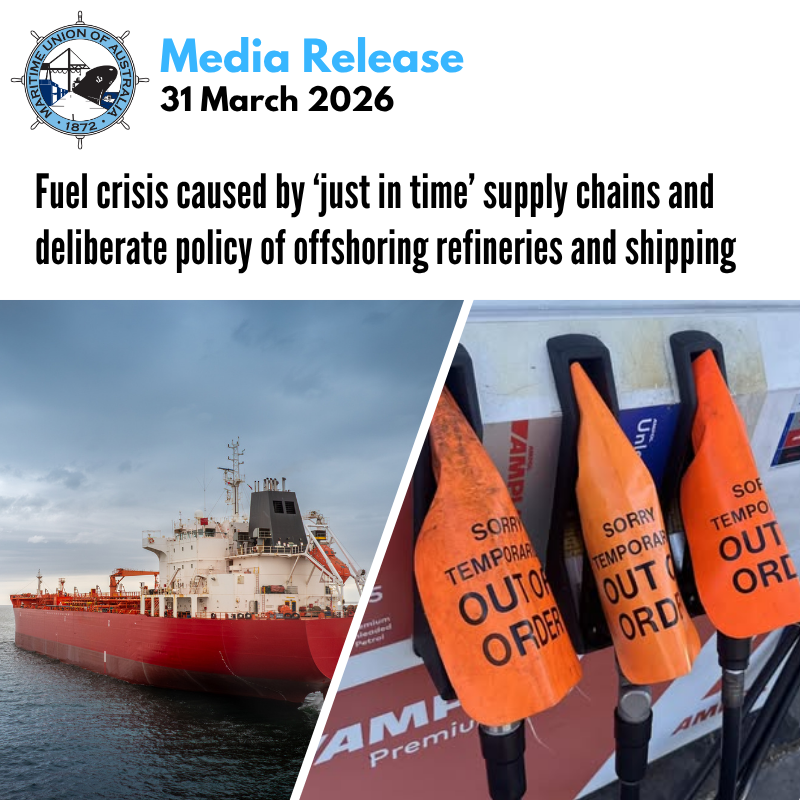

Australia is staring down a fuel security crisis of its own making, and the Federal Government must act now to rebuild our sovereign capacity before global conflict leaves the country stranded.
For more than a decade, the Maritime Union of Australia has warned that Australia’s petroleum supply chain is dangerously exposed. Today, those warnings are becoming reality.
<<READ THE MUA BRIEFING PAPER HERE>>
Australia now imports more than 90 per cent of its refined fuel, entirely on foreign-owned and foreign-crewed vessels. The war in Iran has shown how little control or influence our government has over when fuel shipments arrive, where they go, or who gets priority.
Despite being a major energy exporter, Australia is uniquely vulnerable to diesel and petrol supply shocks. The deliberate closure of Australian oil refineries over a period of almost 15 years has hollowed out domestic production capacity, leaving just two facilities supplying less than 20 per cent of our needs. At the same time, our national fuel reserves fall well short of the 90-day benchmark recommended by the International Energy Agency.
This is not just an economic issue, it is a national security risk.
Multiple fuel shipments to Australia have already been cancelled as foreign governments and corporations move to secure supply for their own populations first. Across Asia, export restrictions and domestic prioritisation are tightening access to refined fuel, while ongoing instability in key global shipping routes continues to disrupt supply chains.
Australia is being forced to compete on the open market for fuel cargoes, often at higher cost and with no guarantee of delivery.
At the same time, there is no Australian-controlled tanker fleet to step in. A decade ago, Australian-flagged and crewed vessels ensured fuel could be safely and reliably transported around our coastline. Today, that capability has been completely dismantled.
Instead, multinational shipping cartels and oil companies determine whether Australia’s fuel needs are met, with no obligation to prioritise this country or protect consumers from price shocks. Our ability to move fuel to where it is needed, whether for industry, transport, agriculture or emergency response, is now dependent on decisions made offshore.
The Maritime Union of Australia is calling for urgent, coordinated action to restore Australia’s fuel security and supply chain sovereignty.
"The establishment of a Fuel Security Taskforce in recent weeks is a good first step, but it must be empowered to provide recommendations beyond the current crisis. Australia must operate its fuel supply chains on a "Just in case" basis instead of "Just in time". The Taskforce therefore can't afford to isolate its focus to the singular flashpoint of the Iran war. It must look at long term resilience and capacity building", said Jake Field, the MUA National Secretary.
"Australia needs targeted investment in domestic refining capacity. Existing refineries should be upgraded to process Australian crude for Australian use, reducing our reliance on imported oil to strengthening local supply. The upside down, back to front madness of having two local refineries configured only to process crude oil from the Middle East while our own high quality crude is shipped offshore must end," Mr Field said.
Critically, the MUA says the country must rebuild its sovereign shipping capability. This includes mapping vulnerabilities in the petroleum supply chain and implementing measures to support the return of Australian-flagged tankers to our coast. Previous proposals have shown this can be achieved at minimal cost to consumers, while delivering significant national benefit.
The Government must also act on the recommendations of the Strategic Fleet Taskforce to create a viable, competitive Australian shipping industry that can operate in the national interest during times of crisis.
"Australia cannot continue to rely on the goodwill of foreign governments, flag-of-convenience operators and global oil markets to keep the nation running," Mr Field said.
"Fuel security is not just about how much we make or how much we store, it's about whether we can control how it is transported, distributed and delivered when it matters most. If we refine it in Brisbane or Geelong, we need to transport it to Fremantle or Sydney, and that must be done on Australian flagged and crewed ships," Mr Field added.
Without decisive action, Australia risks finding itself at the back of the queue in a global crisis, with serious consequences for the economy, national security and everyday Australians.
The time to rebuild Australia’s fuel sovereignty is now.
ENDS
<<READ THE MUA BRIEFING PAPER HERE>>
Contact details:
Tom Harris-Brassil: 0401 834 924
