
Skip to content
Indigenous, Science

Gayini: where science meets traditional knowledge in restoring former cotton country

UNSW Sydney < 1 min read

Traditional Owners, UNSW scientists, government and conservation groups join forces to get Gayini wetlands thriving again.

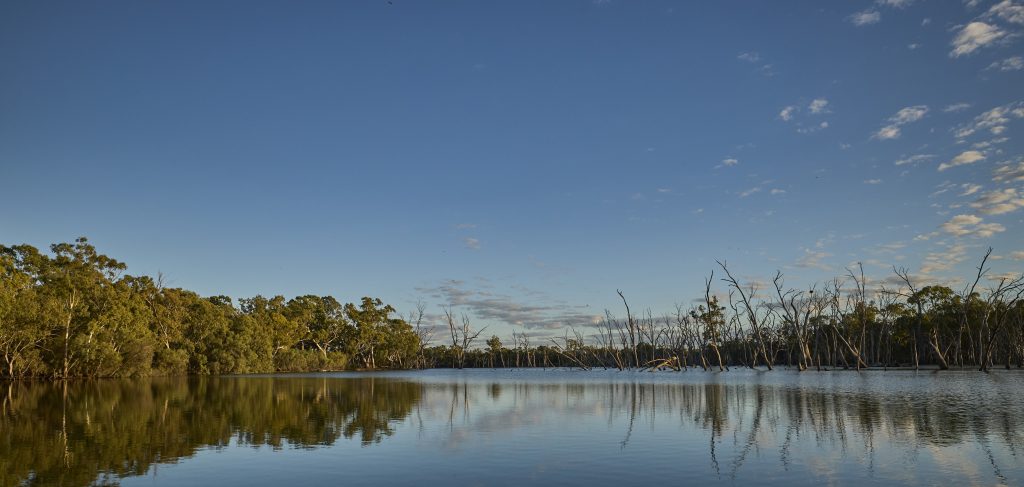
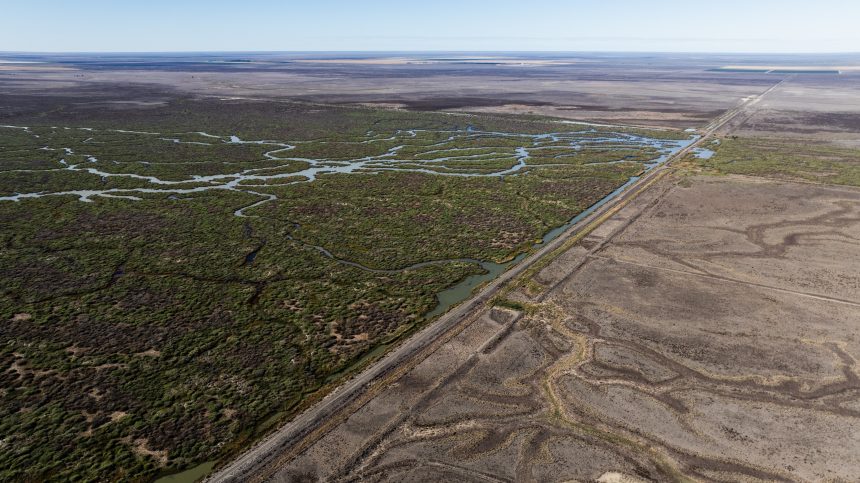
Gayini – meaning “water” in the Nari Nari language – is part of 80,000 hectares of culturally and ecologically rich land in south-west NSW, owned and managed by the Nari Nari Tribal Councilan Aboriginal-led not-for-profit organisation.

Conservation scientists from UNSW Sydney’s Centre for Ecosystem Science – supported by Charles Sturt University, Commonwealth Environmental Water Holder, The Nature Conservancy, the Murray Darling Wetlands Working Group, and the NSW Biodiversity Conservation Trust – are working with the Nari Nari Tribal Council to measure how this landscape can recover after more than two centuries of land and water exploitation – practices that have led to ecosystem degradation, the spread of invasive species, and the decline or extinction of native flora and fauna.

“By restoring natural flooding regimes and managing livestock grazing, our collaboration with the Nari Nari Tribal Council is a study of how Country responds when it's given a new lease on life,” says UNSW's Professor Richard Kingsford.

For more on Gayini, including striking aerial imagery and on-Country insights from Traditional Owners and scientists, visit UNSW’s interactive feature at: https://news.unsw.edu.au/en/gayini-healing-country-supported-by-science


Contact details:

MEDIA ENQUIRIES


Lachlan Gilbert

UNSW News & Content
t: +61 2 9065 5241
e:
[email protected]
Media

More from this category

  • Medical Health Aged Care, Science
  • 16/03/2026
  • 07:02
The Thoracic Society of Australia and New Zealand (TSANZ)

Respiratory Health Priorities Spotlighted at TSANZSRS ASM 2026

Key Facts: · TSANZSRS Annual Scientific Meeting 2026 in Perth to address key respiratory health priorities, including environmental threats, AI advances and new lung testing standards · Growing concerns about airborne microplastics' impact on respiratory health to be explored by leading researchers · Artificial intelligence and digital twin technologies are transforming respiratory research and treatment approaches · Updates to national spirometry and training standards will be presentedPerth, March 2026 – Emerging environmental threats, advances in artificial intelligence and new national standards for lung testing will be among the major respiratory health priorities discussed at the TSANZSRS Annual Scientific Meeting (ASM)…

  • Contains:
  • Environment, Science
  • 13/03/2026
  • 10:23
Charles Darwin University

Australia mapped into global sharks and rays database

A global database documenting the location of critical habitats for sharks, rays, and chimaeras has recently expanded to include Australia, with years of extensive…

  • Contains:
  • Environment, Science
  • 13/03/2026
  • 06:30
Monash University

Fish stocks are on the line: Climate change impacts global fishing yields

As the saying goes, there are plenty more fish in the sea – but climate change is rapidly challenging that notion, with fish stocks around the world under threat. New modelling fromMonash University predicts how climate change will alter fishing yields in many regions, threatening food security, livelihoods and the future of marine life as a sustainable food source. Existing prediction models have looked at how fish species respond to warming temperatures in the absence of evolutionary change. However, research published today in Science now looks at how fish will evolve in response to future climates. Fisheries provide billions of…

Media Outreach made fast, easy, simple.

Feature your press release on Medianet's News Hub every time you distribute with Medianet. Pay per release or save with a subscription.