
Stills here: https://dams.wwf.org.au/resourcespace/?c=6482&k=304f2009e9
The first camera survey ever conducted on Truwana/Cape Barren Island off Tasmania has recorded two rarely seen animals – white-footed dunnarts and blonde echidnas.
A vulnerable shorebird – the Latham’s Snipe – was also photographed.
The project was led by the Truwana Rangers and supported by WWF-Australia’s Eyes on Country program and Dr Elizabeth Znidersic from Charles Sturt University.
Rangers positioned 30 motion-sensor cameras at seven sites from November 2024 to May 2025. When they retrieved the cameras’ SD cards there were half a million pictures to examine.
These images revealed something that delighted everyone: despite the presence of feral cats, small mammals are persisting on the second-largest island of the Furneaux Group.
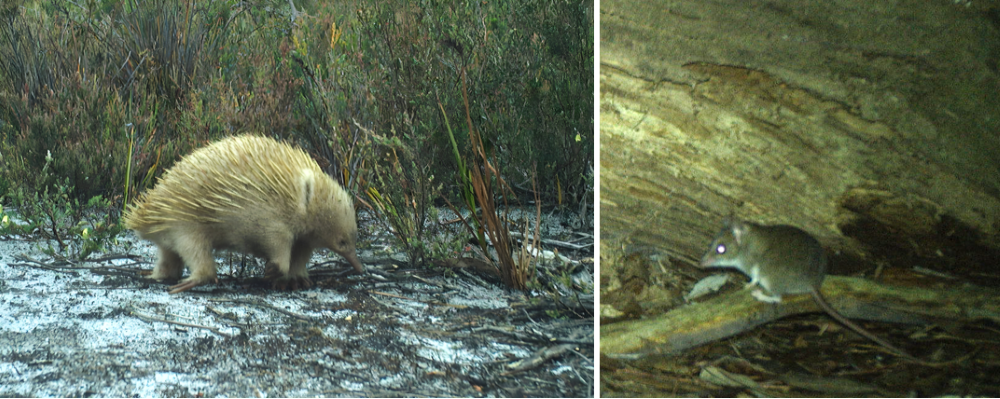
Significantly, white-footed dunnarts were photographed at six of the seven locations. A surprising result considering the species is infrequently recorded elsewhere in its range, despite intensive survey work.
These feisty carnivores are listed as a threatened species in New South Wales. There may be fewer than 5000 in Tasmania so finding another population is good news.
A critical factor in the survival of small animals is the work of the Truwana Rangers, including weed and feral pest control, and cultural burning to restore landscapes.
Truwana was returned to Aboriginal ownership in 2005, and the locals were determined to take the lead in caring for their Country.
Another strong positive is that unlike nearby islands, Truwana has largely avoided colonial-era, broadscale land clearing to create pasture or to grow crops. Native vegetation cover may be helping small mammals avoid predation.
Two rare blonde echidnas were captured on camera along with darker individuals. Truwana’s echidnas are the Tasmanian subspecies which has thicker fur than echidnas from warmer climates.
The pale echidnas likely have a genetic mutation causing leucism, which is a reduction in pigment, rather than the total absence found in albinos.
Bass Strait may be a hotspot for this condition as nearby Flinders Island promotes itself as one of the best places to catch a glimpse of a blonde echidna.
Other project highlights include detections of the Tasmanian subspecies of long-nosed potoroo, and the eastern pygmy possum.
Also noteworthy was the recording of Latham's Snipe which breeds in northern Japan, and some islands off far-eastern Russia, and then migrates to Australia. It is classified as vulnerable on the EPBC Threatened Species list.
They are shy, secretive birds and often remain hidden. Seeing them on the camera images means that the wetlands are in good condition and are of importance to this species in its long migratory cycle.
Truwana Senior Ranger Buck Brown said:
"I’ve seen some of these small animals before, but it’s important to have them named and confirmed on Truwana with our western science partners."
Truwana Ranger Shane Hughes said:
"Our elders told us stories of some of these small secretive animals.
To see them surviving on the Country we live on and manage as rangers, makes us proud of how we look after it."
Truwana Fire Project Ranger Roy Thomas said:
"Knowing we have these small animals in particular landscapes on Truwana encourages us to keep working hard on managing our island for healthy communities.
The more we know, the better we can manage for Community and Country”.
Emma Spencer, Eyes on Country coordinator, World Wide Fund for Nature Australia said:
“These results reinforce what we see again and again — where Traditional Owners are leading management of their Country, native species have a better chance of surviving, even with pressures like feral animals and climate change.”
Dr Elizabeth Znidersic, Charles Sturt University, said:
“Working alongside the Truwana Rangers has fundamentally shaped this research. Their understanding of the land and its species has helped us interpret what the cameras are showing in a much more meaningful way.
These camera arrays are revealing a level of biodiversity that other survey methods often miss, especially for shy or nocturnal birds and mammals.”
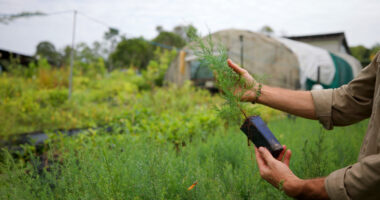
PLEASE NOTE: The pictures of someone holding a white-footed dunnart and an eastern pygmy possum are not from Truwana
Contact details:
Mark Symons
Senior Media Officer, WWF-Australia
m 0400 985 571