
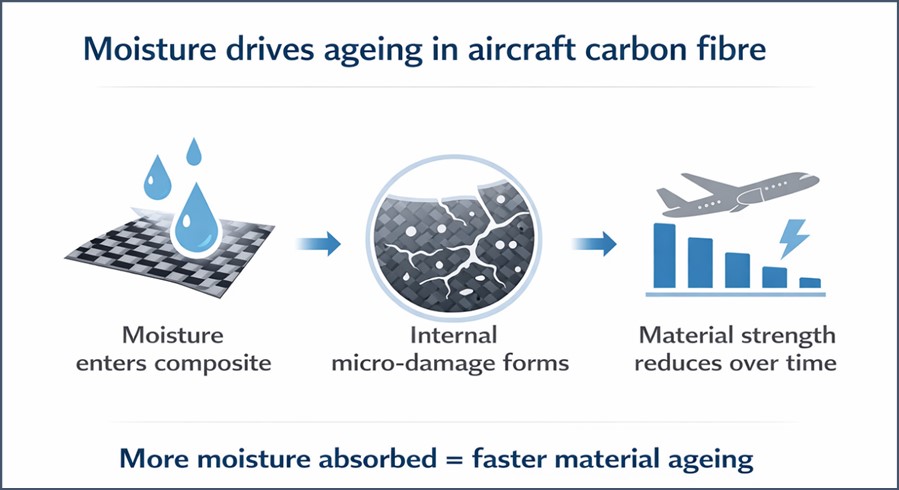
New research from engineers at Monash University and RMIT has revealed that moisture absorption is the most important factor in how carbon fibre used in aircraft degrades over time.
The discovery could help the aerospace industry predict material ageing more accurately, improve aircraft maintenance planning, and design longer-lasting composite structures.
Carbon fibre reinforced polymers are widely used in modern aircraft because they are lightweight, extremely strong, and resistant to corrosion - but these materials can slowly absorb moisture from the environment during service, gradually weakening from within.
The study investigated how different carbon fibre laminate designs aged under a range of hot and humid environmental conditions.
Researchers wanted to understand whether higher temperatures caused different types of damage, or whether they simply accelerated the ageing process.
The results revealed a clear and important finding - the amount of moisture absorbed by the material, not the specific temperature or humidity conditions, is the dominant factor controlling how the material degrades over time.
Dr Katherine Grigoriou, from the Monash Department of Mechanical and Aerospace Engineering, said the finding helps resolve a long-standing question in aerospace materials testing.
“What we found is that it’s not the exact ageing temperature or humidity that matters most, it’s how much moisture the material ultimately absorbs,” Dr Grigoriou said.
“This means that if we understand how moisture builds up inside a composite structure, we can much more reliably predict how it will perform over many years in service.”
The finding is particularly important because aerospace engineers often use accelerated ageing tests to simulate decades of environmental exposure in a much shorter time.
“Our results show that accelerated ageing methods can still provide reliable predictions of long-term performance, as long as the moisture content in the material is properly understood and controlled,” Dr Grigoriou said.
The research also revealed that the internal arrangement of carbon fibres plays a major role in how well the material resists environmental damage.
Using advanced imaging techniques, the team observed microscopic internal damage forming as the material aged, including tiny voids, cracks, and weakening of the bond between fibres and the surrounding polymer matrix. Some fibre layouts were able to retain their strength much better, while others proved significantly more sensitive to moisture-related degradation.
These insights could help engineers design more durable composite structures, improve maintenance strategies, and increase confidence in the long-term safety of aircraft components.
The research highlights the importance of understanding how environmental exposure affects modern aerospace materials, particularly as aircraft increasingly rely on composite structures.
Read the research paper: https://doi.org/10.1016/j.compositesa.2026.109665
MEDIA ENQUIRIES
Courtney Karayannis, Media and Communications Manager
Monash University
P: +61 408 508 454
GENERAL MEDIA ENQUIRIES
Monash Media
P: +61 3 9903 4840
For more experts, news, opinion and analysis, visit Monash News.