Results at a glance:
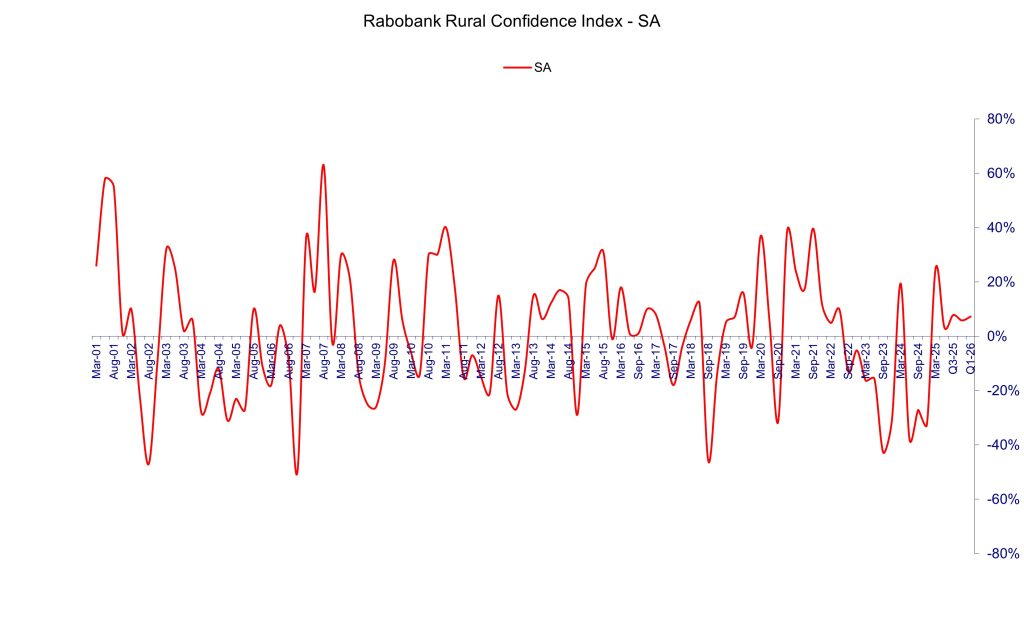
- SA was the only state to record an increase in farmer confidence in the quarter one survey, supported by the 2025-26 harvest and firm beef and sheep prices.
- High input costs were, however, already a mounting concern, even before the outbreak of the conflict with Iran.
- Seasonal conditions had underpinned positive sentiment among SA farmers, with late spring rain having boosted crop yields and livestock conditions in the state.
- While more recent widespread rainfall is expected to have further strengthened confidence about seasonal conditions heading into the 2026 winter cropping program, farmers are now bracing for the knock-on impacts of the current conflict in the Middle East.
South Australian farmers had entered the year with a stable outlook on the year ahead, following a better-than-anticipated 2025-26 harvest for grain growers and strong prices for red meat markets. However, the state’s primary producers are now bracing for the impacts of the current Middle East conflict on their farm businesses.
The quarter one Rabobank Rural Confidence Survey, completed last month, found South Australian farm sentiment tracking at a net reading of seven per cent.
Although this was only a small uptick from net six per cent in the previous survey (from December quarter last year), SA was the only state in the nation to record improved sentiment in the survey.
Rising input costs were, however already mounting as a concern – cited by more than 50 per cent of the state’s farmers – even prior to the start of the conflict with Iran.
And while more recent widespread rainfall is expected to have added to optimism about seasonal conditions, SA farmers are now however preparing for the knock-on impacts of the current conflict in the Middle East on their businesses.
Rabobank state manager for South Australia Roger Matthews said the commencement of the conflict with Iran had occurred after the survey period, however the pressure and uncertainty it has created around the price and availability of key agricultural inputs, including fuel and fertiliser, was compounding farmers’ existing concerns, especially going into this year’s cropping program.
The Q1 survey had found there was an increase in the number of farmers who expect conditions in the agricultural economy to stay the same in the year ahead – 46 per cent of respondents, up from 37 per cent at the end of 2025.
And, while there was a small drop in the percentage of farmers anticipating improved prospects (28 per cent, was 31 per cent), it was balanced by fewer expecting farm business conditions to worsen (21 per cent, down from 26 per cent previously).
The main driver for positivity among SA farmers this quarter was the season, with nearly half those surveyed (49 per cent) citing seasonal conditions as cause for optimism – although this had dipped from 57 per cent with that view last quarter.
Mr Matthews said farmers in the state were continuing to navigate variable seasonal challenges.
“Last year, confidence was subdued for many SA farmers thanks to a late break, low starting subsoil moisture and below-average growing season rainfall,” he said. “However, spring rains benefited later crops and supported better-than-originally-expected harvest results. The spring rain also benefited livestock producers who were able to put condition back on stock and replenish depleted fodder reserves as a risk management strategy.
“Although improved grain yields were offset by soft prices, overall confidence did not slip thanks to positive price signals from domestic and global beef, lamb/mutton and wool markets.”
The quarter one survey captured regional variation in seasonal confidence, reflecting that there are areas – such as the Mallee – which missed out on beneficial rainfall last year.
While net rural confidence had eased on the Eyre Peninsula from 27 per cent to 23 per cent, this region retained the highest confidence nationally in the Q1 survey.
Confidence had lifted – albeit marginally – across the South East and the York Peninsula/Mid North regions.
Mr Matthews noted that the widespread rain in late February should further support farmers’ confidence about seasonal conditions as they look to sowing the 2026 winter crop.
“The pastoral zone of SA received significant rainfall following the survey period which has replenished dams and will set producers up for the year ahead. Many stations received more rain in February than in all of 2025, and producers will be looking to increase stocking numbers to utilise feed. With good rain in other livestock regions across Queensland, Victoria and NSW, this will put strength into the restocker market,” he said.
“Useful rain also fell across key farming areas in the state through February, topping up soil moisture reserves, and we’re already seeing farmers out in the paddock, planting pastures and controlling weeds. However, while it was welcome rain for grain growers and livestock producers, it was ill-timed for SA’s wine grape industry and the impacts to production will be felt through vintage.”
The survey found SA farmers were also setting their hopes on how key markets will perform when it comes to prices, with 40 per cent of those surveyed citing rising commodity prices as cause for optimism (albeit down from 52 per cent last survey).
Beef producers were particularly bullish in their outlook, with a huge jump in sector sentiment reported in the survey, from a reading of net zero last quarter to 44 per cent. More than half of SA beef producers (53 per cent, up from 27 per cent) had indicated they expected business conditions to improve, and only nine per cent (was 27 per cent) for conditions to worsen.
“2026 is expected to be another solid year for beef, thanks to high cattle inventory, favourable seasons and ongoing demand out of the US. These domestic and global forces should keep Australian cattle prices around the levels experienced so far in 2026 for the remainder of the year,” Mr Matthews said.
Net confidence among SA grain growers slipped into negative territory in the survey – to sit at -14 per cent (from one per cent previously) – with more than a third predicting worsening conditions.
While net confidence in the South Australian sheep sector also eased back from 35 per cent to 29 per cent – this reflected a shift towards more producers expecting conditions to stay the same.
“For lamb producers, consistent strong prices are expected to prevail. For wool producers, although mixed demand signals could create price uncertainty for 2026, so far the strong prices from 2025 have continued,” Mr Matthews said.
However, positive seasonal and commodity market forecasts did not allay concerns about the cost of doing business – with 51 per cent of SA’s farmers in the survey worried rising input costs would have a negative impact on the agricultural economy.
“Input costs across the board – including fuel, fertiliser, labour, transport and insurance – have already remained stubbornly high for farmers for some time. Concern about the impact on farm budgets as a result has been steadily tracking higher in SA for the past year in line with costs creeping up quarter on quarter,” Mr Matthews said. “And now, the conflict in the Middle East is compounding concerns about high production costs, and the anticipated impact to global fuel and fertiliser supplies and prices.”
Drought was found to be slightly less of a concern for the state’s farmers this quarter, cited by 37 per cent (from 41 per cent previously). Worries about falling commodity prices were stable at 34 per cent this survey.
Against the backdrop of high production costs and the Reserve Bank of Australia’s decision to lift the cash rates in February (and since in March), SA farmers were taking a subdued approach to investing in their farm businesses for the coming 12 months.
Three-quarters of the state’s farmers surveyed were planning to hold business investment levels steady – an increase from 47 per cent last quarter – with far fewer this quarter intending to increase investment (19 per cent, down from 37 per cent).
On-farm infrastructure continued to be the highest planned capital expenditure for the year ahead, with 57 per cent of SA farmers surveyed investing in fences, yards, silos etc., although this is down from 67 per cent with that intention last quarter.
Farmers’ intention to purchase new plant and machinery was found to be stable quarter-on-quarter at 35 per cent. There was reduced appetite for adopting new technologies (planned by 27 per cent, down from 39 per cent previously), but planned investment in irrigation/water infrastructure increased to 22 per cent of farmers (up from 13 per cent) as SA farmers continued to invest in drought preparedness strategies.
Fewer SA farmers indicated they would invest in increasing livestock in the survey, compared to last (23 per cent, was 33 per cent).
Although interest in property purchases spiked in the previous quarter, it settled back to normal levels in the Q1 survey, with 14 per cent of SA respondents indicating they were keen to expand their farmland (was 23 per cent). Mr Matthews said this had reflected the timing of the survey, with most farmland changing hands immediately following harvest.
A comprehensive monitor of outlook and sentiment in Australian rural industries, the Rabobank Rural Confidence Survey questions an average of 700 primary producers across a wide range of commodities and geographical areas throughout Australia on a quarterly basis. The most robust study of its type in Australia, the Rabobank Rural Confidence Survey has been conducted since 2000 by an independent research organisation. The next results are scheduled for release in June 2026.
<ends>
Media contacts:
Denise Shaw Will Banks
Media Relations Media Relations
Rabobank Australia & New Zealand Rabobank Australia
Phone: 02 8115 2744 or 0439 603 525 Phone: 0418 216 103
Email: [email protected] Email: [email protected]
About us:
Rabobank Australia & New Zealand Group is a part of the international Rabobank Group, the world’s leading specialist in food and agribusiness banking. Rabobank has more than 125 years’ experience providing customised banking and finance solutions to businesses involved in all aspects of food and agribusiness. Rabobank is structured as a cooperative and operates in 35 countries, servicing the needs of more than nine million clients worldwide through a network of more than 1000 offices and branches. Rabobank Australia & New Zealand Group is one of Australasia’s leading agricultural lenders and a significant provider of business and corporate banking and financial services to the region’s food and agribusiness sector. The bank has 87 branches throughout Australia and New Zealand.