
Key points:
- Colour and thermal-infrared technology in drones was used to detect marine debris entanglements in fur seals
- The technology can also detect shark bites and other injuries on fur seals that showed up as elevated temperatures
- Researchers combined colour and thermal drone video to help identify at-risk animals more effectively
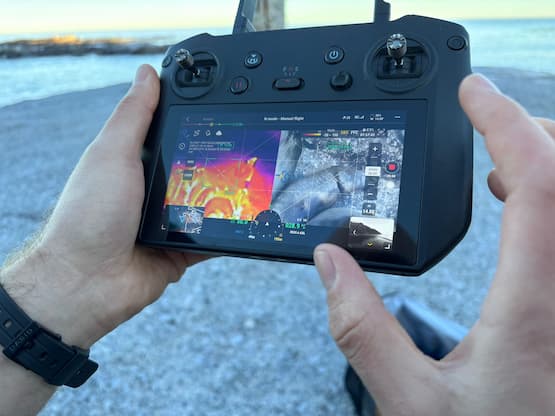
New research from Monash University and Phillip Island Nature Parks is using thermal and infrared drone technology to spot marine debris entanglements in Australian fur seals.
Marine debris entanglement is an escalating threat to marine wildlife such as seals and fur seals with well-documented impacts including injury, restricted movement and increased energy expenditure.
Published in Marine Pollution Bulletin, the research used drone-borne colour (RGB) cameras and thermal infrared (TIR) imaging to detect entanglements in Australian fur seals at Seal Rocks, southwest of Phillip Island in Victoria.
Results from across 54 drone surveys indicated that entanglements were clearly visible in handheld TIR via elevated heat at the site of the entanglement. While similar thermal anomalies were visible in 81 per cent of RGB+TIR drone detections of marine debris entanglements, with 95 per cent human reviewer agreement.
Lead author Adam Yaney-Keller, a PhD candidate from the School of Biological Sciences at Monash University, said this study presents the first use of drone-borne TIR imaging to detect debris entanglements in wildlife.
“Our findings demonstrated that not only do entanglements have a heat signature we can see in thermal, but that we can spot this heat signature from over 50 metres in the air using a drone, making it easier to spot entanglements and with less disturbance to fur seals across the breeding site,” Mr Yaney-Keller said.
“Most importantly, fishing line entanglements were detected in the dual RGB+TIR drone imagery, when in previous drone-based methods these types of thin or transparent materials would often be missed.
“Fur seals are just one of many species impacted by entanglement. But because they spend time on land and at sea, we can use them as an indicator of the problem for all marine life. By improving detection and rescue techniques, we get a better idea of how bad this problem really is in our oceans.”
Seal Rocks is the world's largest Australian fur seal breeding site where there is a high prevalence of entanglement, particularly with fishing lines. This new technology has improved detections of entanglement and offers greater opportunity to save wildlife from unintended harm.
An unexpected outcome from the research was that other injuries, such as shark bites, were also clearly visible in the thermal imaging, meaning the technique can be used for larger monitoring projects across the marine ecosystem.
Phillip Island Nature Parks Marine Scientist Rebecca McIntosh said using thermal drones to scan fur seal colonies is a major breakthrough for conservation.
“This technology allows us to see subtle heat signatures that reveal injuries and entanglements from the air that can normally be difficult to see,” Dr McIntosh said.
“It means we can detect at-risk seals earlier, intervene with better information and ultimately improve welfare outcomes for individuals and better understand trends in entanglement and impacts on the population as a whole.”
The researchers have already begun sharing their technique with the wider marine science community, recently trialling the same technology successfully with the City of Cape Town and Two Oceans Aquarium in Cape Town, South Africa with Cape fur seals, with similar results.
“By combining innovation with our longstanding commitment to the conservation of marine wildlife, we’re gaining a clearer picture of how marine debris can affect seal colonies and what we can do to protect them,” Dr McIntosh said.
Read the research paper: https://doi.org/10.1016/j.marpolbul.2026.119456
ASSETS AVAILABLE
Images and video footage available here.
MEDIA SPOKESPEOPLE
Adam Yaney-Keller, PhD candidate, School of Biological Sciences at Monash University
Rebecca McIntosh, Marine Scientist, Phillip Island Nature Parks
MEDIA ENQUIRIES
Hande Cater
Media and Communications Manager
P: +61 456 428 906
E: [email protected]
Silvia Dropulich
Marketing, Media & Communications Manager, Monash Science
T: +61 3 9902 4513
M: +61 435 138 743
Email: [email protected]
Lisa Gilbert, HeadlinePR
Phillip Island Nature Parks
M: 0412 822 673
E: [email protected]
GENERAL MEDIA ENQUIRIES
Monash Media
P: +61 3 9903 4840
E: [email protected]
For more experts, news, opinion and analysis, visit Monash News.