
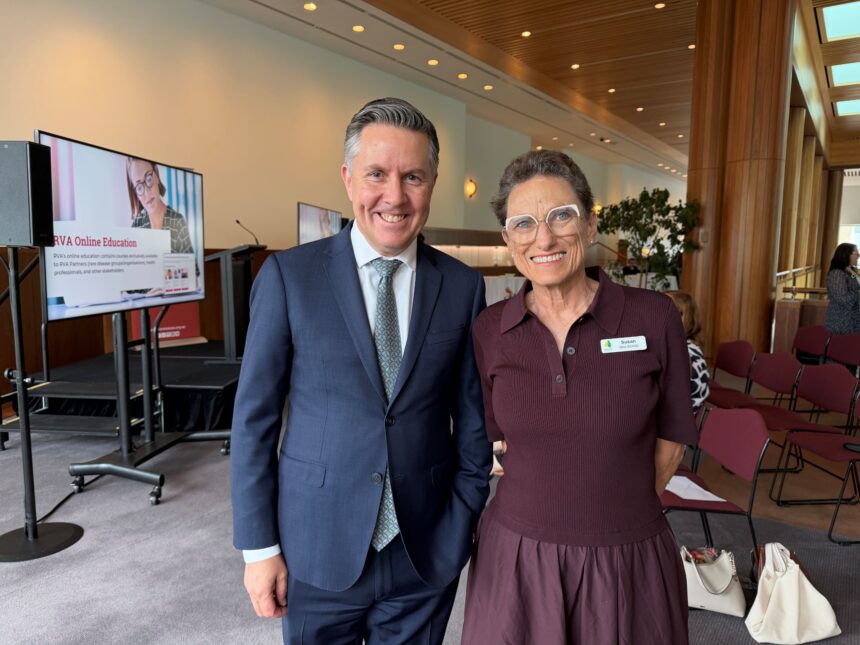
Alexion, AstraZeneca Rare Disease’s Ultomiris® (ravulizumab rch) has been listed on the Pharmaceutical Benefits Scheme (PBS) for adults with generalised myasthenia gravis (gMG) who are anti-acetylcholine receptor (AChR) antibody positive (Ab+). The Minister for Health and Ageing, The Hon Mark Butler MP, made the announcement at today’s World Rare Disease Day event at Parliament House.
Ultomiris is now available on the PBS for people with acute, severe gMG at high risk of rapid deterioration; for short term disease control as other treatments take effect; and for people not responding, intolerant or contraindicated to other therapies.[1],[2]
gMG is a rare, debilitating, chronic, autoimmune neuromuscular disease that leads to a loss of muscle function and severe weakness. Those living with gMG may initially experience slurred speech, double vision, droopy eyelids and weakness, with symptoms becoming more severe as the disease progresses, including extreme fatigue, difficulty swallowing, choking and respiratory distress. [3],[4]
Around 3,000 Australians are estimated to be living with gMG[5],[6],[7] and approximately 80 per cent are AChR Ab+.2 gMG most commonly begins in females before the age of 40, or in males after the age of 60, but can occur at any age including in childhood.[8],[9],[10]
Leading Australian neurologist and gMG expert, Associate Professor Stephen Reddel, said: “Generalised myasthenia gravis can be a debilitating disease for patients, causing unexpected and severe symptoms which can make many daily tasks difficult.
“Sometimes, in more severe cases, muscles that control breathing, swallowing and body movements are impacted resulting in symptoms such as difficulty speaking, swallowing, respiratory issues and muscle weakness, which can be very serious. Having new treatments available will give patients and clinicians more options to treat the disease," concluded A/Prof. Reddel.
Susan White, Chairperson of Myasthenia Alliance Australia said: “It is such an important day for myasthenia gravis patients as they will now have PBS access to a new treatment for this condition. It’s been a long journey to see this medicine reach the PBS and we thank the government for making this innovative medicine accessible for Australians.”
Nicole Gaupset, General Manager, Alexion Australasia, said: “At Alexion, we are committed to bringing innovation to rare disease patients, so we are excited that our treatment for gMG will now be available through the PBS. It’s been a long road to reach this point, but we have never given up in Australia.”
Treatment options should be discussed with a patient’s clinician.
▼ This medicine is subject to additional monitoring in Australia. This will allow quick identification of new safety information. Patients can report side effects to their doctor or to the TGA via www.tga.gov.au/reporting-problems. Healthcare professionals can report any suspected adverse events to www.tga.gov.au/reporting-problems.
Adverse events can also be report to Alexion at https://contactazmedical.astrazeneca.com.
|
WARNING: SERIOUS MENINGOCOCCAL INFECTIONS
ULTOMIRIS increases the risk of meningococcal infections. Life-threatening meningococcal infections/sepsis have occurred in patients treated with Ultomiris. Meningococcal infection may become rapidly life-threatening or fatal if not recognised and treated early. Immunise patients with meningococcal vaccines at least 2 weeks prior to administering the first dose of ULTOMIRIS, unless the risks of delaying ULTOMIRIS therapy outweigh the risk of developing a meningococcal infection (refer to full PI, section 4.4 Special Warnings and Precautions for Use for additional guidance on the management of the risk of meningococcal infection). Refer to the most current edition of the Australian Immunisation Handbook for meningococcal vaccination guidelines. Patients who initiate ULTOMIRIS treatment less than 2 weeks after receiving meningococcal vaccination must receive treatment with appropriate prophylactic antibiotics until 2 weeks after vaccination. Vaccination reduces, but does not eliminate, the risk of meningococcal infections. Monitor patients for early signs of meningococcal infections and evaluate immediately if infection is suspected. Patients should be advised about the signs and symptoms of meningococcal infection and to seek medical care immediately if they occur. |
Please review the full Ultomiris Product Information before prescribing, which can be accessed at https://rss.medsinfo.com.au/xi/pi.cfm?product=xipultoi
The Australian Ultomiris Consumer Medicine Information can be accessed at https://rss.medsinfo.com.au/xi/cmi.cfm?product=xicultoi
PBS Information: From 1 March 2026: Ultomiris is listed on the PBS as a Section 100 item for the treatment of generalised myasthenia gravis (gMG). Refer to PBS Schedule for full authority information.
– ENDS –
No compensation was provided to Associate Professor Stephen Reddel in relation to this announcement and the opinions expressed are his own. He has been briefed by Alexion on the approved use of this product.
Associate Professor Reddel has received consultancy fees/honorarium for speaking engagements, was an Advisory Board member and has received research funding from Alexion.
Notes
gMG
gMG is a rare autoimmune disorder characterised by loss of muscle function and severe muscle weakness. Eighty percent of people with gMG are AChR Ab+2 meaning they produce specific antibodies (anti-AChR) that bind to signal receptors at the neuromuscular junction (NMJ), the connection point between nerve cells and the muscles they control.[11] This binding activates the complement cascade, causing the immune system to attack the NMJ, leading to inflammation and a breakdown in communication between the brain and the muscles.11[12]
Ultomiris
Ultomiris is a type of medicine called a monoclonal antibody. The medication works by inhibiting the C5 protein in the terminal complement cascade, a part of the body’s immune system.3 By binding to C5, Ultomiris inhibits the process that occurs in people with gMG when the complement system malfunctions and produces antibodies that mistakenly attack healthy cells in the neuromuscular junction. Ultomiris is given as an intravenous infusion every eight weeks, two weeks after an initial loading dose.3
Alexion
Alexion, AstraZeneca Rare Disease is focused on serving patients and families affected by rare diseases and devastating conditions through the discovery, development and delivery of life-changing medicines. A pioneering leader in rare disease for more than three decades, Alexion was the first to translate the complex biology of the complement system into transformative medicines, and today it continues to build a diversified pipeline across disease areas with significant unmet need, using an array of innovative modalities. As part of AstraZeneca, Alexion is continually expanding its global geographic footprint to serve more rare disease patients around the world. It is headquartered in Boston, US. Please visit https://alexion.com/worldwide/Australia.
AstraZeneca
AstraZeneca (LSE/STO/NYSE: AZN) is a global, science-led biopharmaceutical company that focuses on the discovery, development, and commercialisation of prescription medicines in Oncology, Rare Diseases, and BioPharmaceuticals, including Cardiovascular, Renal & Metabolism, and Respiratory & Immunology. Based in Cambridge, UK, AstraZeneca’s innovative medicines are sold in more than 125 countries and used by millions of patients worldwide. Please visit astrazeneca.com and follow the Company on Social Media @AstraZeneca. For more information, please visit www.astrazeneca.com.au.
Alexion Pharmaceuticals Australasia Pty Ltd. ACN 132 343 036. Macquarie Park, NSW 2113. Medical enquiries: 1800 788 189. February 2026. AU/ULT-g/0118.
Contacts
Nicki Sambuco M: +61 452 446 084 E: [email protected].
References
[1] Australian Government. Department of Health, Disability and Ageing. The Pharmaceutical Benefits Scheme (PBS) [Online]. Available at: https://www.pbs.gov.au/ Accessed February 2026.
[2] Australian Government. Department of Health, Disability and Ageing. Pharmaceutical Benefits Advisory Committee (PBAC). Ravulizmab Public Summary Document – March 2025 PBAC Meeting. [Online] Available at: https://www.pbs.gov.au/industry/listing/elements/pbac-meetings/psd/2025-03/files/ravulizumab-psd-march-2025.pdf Accessed February 2026.
[3] Catalin J, et al. 2019. Clinical presentation of myasthenia gravis. Thymus.
[4] Farid ZR, et al. 2020. Factors affecting generalization of ocular myasthenia gravis. Sriwijaya Journal of Ophthalmology. 3(2):48-54.
[5] Sansoni J, Menn N, Viali L et al. 2023. Clinical features, treatments, their impact, and quality of life for Myasthenia Gravis patients in Australia. J Clin Neurosci, 118, 16-22.
[6] Gattellari M, Goumas C & Worthington JM. 2012. A national epidemiological study of Myasthenia Gravis in Australia. Eur J Neurol, 19(11), 1413-1420.
[7] Australian Bureau of Statistics (ABS). National, state and territory population. Reference period June 2025. [Online] Available at: https://www.abs.gov.au/statistics/people/population/national-state-and-territory-population/latest-release Accessed February 2026.
[8] Meriggioli MN & Sanders DB. 2009. Autoimmune myasthenia gravis: emerging clinical and biological heterogeneity. Lancet Neurol, 8(5), 475-90.
[9] National Organization for Rare Disorders (NORD). Myasthenia Gravis. [Online] Available at: https://rarediseases.org/rare-diseases/myasthenia-gravis/ Accessed February 2026.
[10] Health Direct. Myasthenia gravis. [Online] Available at: https://www.healthdirect.gov.au/myasthenia-gravis. Accessed February 2026.
[11] Omar A, et al. 2023. Physiology, neuromuscular junction. StatPearls.
[12] Zhu Y, et al. 2023. Clinical features of myasthenia gravis with neurological and systemic autoimmune diseases. Front Immunol. 14(14):1223322.