Gippsland, Coffs Harbour and Brisbane amateur astronomers, each inspired by the Apollo missions, honoured by Australia’s professional astronomers.
The Gippsland planet hunter
Chris Stockdale co-discovered an ‘ultra-hot Neptune’, four ‘super Jupiters’ and several potentially Earth-like planets, all orbiting distant stars. He has jointly authored over 100 planet discovery papers including a Nature paper.
From the dome in his backyard in Hazelwood, he looks for a slight drop in light as planets orbiting distant stars pass between us and ‘their sun’. Usually this is a tiny one per cent drop in brightness in the appearance of a star hundreds of light years away from Earth.
In some ways Chris is the ‘human in the loop’. Since 2018, NASA’s Transiting Exoplanet Survey Satellite (TESS) has identified nearly 8,000 potential exoplanets, at a cost of nearly $AUD 500 million. Chris checks TESS’s work using his telescope to validate potential planets so that the $AUD 20 billion James Webb Space Telescope can take a closer look, searching for evidence of an Earth-like atmosphere.
Chris also collaborates on planet hunting with the Las Cumbres Observatory Global Telescopes.
“I first got a taste for space during Apollo. We were living on a farm with dark skies where my dad showed me a comet, which I watched and sketched from day to day,” said Chris.
Chris reckons his setup is worth about $100,000. It makes observations automatically through the night. Then Chris uses skills from a career in IT to crunch the data.
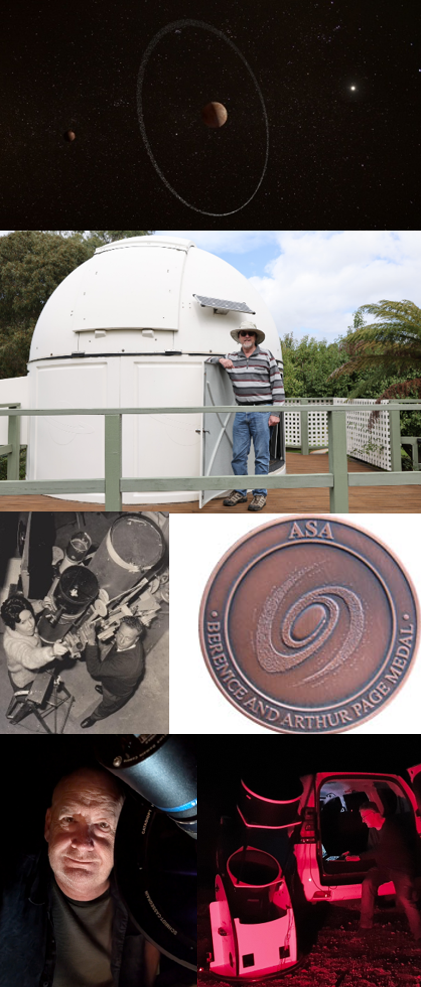
A giant ring that shouldn’t be, found around Quaoar on the outskirts of the solar system
Jonathan Bradshaw, Renato Langersek and John Broughton are the first amateur astronomers to discover a planetary ring.
The giant ring is rotating 4,000 km above the dwarf planet Quaoar which, according to the theories of the time, shouldn’t be. They were co-authors of a Nature paper that reported on their discovery and on subsequent observations of Quaoar.
Jonathan and Renato have been awarded the 2026 Page Medal for this work. John was previously honoured with the Medal in 2008 for the discovery of more than 500 asteroids, two comets and his extensive work on near-Earth objects.
Using their telescopes in Samford, Brisbane and the Gold Coast in 2021, they all were watching as Quaoar passed in front of a distant star.
“The star blinked before and after Quaoar passed in front of it. Renato, John and I all saw it, so we knew it wasn’t a glitch,” said Jonathan. “The best explanation was that there was a ring. It was an enigma because it is much further from Quaoar than expected by the ‘Roche Limit’.
Rings are usually found inside the Roche limit, where the planet’s tidal forces stop rings and debris from forming into a moon.
Quaoar is roughly half the size of Pluto and takes 288 years to orbit the Sun. It’s now known to have a moon and two rings.
“Our discovery generated an avalanche of interest around the world,” said Renato. “We were invited to participate in occultation events in the USA, Mexico and with NASA in the Northern Territory.”
Recognition
“These three remarkable astronomers demonstrate that dedicated amateurs can make significant contributions to our understanding of the cosmos,” said Professor Richard McDermid, President of the Astronomical Society of Australia and Director of AAO (Australian Astronomical Optics) at Macquarie University.
“These ‘backyard astronomers’ remind us that everyone can look at the night sky and observe. And their observations can guide the work of billion-dollar telescopes,” said Dr Tanya Hill, ASA prizes coordinator and astronomer at the Melbourne Planetarium.
The medals were presented at the National Australian Convention of Amateur Astronomers dinner at Tamworth on Saturday 4 April by Professor Fred Watson AM.
“As a recent up taker of astro-photography, I have been severely challenged to successfully manage the basics of focus and camera exposure, let alone the dark art of collimation,” said Bryce Little, the convention’s convenor. “So, I am in awe of the extraordinary technical achievements the Page Medal winners have made with their modest equipment, and the resulting impact of their efforts advancing global astronomy research. There is hope for me yet.”
The Page Medal is supported by the Foundation for the Advancement of Astronomy (FAA). Donations to the Foundation are tax-deductible and support the development and promotion of astronomy in Australia.
Images
- Chris Stockdale and his observatory in Gippsland, Victoria.
- Arthur and Berenice Page at their Chermside facility circa 1968
- The Page Medal
- Jonathan Bradshow with his telescope
- Renato Langersek observing
- Award ceremony photos available. All images at https://www.scienceinpublic.com.au/category/astronomical-society-of-australia-asa/
About the Berenice and Arthur Page Medal
The Berenice Page Medal was inaugurated by the Astronomical Society of Australia (ASA) in 1972 in memory of Mrs Berenice Page, an exceptional amateur astronomer and foundation member of the Society. Although most ASA members are professional astronomers, Berenice and her husband Arthur, were readily accepted into the Society because of the indispensable part they played in the IAU Flare Star Programme in the 1960s. Arthur Page remained an ASA member until his death in 2011 and, with his family’s agreement, the Society renamed the medal as the Berenice and Arthur Page Medal.
The ASA awards the Berenice and Arthur Page Medal for excellence in amateur astronomy in Australia and its territories. It is normally awarded every two years for scientific contributions by an amateur astronomer that has served to advance astronomy.
Links
- Chris Stockdale’s papers on ResearchGate
- Nature paper: A dense ring of the trans-Neptunian object Quaoar outside its Roche limit
- More about the ASA at https://asa.astronomy.org.au
- Full release and images at https://www.scienceinpublic.com.au/category/astronomical-society-of-australia-asa/.
Contact details:
·
Niall Byrne, 0417-131-977, [email protected]
Jacqui Tyack, 0422-999-088, [email protected]
and visit www.scienceinpublic.com.au