National study shows high adoption rates are masking a ‘fluency gap’– with leaders pursuing workforce reductions before their organisations are ready
Sydney, 30 April 2026 – Seven in ten Australian knowledge workers now use AI regularly at work, but new national research reveals a growing AI capability deficiency that is limiting the value it delivers.
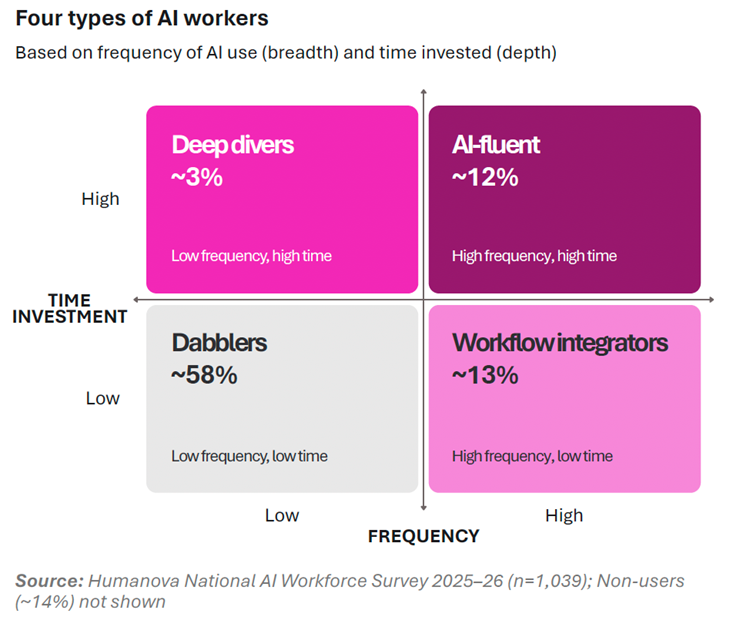
The Humanova National Workforce Report 2026, Australia is not ready for the AI era, is based on a YouGov survey of more than 1,000 knowledge workers, found that just 1 in 8 workers have developed genuine AI fluency – the ability to collaborate with AI on complex work rather than use it as a shortcut.
The majority is what the report calls ‘dabblers’: workers who have tried AI, use it occasionally, but haven’t learned much beyond summarising an email.
The report also found AI fluency is unevenly spread. Senior leaders are more than five times as likely to be AI-fluent as the average office worker. Adoption, in other words, is widespread, but advanced capability is rare, uneven, and concentrating at the top.
At the same time, leaders are increasingly seeing AI as an opportunity for workforce reductions. Humanova’s research found that 26% of senior decision-makers identify AI as an opportunity to reduce headcount, rising to 32% in organisations with more than 1,000 employees.
The report warns that this creates a serious execution risk. Organisations may be tempted to use AI to reduce the size of the workforce, often responding to pressure from shareholders, before they have built the capability needed to make an AI-enabled operating model work.
“The question most business leaders are asking is, ‘how many of my people are using AI?’ That’s the wrong question,” said Dr Sean Gallagher, Founder of Humanova and author of the report. “Adoption is not the same thing as capability. You don’t solve the second problem by celebrating the first.”
“Organisations are rushing to redesign work around AI. But the danger is that they cut before they build. If you make the organisation smaller before you make it smarter and more productive, AI becomes a cost-cutting story that brings risk, rather than a transformation story that delivers value.”
A two-tier workforce is forming
A structural gap is emerging in the workforce, with one in four senior leaders acquiring AI-fluency, compared with just one in twenty office workers. Senior leaders are also more than three times as likely to spend sustained daily time working alongside AI – the single strongest predictor of developing real capability.
Through sustained engagement, leaders develop what the report calls AI intuition: the judgement to know when to trust AI’s output, which tasks to delegate, and how to direct it effectively.
Most office workers, by contrast, operate in process-heavy, system-coupled environments where the friction of integrating AI into day-to-day work prevents them from engaging more deeply.
Fewer people will not fix the fluency gap
The report warns that the arrival of AI agents – systems that can plan, act, and execute multi-step tasks autonomously – will accelerate the divide rather than flatten it.
Agents may reduce the need for some routine work. But they also increase the need for people with the intuition to work with AI to oversee outputs, frame problems and make decisions across systems. These are precisely the capabilities most workers have not yet had the opportunity to build.
“Agents will make your business faster and cheaper. They won’t make it smarter. Only your people can do that,” Dr Gallagher said. “If organisations begin removing routine work before they have built higher-order AI capability, they risk removing the very on-ramp workers need to become fluent.”
“You might not be able to avoid workforce change. But you can avoid being unprepared for it. The organisations that will thrive won’t necessarily be the ones that cut fastest. They’ll be the ones whose people have the capability to figure out what comes next.”
What closing the gap looks like
One organisation has done exactly that. HR technology company ELMO Software engaged Humanova when early internal AI adoption stalled beyond basic applications.
Rather than treating AI as a technology rollout, ELMO approached it as a culture change – embedding capability through structured training, leadership alignment, and frameworks that gave every employee a reliable foundation for using AI well.
The results are measurable:
- Sales preparation time dropped from ten hours to fifteen minutes
- More than 250 HR policy queries resolved automatically per month
- 100% AI usage across its workforce, with more distributed fluency and intuition.
Joseph Lyons, President of ELMO, said:
“The challenge is no longer the time it takes to implement a good idea, but how quickly we can generate and test new ones. That’s where AI has the potential to deliver lasting gains.”
“Adoption numbers have told us what we wanted to hear for three years,” Dr Gallagher said. “The real question is which of your people are fluent, which are dabbling, and what’s stopping the rest from progressing. Most leaders don’t know the answer. The ones who find out first will have a workforce the others can’t buy.”
– ENDS –
About the research:
The Humanova National Workforce Report 2026 is the third annual wave of Australia’s national AI workforce research program, initiated by Dr Sean Gallagher at Swinburne University of Technology in 2023 and continued through Humanova. Fieldwork was conducted by YouGov Australia in December 2025, surveying 1,039 knowledge workers in organisations with 25 or more employees.
Report availability:
The full report is available at humanova.com.au. An infographic summarising key findings is available on request.
Spokespeople available for interview:
- Dr Sean Gallagher, Founder, Humanova – report author
- Justin Meier, Head of Talent, Capability & Workforce Experience, ELMO Software – on ELMO’s experience building organisation-wide AI capability
Key data points
- 70% of Australian knowledge workers use AI at least weekly; 30% use it daily
- Only 12% are AI-fluent – capable of collaborating with AI on complex work
- 58% of workers are ‘dabblers’ – some AI exposure but little real integration
- Senior leaders are more than five times as likely to be AI-fluent as office workers
- One in four senior leaders are AI-fluent, compared with one in twenty office workers
- Senior leaders are 3.1× more likely to spend sustained daily time with AI
- 92% of advanced AI intuition is driven by depth of engagement, not frequency of use
- 26% of senior decision-makers identify AI as an opportunity to reduce headcount
- That rises to 32% in organisations with more than 1,000 employees
- The most common use of AI in Australian workplaces is still summarising an email
About Humanova
Humanova is an Australian AI workforce research and advisory firm. Founded by Dr Sean Gallagher, an internationally recognised expert in AI workforce transformation who initiated Australia’s national AI workforce research program at Swinburne University of Technology in 2023, Humanova works with organisations to diagnose the AI capability gap, design workforce strategies for the AI era, and build the human capability that sustainable AI transformation demands.
Humanova has worked with organisations across finance, insurance, property, government, agriculture, construction, and HR technology.
humanova.com.au
Contact details:
Scott Thomson, SenateSHJ
+61 432 218 681