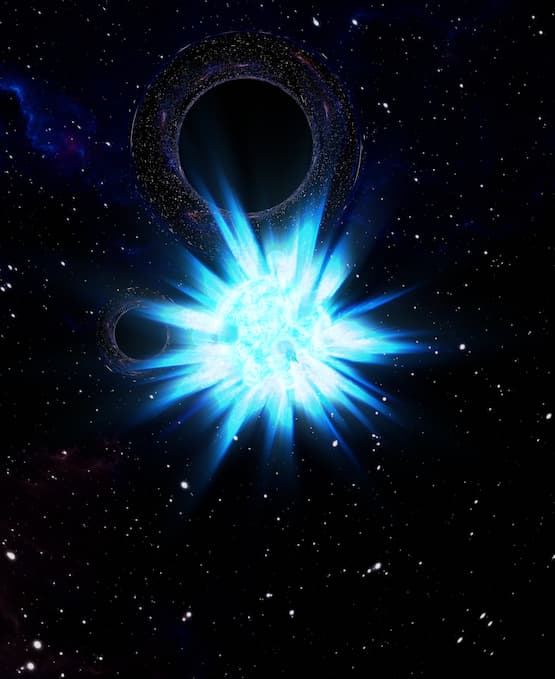
An international team led by Monash University has uncovered evidence of a rare form of exploding star, helping to shed light on one of the most cataclysmic events in the Universe.
At the end of their lives, most massive stars collapse into black holes – objects with gravity so strong that not even light can escape.
Some very massive stars, however, are expected to become so hot that they are blown apart in a pair-instability supernova – an explosion so intense that the star is completely disrupted, leaving behind no black hole.
First predicted in the 1960s, pair-instability supernovae are challenging to distinguish from more common stellar explosions that leave behind black holes.
In a study published in Nature, researchers found that by using gravitational waves – ripples in the fabric of spacetime detected by the LIGO-Virgo-KAGRA observatory network – they were able to measure the properties of black holes and found a “forbidden range” of black-hole masses.
Black holes with masses more than 45 times the mass of the sun are rare because the stars that might otherwise have made them exploded in pair-instability supernovae.
Project lead, Hui Tong, a PhD candidate from Monash University’s School of Physics and Astronomy and the ARC Centre of Excellence for Gravitational Wave Discovery (OzGrav), said the research found a forbidden mass range where stars seemingly don’t make black holes.
“The observation is well explained by pair instability; there are no stellar-origin black holes in the forbidden zone because stars are undergoing pair-instability supernovae. The only black holes in this mass range are made from merging smaller black holes, rather than directly from stars,” Mr Tong said.
Confirming the existence of this gap would help settle a major question about how the most massive stars live and die, and the origin of black holes.
Project collaborator, Professor Maya Fishbach from the University of Toronto and CITA said the study highlights the potential of gravitational waves to probe the lives, deaths and afterlives of the most massive stars in our Universe.
“We are seeing indirect evidence of one of the most titanic blasts in the cosmos: pair-instability supernovae. At the same time, we are finding that once they are born, black holes can grow via repeated mergers,” said Professor Maya Fishbach.
“It’s a cool result because we are using black holes to learn about the nuclear reactions inside stars,” said Professor Eric Thrane, Chief Investigator at OzGrav.
Read the research paper: https://doi.org/10.1038/s41586-026-10359-0
ASSETS AVAILABLE
Images and video footage available here.
MEDIA ENQUIRIES
Hande Cater
Media and Communications Manager
P: +61 456 428 906
E: [email protected]
GENERAL MEDIA ENQUIRIES
Monash Media
P: +61 3 9903 4840
E: [email protected]
For more experts, news, opinion and analysis, visit Monash News.