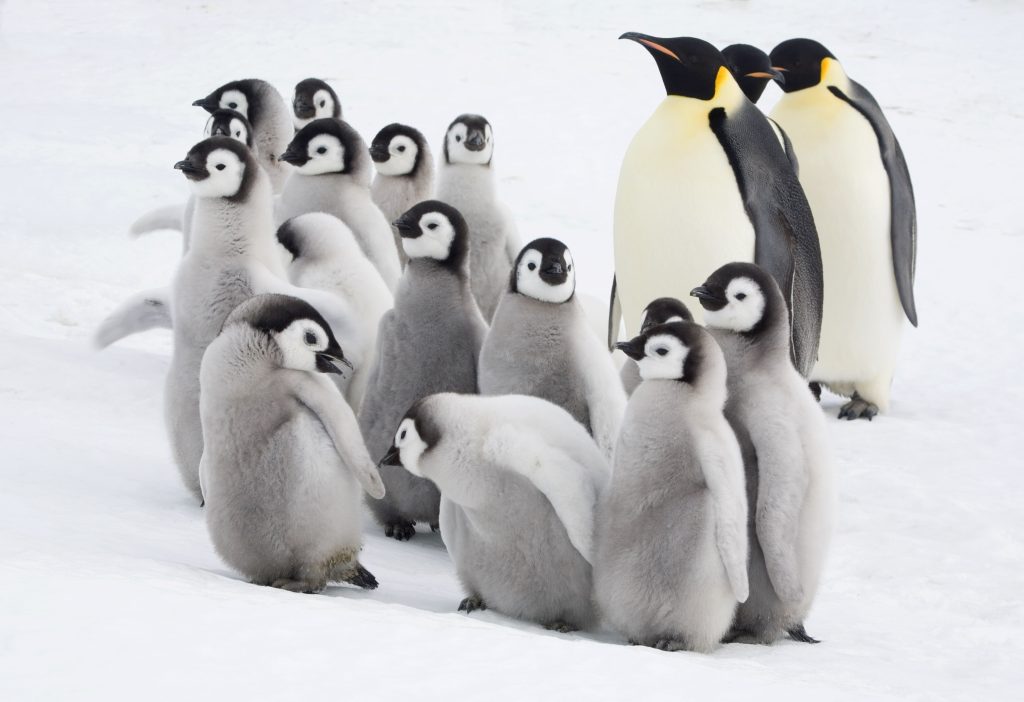

* The emperor penguin has now been listed as Endangered due to climate change
* Climate change in Antarctica is leading to changes in sea-ice that are projected to cause the emperor penguin population to halve by the 2080s
* WWF warns the species may be on a path towards extinction without urgent action
Photos: https://hive.panda.org/Share/n2kt4571vgyltu3qdqeraq14x256uasy
Video: https://hive.panda.org/Share/27q73guiqu2q4n8xoktq5f5q7yp61k3d
WWF is warning that emperor penguins face population collapse and may be on a path towards extinction after the IUCN downgraded their status on its Red List by two places from 'Near Threatened' to 'Endangered', based upon the prediction that their population could collapse by about half over the next 50 years.
With previous modelling suggesting further decline or even functional extinction by the end of the century, urgent action is required to halt climate change and protect emperor penguins and their habitat.
Found only in Antarctica, emperor penguins are uniquely adapted for survival in this unforgiving environment. For nine months of the year, they are dependent on ‘fast’ ice - sea ice which is connected to land, seabed or ice shelves. During this period, they gather in large colonies to mate, lay eggs, raise chicks, and moult to replace their waterproof and insulating feathers.
Since 2013, WWF has supported scientists to monitor emperor penguin colonies in Antarctica using Very High Resolution (VHR) satellite imagery, revealing an increasingly bleak picture. This research helped to inform the IUCN’s decision to move emperor penguins from 'Near Threatened' to 'Endangered'. Composed of over 1,400 Member organisations from government and civil society and the input of some 17,000 experts, including WWF, the IUCN is a global authority on the status of the natural world.
Sea ice levels naturally change throughout the year as the surface of the ocean around Antarctica freezes over in the winter and melts back each summer. However, since 2016, sea ice in the Antarctic has dramatically decreased both in terms of the area it covers and the length of time that it stays. The early break up of fast ice at the location of many breeding colonies around Antarctica has resulted in catastrophic breeding failures.
In 2022, four out of five known breeding sites in the Bellinghausen Sea collapsed, with thousands of chicks, who lack waterproof feathers until almost fully grown, likely freezing or drowning.
With a current population estimate of about 595,000 adult Emperor Penguins, research assessing numbers between 2009-2018 indicated that there had already been an almost 10% decline in the population around Antarctica.
In recent years the situation has become even more critical. With record reductions in sea ice, studies supported by WWF revealed there has been an estimated 22% regional decline in emperor penguins in the Western Antarctic sector in the years between 2018 and 2023.
Adult penguins are at their most vulnerable during their annual moult, when they replace their waterproof feathers. Without secure spaces to safely moult, adult penguins risk death in the freezing oceans.
In February of this year, a study by British Antarctic Survey researchers supported by WWF demonstrated that emperor penguin adults are vulnerable to fast ice breakup in January to March during their moult. Early breakup of the sea ice in parts of West Antarctica resulted in moulting penguins concentrating within a smaller area of remaining sea ice, increasing the likelihood of them falling into the icy waters before their waterproof feathers have been replaced.
Adult mortality is even more critical to future populations than chick mortality. Combined, the effects of fast ice breakup have very serious consequences for emperor penguin population trends.
The fate of the emperor penguin is inextricably linked to climate change policy, underlining the need for governments to rapidly decarbonise to prevent catastrophic effects on nature, wildlife and people. Transitioning away from fossil fuels and stabilising global temperature increases to no more than 1.5ºC is critical in avoiding the worst effects.
However, there is also action that can be taken in the region. At the next Antarctic Treaty Meeting to be held in May in Japan, WWF is calling for emperor penguins to be listed as a Specially Protected Species. This would give additional protection from pressures on their habitat from human activity, including tourism and shipping.
Rod Downie, WWF-UK Chief Adviser, Polar & Oceans, said:
“The fate of these magnificent birds is in our hands.
“Climate change is having a profound impact on the Antarctic, where emperor penguins are increasingly vulnerable to changes in seasonal sea ice. They require stable sea ice as a platform to mate, incubate their eggs, raise their chicks and replace their feathers during their annual moult.
“With the shocking decline in Antarctic sea ice that we are currently witnessing, these icons on ice may well be heading down the slippery slope towards extinction by the end of this century – unless we act now.
“Urgent action is needed to limit average global temperature rise, to protect the waters surrounding Antarctica, which are teeming with life, and to designate emperor penguins as Specially Protected Species at this year’s Antarctic Treaty Meeting.”
Emily Grilly, WWF-Australia’s Antarctica expert and Oceans Conservation Manager, said:
“People marvel at the ability of emperor penguins to survive some of the harshest conditions on earth.
“But now human activity is pushing them to the brink.
“It’s distressing to think of penguin chicks freezing when sea ice breaks up before their waterproof feathers are ready.
“Unless global emissions are urgently reduced to halt a rapidly warming climate in Antarctica, these iconic birds face a bleak future.
“In the meantime, emperor penguins need additional protections. Something WWF has been calling for since 2022.
“We urge Antarctic Treaty members to do the right thing and declare emperor penguins a Specially Protected Species at their upcoming meeting this May.
“This would reduce pressures like fishing and tourism that add additional stress on colonies. There would also be targeted actions to support their recovery.”
Contact details:
Paul Fahy, 0455 528 161, [email protected]