
Skip to content
Building Construction

Smart soil design to stop Australia’s underground water pipelines from corroding

Monash University 2 mins read

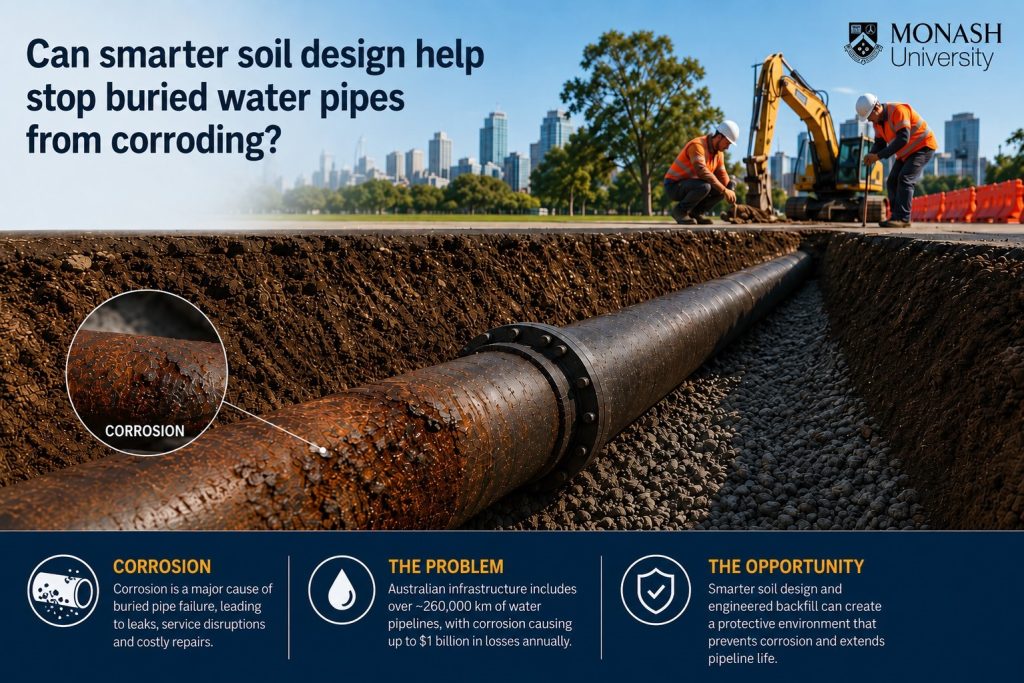
Engineers are rethinking the soil surrounding buried pipelines in a bid to help reduce Australia’s billion-dollar annual corrosion problem and extend the lifespan of critical infrastructure.

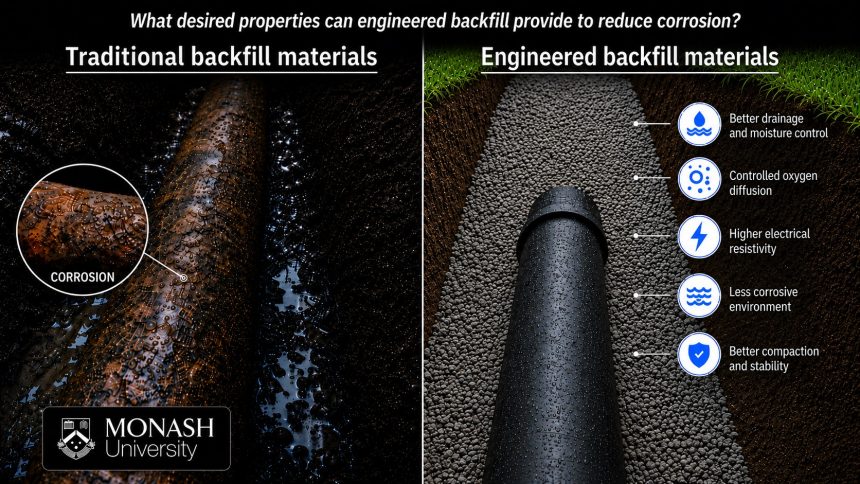
Monash research, published in Geotechnical and Geological Engineering, explores how specially designed backfill materials could be used as an active corrosion protection system rather than simply providing mechanical support.

Australia has an estimated 260,000 kilometres of pipelines, with around 80 per cent buried underground and made from metallic materials vulnerable to corrosion. 

Corrosion-related failures are estimated to cost up to $1 billion annually through repairs, maintenance, water loss and infrastructure replacement.

The review paper brings together research from geotechnical engineering and corrosion science to examine how factors including moisture, soil acidity, salt concentration, electrical resistivity and compaction influence the corrosion of buried ductile iron pipelines.

Lead author and Monash PhD candidate Thisara Senarathna said current industry approaches typically focus on the structural performance of backfill materials, despite the surrounding soil environment playing a major role in corrosion rates.

“Protective coatings and cathodic protection systems remain important, but their effectiveness is strongly influenced by the surrounding soil conditions,” Mr Senarathna said.

“Our work shows backfill should be treated as part of the corrosion protection strategy itself, not just material used to support the pipe.”

The broader project is investigating new resistive backfill materials, construction methods and modelling techniques aimed at minimising corrosion across entire pipeline networks, including interference effects between adjacent buried pipes in congested urban environments.

Researchers say the approach could provide a more practical and low-cost pathway for improving infrastructure longevity while reducing maintenance demands and the carbon footprint associated with replacing ageing underground assets.

Co-author Professor Jayantha Kodikara, Director of the ARC Smart Pavements Hub at Monash, said the findings support a shift toward performance-based backfill design standards.

“Corrosion is often treated as a separate issue from geotechnical engineering, but these systems are deeply interconnected,” Professor Kodikara said.

“This research highlights the need for more integrated infrastructure design approaches that consider both structural performance and long-term corrosion resistance.”

The study also includes insights from Australian industry surveys examining current maintenance challenges and corrosion management practices across buried pipeline systems.

Read the research paper: https://doi.org/10.1007/s10706-026-03692-8 

MEDIA ENQUIRIES 

Courtney Karayannis, Media and Communications Manager

Monash University

P: +61 408 508 454

E: [email protected] 

GENERAL MEDIA ENQUIRIES

Monash Media

P: +61 3 9903 4840

E: [email protected]


For more experts, news, opinion and analysis, visit Monash News.
Media

More from this category

  • Building Construction
  • 14/05/2026
  • 23:25
Command Alkon Incorporated

Celebrate Industry Excellence – Nominations Open for 2026 Elevate Best of the Year Awards

Peer-Nominated Awards Recognize Outstanding Individual Contributions Across the Heavy Building Materials IndustryHILLIARD, Ohio, May 14, 2026 (GLOBE NEWSWIRE) -- Command Alkon, the global leader in software and platform technology for the heavy building materials industry, is pleased to announce that nominations are now open for the 2026 Elevate Best of the Year Awards. These awards honor the individuals who go above and beyond in their roles to drive operational excellence, innovation, and industry advancement.Nominations are open to Command Alkon systems users, partners, and industry peers who wish to recognize colleagues and professionals making a meaningful impact in their organizations and…

  • Building Construction
  • 13/05/2026
  • 18:44
Australian Institute of Architects

Announcing the Australian Institute of Architect’s 2026 National Prize Winners

2026 Gold Medal Architects Neil Durbach, Camilla Block and David Jaggers of Durbach Block Jaggers have been named as joint recipients of the Australian Institute of Architects Gold Medal for 2026. The Gold Medal – the Australian Institute of Architects’ highest honour – recognises distinguished service by architects who have designed or executed buildings of high merit, producing work of great distinction that has advanced architecture or endowed the profession in a distinguished manner. For nearly thirty years, Durbach Block Jaggers (DBJ) has been a leading force in Australian architecture under the leadership of Neil Durbach, Camilla Block, and David…

  • Contains:
  • Building Construction, Engineering
  • 13/05/2026
  • 14:45
Australian Steel Institute

ASI asks PC to approve a Safeguard quota and tariff on imported fabricated steelwork to save industry

The surplus international capacity for finished steel products has put the future of the Australian fabricated steel market under threat, with very low-cost fabricated steelwork surging into Australia, the Australian Steel Institute (ASI) has told the opening day (May 13) of the Productivity Commission (PC) Safeguard hearing into imported fabricated structural steel (FSS). An immediate provisional emergency Safeguard measure in the form of a tariff rate quota (TRQ) on fabricated steelwork is essential to save the local industry, the ASI argued. The Australian fabricated structural steel industry, which comprises some 350 ASI fabricator members and employs more than 20,000 people,…

Media Outreach made fast, easy, simple.

Feature your press release on Medianet's News Hub every time you distribute with Medianet. Pay per release or save with a subscription.