New research led by UNSW suggests as the climate warms, the conditions that produce hailstorms are drifting towards the poles – leaving winter crops exposed.
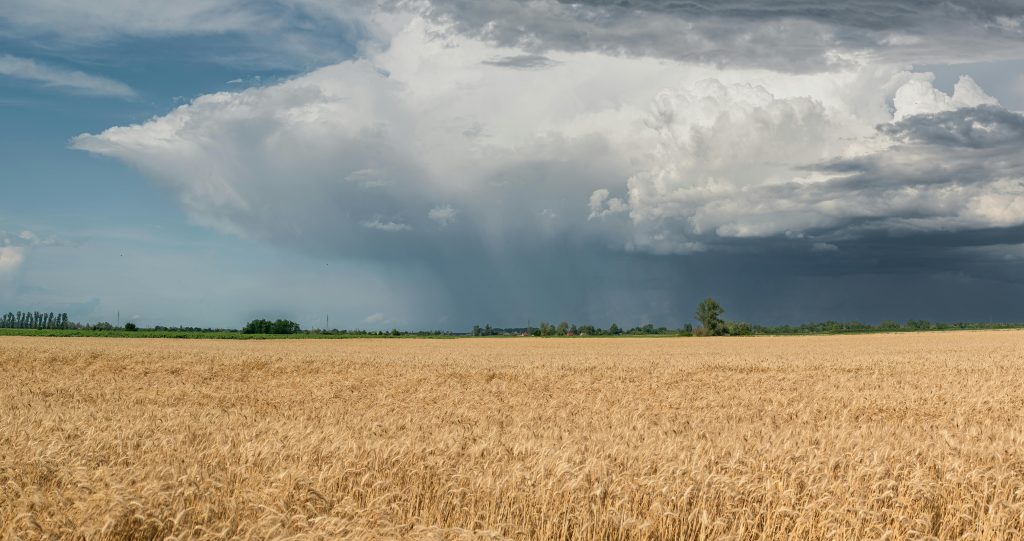
A hailstorm can undo a season’s work in minutes. It can strike quickly and unevenly, shredding wheat, bruising fruit, flattening crops – while also leaving neighbouring paddocks untouched.
In a new Nature Climate Change study, scientists from UNSW Sydney say the geography and seasonality of that risk is changing.
As the planet warms, the atmospheric conditions that produce damaging hail are projected to shift away from some warmer regions towards the cooler parts of the world – including south-eastern Australia and New Zealand.
Lead author Dr Tim Raupach from the UNSW Institute of Climate Risk and Response says this is part of an overall hail condition frequency shift towards the poles.
“Under modelling scenarios of 2°C and 3°C of global warming, we see this overall shift towards more risk in cooler places and cooler times of the year,” Dr Raupach says.
“So increasing risk in winter and often decreasing risk in summer – a shift from warmer to cooler regions and seasons,” he says. “Those cooler regions include not only parts of southern Australia and New Zealand, but northern North America and Europe.
“And there are decreases – though still with a lot of uncertainty – in the subtropics and parts of the mid-latitudes. This includes much of Australia as well as regions of India, China and much of Africa.”
An atmospheric tug of war
Because hailstorms are brief and difficult to observe, the researchers did not model hailstones directly. Instead, they used three different proxies, or methods, to detect atmospheric conditions that occur when hail is more likely to form.
These proxies did not always agree, particularly in the tropics, underscoring how difficult future hail risk remains to predict. The disagreement showed that with a warmer atmosphere, several forces act at the same time.
“Usually, as the atmosphere gets warmer, we expect it to have more energy, which could be turned into updrafts,” Dr Raupach says. Updrafts are a key feature of hailstorms.
“When you have these strong winds in the thunderstorms, they can support the growth of larger hailstones,” he says.
At the same time, warmer air also raises the level at which frozen hailstones begin to melt.
“There is a lot more melting in a warmer atmosphere,” Dr Raupach says.
“This can make smaller hailstones melt away.”
The result is an offsetting effect, or an atmospheric tug of war, where warming pushes the system in two directions at once.
“The atmosphere might be more prone to create storms, but the storms that are created might be less likely to have hail reach the ground,” Dr Raupach says.
However, he says the concern is that while hail may become less common across some regions or seasons, they may be more destructive when they do happen.
“Larger hailstones are more likely with stronger storm dynamics,” he says. “That still has important implications for agriculture.”
Winter crops in the firing line
A decrease in summer hail risk also does not necessarily help a winter crop if the danger rises during growing season.
The researchers examined 26 major crop types globally.
“One of the things that makes this study unique is that we looked at the changes in risk to crops based on the hazard changes that we see in the hail-prone environments,” Dr Raupach says.
He and the team looked at what proportion of each crop’s growing season was likely to be affected by hail-prone conditions, and how that exposure changed in future climate projections.
“We saw in the future projections that often the hazard was increasing for winter crops.”
In Australia, where wheat is a major winter crop, the signal is clearest in the south-east – from Tasmania up along the broad arc from Melbourne towards Sydney – where hail-prone environment increases appear in both past trends and future projections.
Risk planning
A crop does not even need to be damaged often for hail to matter – just one severe storm is enough. But for farmers, insurers and policymakers, it is a difficult risk to plan around.
The findings also complicate some assumptions about climate adaptation. As global warming forces crop-growing regions to shift poleward, agriculture may also move into areas where hail risk is increasing.
This means that potential gains from a warmer climate, such as new growing zones or longer seasons in cooler regions, could be offset by exposure to more damaging storm conditions.
Dr Raupach says the uncertainty surrounding future hail risk remains a major challenge.
“It’s hard,” he says. “The uncertainty of it and the difficulty in getting at exactly what’s going on is one of the challenges that we face, and that decision-makers face.
“But we can make broad statements. And the shift towards the poles is the broad statement we can make here.”
Dr Joanna Aldridge is the Head of Research & Development, Catastrophes at QBE, which supported the research.
She says this work is building the scientific evidence base needed to understand how hail risk is shifting.
“This enables better risk assessment, resilience planning and decision-making across industries such as insurance and agriculture,” Dr Aldridge says.
On the move
For Australia, another broad statement concerns the south-east of the continent.
“The southeast of Australia comes up not only in the trends that we see in the past, but also in the future projections as a place where the hazard is increasing,” Dr Raupach says.
While hail has often received less public attention than other climate-linked agricultural threats – such as drought, heatwaves, floods and bushfires – for farmers it can be one of the most immediate and damaging hazards.
The study warns these overlapping shifts “may attenuate any positive impact on crop yields in a warming world”.
Dr Tim Raupach’s position at UNSW is supported by QBE Insurance. Dr Raupach and study co-author Professor Steven Sherwood are affiliated with the UNSW Climate Change Research Centre and the ARC Centre of Excellence for 21st Century Weather – where Dr Raupach is an Associate Investigator and Prof. Sherwood is a Chief Investigator.
Contact details:
Melissa Lyne
UNSW News & Content