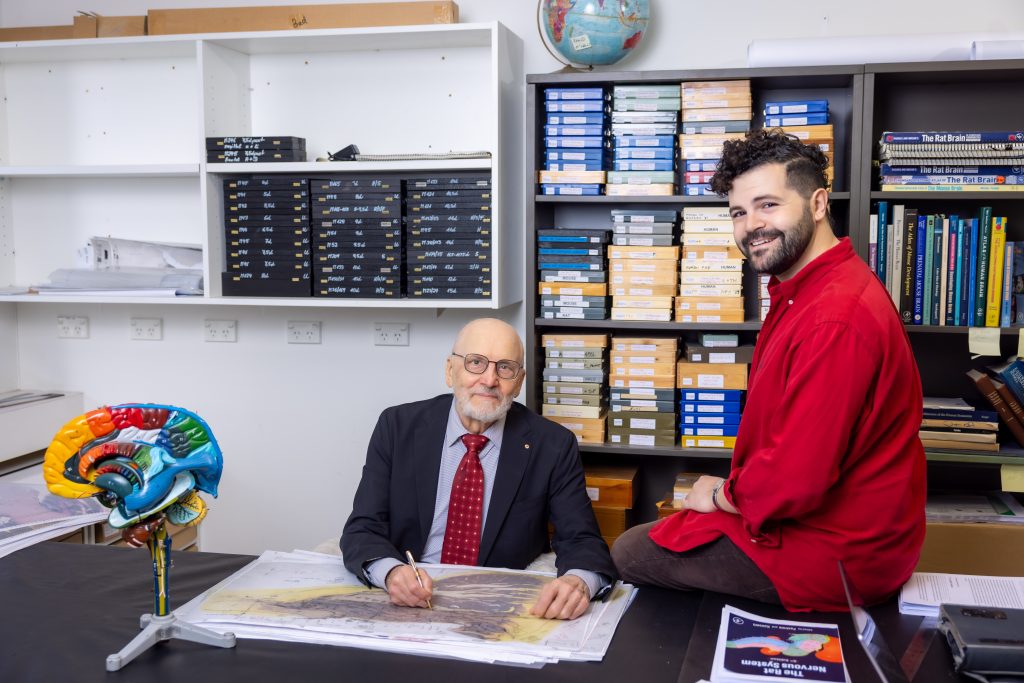
- A unified list of terms and abbreviations for central nervous system structures has been proposed by researchers from Neuroscience Research Australia (NeuRA).
- At present, terminology and abbreviations are often in conflict across species, developmental stages and neuroanatomical traditions.
- Researchers have developed an online resource for more than 3,300 brain and spinal cord structures to improve clarity and accuracy in communication.
As if the brain were not complex and difficult enough to study, conflicting terms and abbreviations make it even harder to decipher. Now, researchers from Neuroscience Research Australia (NeuRA) are proposing the equivalent of a ‘periodic table’ to improve clarity and reduce confusion for neuroscientists and clinicians.
World-renowned brain cartographer and NHMRC Senior Principal Research Scientist at NeuRA, Scientia Professor George Paxinos, AO, made the proposal in Trends in Neuroscience after developing this resource.
“Different labs and brain atlases use different abbreviations for the same structure and sometimes the same abbreviations for different brain structures,” Prof Paxinos said.
“Imagine one airport used ‘SYD’ for Sydney and another used ‘SDN’ for Sydney, whilst a third used ‘SYD’ for a completely different city. There would be confusion, similar to what happens now among neuroscientists when they explore the brain.”
Inspired by the periodic table, Prof Paxinos and his colleagues have proposed and developed a solution: a unified system of brain and spinal cord terms and abbreviations.
“Chemists solved this problem with the periodic table by creating non-conflicting abbreviations for the elements and we need the same for the brain,” Prof Paxinos said.
“There are approximately 3,300 structures of the brain and spinal cord and we want to improve clarity in diagrams, text and oral communication, to reduce ambiguity for neuroscientists and clinicians.
“We proceeded to derive abbreviations using a set of rules inspired by the periodic table. We presented the rules and proposed a comprehensive list of terms and abbreviations in our online resource.”
Refining terms and determining abbreviations
While organisations such as the Federative International Programme for Anatomical Terminology (FIPAT) and the International Federation of Associations of Anatomists (IFAA) have worked to consolidate central nervous system (CNS) terminology, this covers only a fraction of terms needed to navigate the brain and spinal cord, focuses only on human anatomy and provides no abbreviations.
“There are multiple, non-systematic abbreviations for the structures of the central nervous system,” Prof Paxinos said.
“For example, the nucleus accumbens has been abbreviated in at least 27 ways. We also see different scientists using the same abbreviation of ‘SO’ to mean different things, including the supraoptic nucleus and superior olive.
“When abbreviations are constructed without rules or are idiosyncratic to the lab that produced them, it creates confusion for those using them.
“Just as the periodic table and the post office have unique codes to identify elements and suburbs, respectively, unique terms and abbreviations are needed to identify structures of the CNS.”
A resource for all
Prof Paxinos and his team developed the ‘Central Nervous System Terms and Abbreviations’ cross-species online resource. Corresponding (homologous) structures across species are given the same name and abbreviation.
“Our cross-species list is principally based on an integration and adjustment of lists I had assembled with colleagues across the last 45 years in creating the adult and developmental brain and spinal cord atlases of humans, rhesus and marmoset monkeys, rats, mice and birds,” Prof Paxinos said.
The team applied several rules to ensure abbreviations were consistent, including rules around capitalisation and word order. The resource includes the abbreviations, the terms they refer to and the species the structures are found in.
“If the proposed abbreviation rules were followed consistently, one could be presented with a figure from an unfamiliar species and yet be able to know the name of the structures just from the abbreviations,” Prof Paxinos said.
“Our resource is intended to evolve, and we encourage others who have collections of terms and abbreviations for other species to contact us.”
The paper was published in Trends in Neurosciences and is available here.
The unified list of abbreviations is available at cnsterms.neura.edu.au
About us:
Neuroscience Research Australia (NeuRA) is an independent, not-for-profit research institute based in Sydney aiming to prevent, treat and cure brain and nervous system diseases, disorders and injuries through medical research. To learn more about NeuRA: www.neura.edu.au
Contact details:
Katana Smith
Senior Media and PR Advisor
0452 140 477 | [email protected]