An ancient marine 'crime scene' discovered near Richmond in Outback Queensland captures the world first evidence of a flying reptile being eaten by a sea monster... before that predator became dinner itself.
VNR – Dr Matt White, overlay here
Dr Dean Lomax and Dr Matt White with BOB here
Stills and illustrated graphic here
WORLD-FIRST QUEENSLAND FOSSIL REVEALS THE BIGGEST DINNER DRAMA OF THE DINOSAUR AGE
BAG OF BONES: Queensland fossil find rewrites the rules of prehistoric life
An ancient marine 'crime scene' discovered near Richmond captures the world first evidence of a flying reptile being eaten by a sea monster... before that predator became dinner itself.
Forget Jurassic Park - beneath the ancient waters that once covered Outback Queensland, life was every bit as dramatic, brutal and unpredictable as any Hollywood blockbuster. Now, an extraordinary fossil discovered near Richmond has revealed one of the most remarkable prehistoric "crime scenes" ever uncovered, providing the world's first definitive evidence that an ancient marine reptile ate a flying reptile... before becoming prey itself to one of the largest predators ever to patrol Australia's inland sea.
***Published overnight in the international scientific journal Gondwana Research, the discovery rewrites what scientists know about life beneath Queensland's prehistoric Eromanga Sea more than 100 million years ago.
At the centre of the discovery is a six-to-seven-metre-long ichthyosaur, a dolphin-shaped marine reptile, whose fossil preserves an astonishing sequence of events never before documented anywhere in the world.
Using cutting-edge 3D imaging technology, scientists discovered fragments of a pterosaur, a flying reptile, preserved inside what are believed to be the ichthyosaur's fossilised stomach contents. It is the first definitive evidence anywhere in the world that an ichthyosaur consumed a pterosaur.
But that’s not the end of the story.
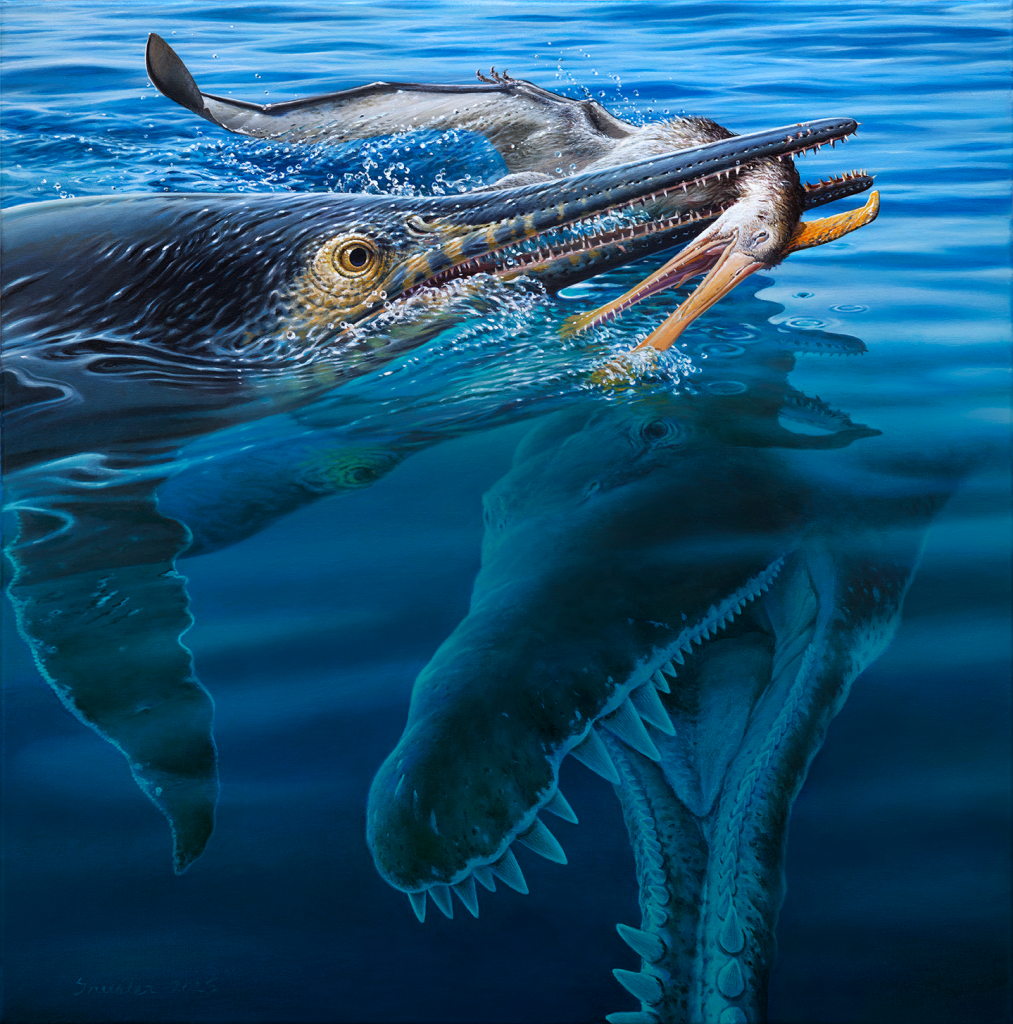
The ichthyosaur's own skeleton bears enormous crushing bite marks, shattered bones and missing sections consistent with an attack - or scavenging event - by Kronosaurus queenslandicus, the giant apex predator that ruled Queensland's ancient inland sea. Together, the fossil preserves an extraordinary prehistoric food chain frozen in time: PTEROSAUR → ICHTHYOSAUR → KRONOSAURUS
Internationally renowned palaeontologist Dr Dean Lomax, who recently visited Australia for the first time during Queensland Dinosaur Week said, “It's one of the clearest examples ever discovered of a three-tier predator interaction and offers an unprecedented snapshot of behaviour in Australia's Cretaceous seas. This extraordinary fossil records a trophic interaction between a pterosaur eaten by an ichthyosaur that was then partly consumed by a giant pliosaur. It gives us direct evidence of behaviour in the Eromanga Sea."
*Dr Matt White, Research Associate at the University of New England and lead author of the study and a self‑funded palaeontologist said the fossil was unlike anything the team had seen before.
"I was amazed by the size of the ichthyosaur, and shocked to see it littered with bite marks and partially exposed pterosaur remains behind the skull," he said.
“This discovery enriches our understanding of these ancient marine reptiles and illustrates the complex interactions that shaped their prehistoric aquatic environment. The public fossicking areas near Richmond have yielded thousands of fossils over the years, including dinosaurs, birds, turtles, polycotylid, plesiosaurs pliosaurs, pterosaurs and other marine reptiles.”
As research continues and methodologies advance, each fossil discovery, like this Platypterygius australis, has the potential to reveal more intricate patterns and provide glimpses into the complex food webs that existed beneath the waves during a pivotal time in Earth’s history.”
Dr Peter Trusler produced scientific artwork for the paper, updating depictions of Kronosaurus skull proportions and illustrating the ichthyosaur and pterosaur interaction. The prepared specimen (nicknamed BOB) is curated at Kronosaurus Korner Museum.
HOW THIS WAS DISCOVERED: from 'Bag of Bones' to global discovery
Remarkably, one of Australia's most significant marine fossil discoveries began with an ordinary fossicking trip. In August 2019, Richmond visitors Mike and Cathy Freeman, together with Gary and Barb Flewelling, uncovered large fossilised bones at a public fossicking site outside the Outback Queensland town.
The mystery bones were collected, bagged and affectionately nicknamed B.O.B. (Bag of Bones).
Three years later, Kronosaurus Korner curator Kevin Petersen returned to the site and uncovered the rest of what proved to be an enormous, partially articulated ichthyosaur stretching almost eight metres across the excavation.
More than 600 volunteer and staff hours were invested preparing the specimen before several unusual rock nodules behind the skull prompted scientists to investigate further. Rather than breaking the rocks apart and risking damage, researchers sent them to the Australian Nuclear Science and Technology Organisation (ANSTO), where advanced neutron tomography at the Australian Centre for Neutron Scattering allowed scientists to look inside without destroying the fossil.
Hidden within the rock were fish, squid-like cephalopods... and fragments of a flying reptile's jaw.
Queensland's ancient ocean was a dangerous place: Long before dinosaurs dominated the Australian landscape, much of Outback Queensland lay beneath the vast Eromanga Sea, home to giant marine reptiles, sharks, turtles and predators unlike anything alive today.
This remarkable fossil confirms those ancient waters were not home to simple predator-prey relationships, but to an incredibly complex ecosystem where hunters could quickly become the hunted.
The discovery also reinforces Richmond's reputation as one of Australia's most important marine fossil regions, where public fossicking sites continue to produce internationally significant scientific discoveries.
Perhaps most remarkably of all, this world-first began not with a multimillion-dollar expedition, but with four curious fossil hunters willing to pick up what looked like an ordinary bag of bones.
More than 100 million years later, B.O.B. has become one of the clearest windows ever discovered into life and death beneath Queensland's ancient inland sea.
FUN FACT: When Dr Matt White isn’t digging up dinosaurs you’ll find him at the beach kitesurfing. On one occasion, while showing off, he collided with a rock wall and ended up in Mackay Hospital. He was fine, but while undergoing a CT scan he joked, “Can you scan dinosaur bones in this thing?” It earned a few puzzled looks and the “how hard did he hit his head?” question. The episode ended up leading to the first hospital CT scan of dinosaur bones in Queensland.
Dinosaur Experiences Australia | Discover the Outback Dinosaur Trail
DINOSAUR EXPERIENCES AUSTRALIA & QUEENSAND DINOSAUR WEEK
One of the enduring legacies of Queensland Dinosaur Week 2026 has been the strengthening of relationships between Queensland's tourism and scientific communities. Following the event, lead author Dr Matt White and Dinosaur Experiences Australia identified a shared commitment to bringing Queensland's internationally significant palaeontological discoveries to a broader audience.
Karen Hanna Miller, Executive Officer of Dinosaur Experiences Australia, said Queensland Dinosaur Week had demonstrated the powerful connection between science and tourism. "Queensland is home to discoveries that are changing our understanding of prehistoric life, and those discoveries deserve to be shared beyond the scientific community. When people can stand in front of the very fossil featured in an internationally significant research paper, science becomes a real and memorable visitor experience. Scientific discovery provides the stories that inspire travel, while tourism helps those stories reach the world. Together they create greater awareness, stronger regional economies, increased support for museums and researchers, and inspire the next generation of scientists. Science drives tourism, and tourism helps sustain science."
Dinosaur Experiences Australia | Discover the Outback Dinosaur Trail
For media enquiries please contact Kath Rose | 0416 291 493 | [email protected]
Contact details:
Kath Rose | 0416 291 493 | [email protected]