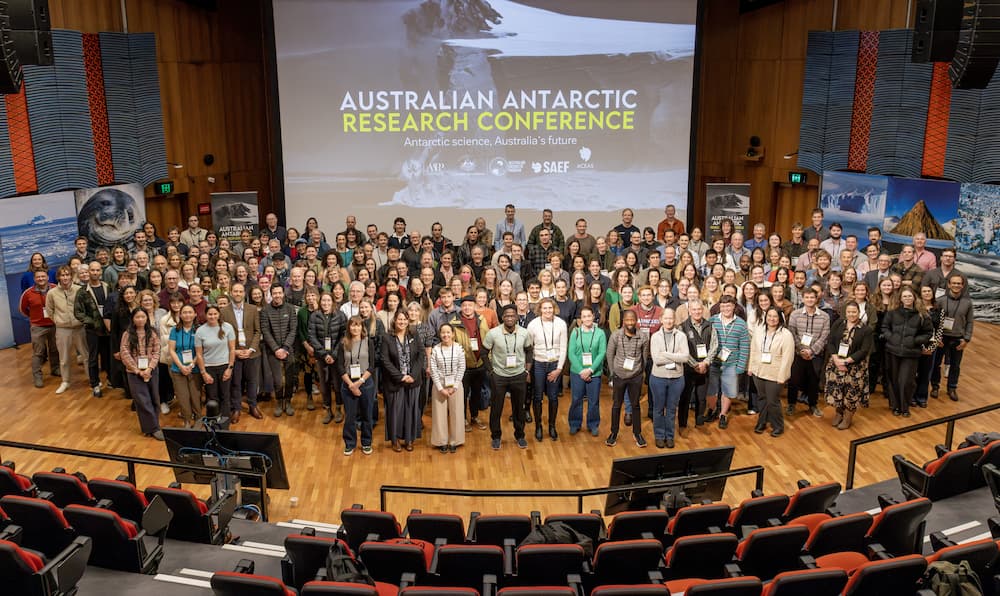
More than 400 polar experts from Australia and around the world have gathered at the University of Tasmania this week for the Australian Antarctic Research Conference (AARC), as Antarctica and the Southern Ocean undergo rapid environmental change.
The conference brings together research from sea ice and biodiversity to climate modelling, social sciences and technology, reflecting Antarctica's growing importance to Australia’s future.
As the conference draws to a close, Australian Centre for Excellence in Antarctic Science (ACEAS) geophysicist Dr Mark Hoggard with the Australian National University, said it underlined the importance of the work to understanding Australia’s future.
“One of the biggest challenges facing Antarctic science is understanding what changes in Antarctica mean for global sea-level rise, particularly for coastal communities here in Australia and our Pacific island neighbours,” Dr Hoggard said. “This conference showcases Australia's strength in bringing together the science needed to answer those critical questions and help communities prepare for the future.”
Mathematician Professor Michael Bode from Securing Antarctica's Environmental Future (SAEF) with Queensland University of Technology noted that Australia’s strong Antarctic science community is also shaping efforts globally.
“I've modelled decision-making about the continent and found that Australia is among a handful of countries leading the world in action on Antarctica," Professor Bode said. “Decisions about Antarctica depend heavily on science.”
Both noted that the conference is essential to the Australian Antarctic science community as they progress plans to address some of the world's most pressing environmental challenges, and for meeting the objectives of the Australian Antarctic Science Decadal Strategy 2025-2035.
AARC 2026 is jointly sponsored by the Australian Antarctic Program Partnership (AAPP), the Australian Centre for Excellence in Antarctic Science (ACEAS), Securing Antarctica's Environmental Future (SAEF), and the Australian Antarctic Division (AAD), with support from the Tasmanian Government.
ASSETS:
Images are available here.
MEDIA CONTACTS:
Mark Horstman AAPP, p 0407 701 530
Natsumi Penberthy SAEF, p 0423 126 468
Grace Moss ACEAS, p 0409 985 255
About Securing Antarctica’s Environmental Future (SAEF):
Securing Antarctica’s Environmental Future is a Monash-led research and workforce development program, funded by the Australian Research Council. SAEF is delivering leading Antarctic and Southern Ocean science to benefit Australians, our neighbours in the Asia-Pacific, and society around the globe in the context of a changing climate.