
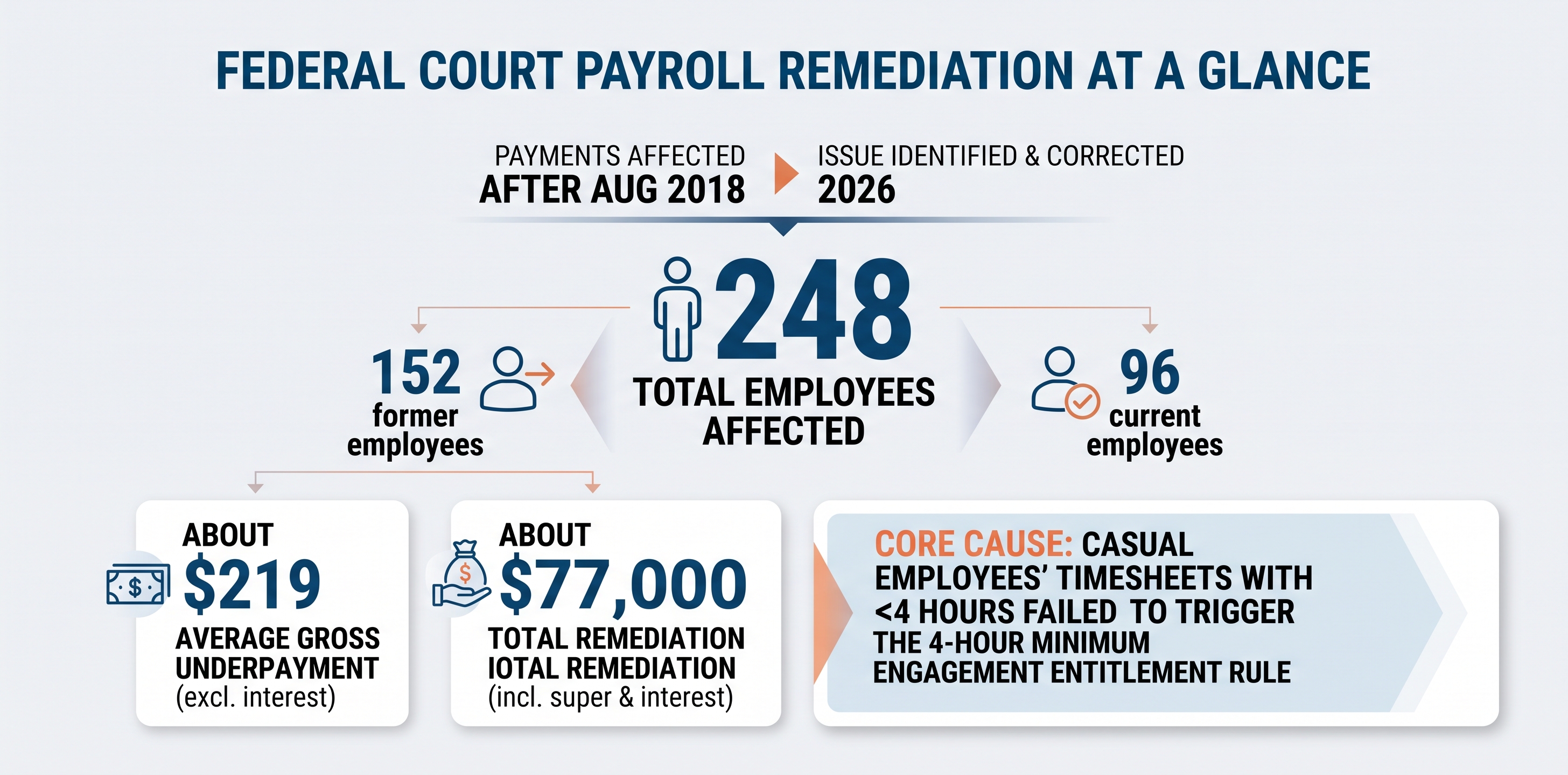
- The Payroll Leadership Institute of Australia (PLIA) has called on employers to re-test payroll entitlement rules following a Federal Court disclosure revealing that 248 casual employees were underpaid due to a payroll configuration issue, resulting in approximately $77,000 in remediation payments including superannuation and interest.
- The issue arose because the payroll system failed to apply a minimum four-hour engagement entitlement for casual employees who recorded fewer than four hours on their timesheets, demonstrating that accurate payroll inputs do not guarantee correct entitlement calculations.
- PLIA emphasised that payroll assurance must go beyond confirming that pay runs processed successfully, and should instead test whether employment rules are being correctly interpreted and applied between recorded work and final payment.
- The Institute recommended three key controls: tracing entitlements from their source through to payroll configuration; deliberately testing exception scenarios such as short shifts, overtime thresholds and penalty rates; and re-testing rules following any changes to employment conditions, software or configuration.
- PLIA warned that payroll compliance is not a one-time activity completed at system go-live, stating that every significant change to employment conditions or payroll configuration creates a risk that entitlements and calculations may drift apart.
Payroll Leadership Institute Calls for Payroll Rule Reviews Following Federal Court Underpayment
PLIA says employers should continuously re-test payroll entitlements as agreements, systems and workforce conditions change
Aug. 24, 2026 - The Payroll Leadership Institute of Australia (PLIA) today called on Australian employers to re-test payroll entitlement rules following a Federal Court disclosure showing how a narrow configuration issue can persist across multiple pay cycles.
The Federal Court of Australia Listed Entity disclosed in August that it had identified and corrected a payroll configuration issue affecting casual employees who recorded fewer than four hours on their timesheets. Those employees did not receive the minimum four-hour engagement entitlement required under the relevant enterprise agreements.
The issue affected 248 employees, comprising 152 former employees and 96 current employees, for payments dating from after August 2018. The Listed Entity estimated the average gross underpayment at approximately $219 per employee, excluding interest, with total remediation payments of approximately $77,000 including superannuation and interest.
The four-hour entitlement also appears in the current Federal Court of Australia Enterprise Agreement 2024-2027, which states that a casual employee will be engaged for a minimum of four hours per engagement or paid for a minimum of four hours at the appropriate casual rate.
PLIA said the incident demonstrates an important distinction for payroll governance: accurate payroll inputs do not necessarily guarantee that an employee's full entitlement has been calculated correctly.
“Accurate timesheets do not automatically mean accurate payroll,” PLIA said. “Employers also need to test whether the employment rules sitting between recorded work and the final payment are being interpreted and applied correctly.”
The Listed Entity said the issue was detected through improved payroll assurance and control procedures. It has corrected the issue, notified relevant oversight agencies and said it will continue reviewing and enhancing its payroll controls.
PLIA said this is an important part of the case for employers to consider. Payroll assurance should not be limited to confirming that a pay run processed successfully, timesheets were approved or payroll totals reconciled.
Instead, PLIA recommends employers focus on three higher-level controls:
-
Trace entitlements into payroll. Employers should be able to trace an obligation from its source, including an Award, enterprise agreement, contract or legislation, through its interpretation and into the rule configured in payroll.
-
Test exceptions, not only normal pay runs. Assurance should deliberately test transactions more likely to expose an incorrect rule, including short shifts, overtime thresholds, allowances, penalty rates and manual overrides.
-
Re-test after change. Employment conditions and payroll environments are not static. Award variations, new enterprise agreements, classification changes, software migrations, integrations and manual configuration changes can all create a need to validate rules again.
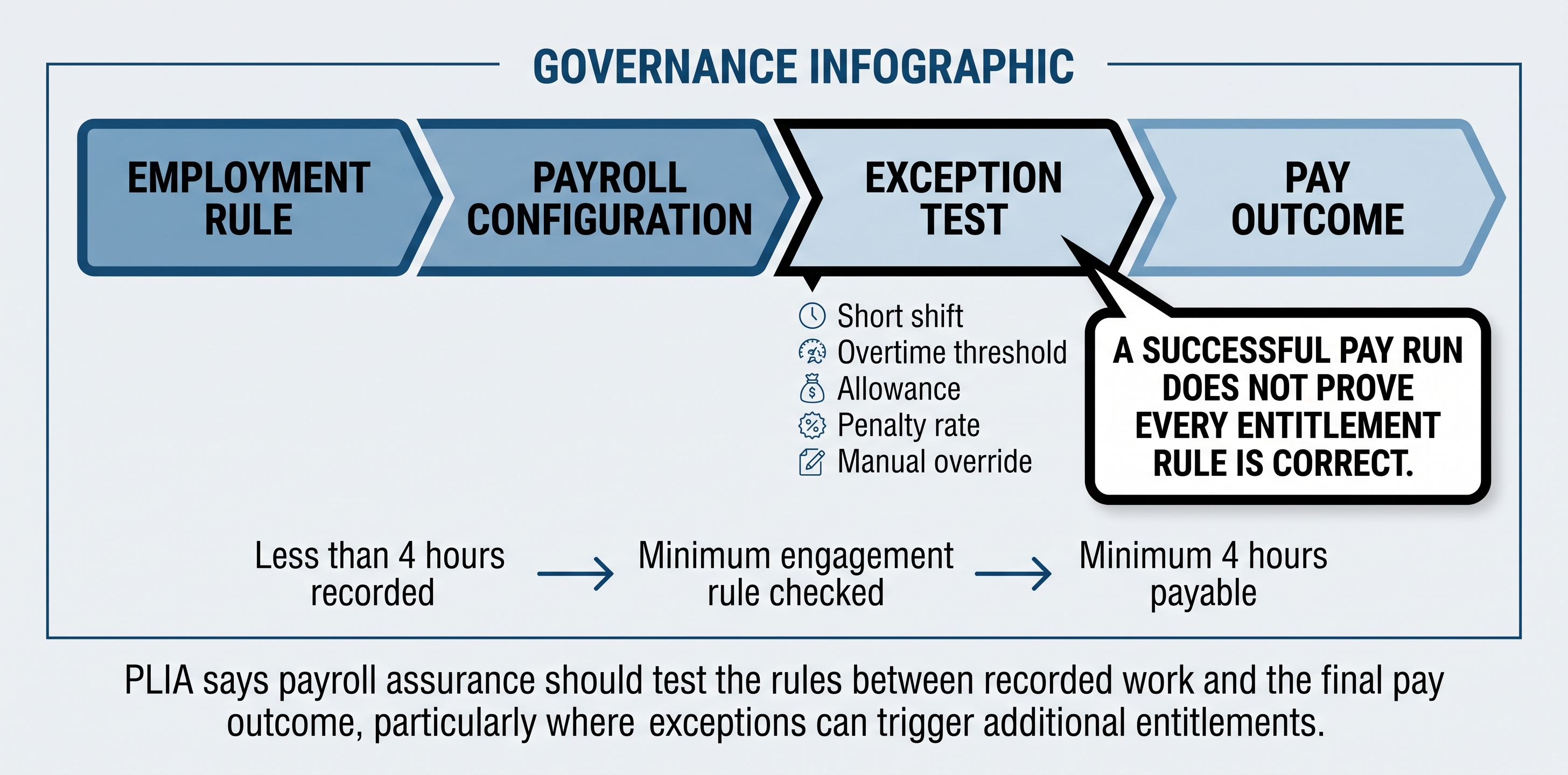
PLIA says payroll assurance should test the rules between recorded work and the final pay outcome, particularly where exceptions can trigger additional entitlements.
“Payroll compliance should not be treated as something completed when a payroll system goes live,” PLIA said. “Every significant change to employment conditions, workforce arrangements or payroll configuration creates another point where the underlying entitlement and the calculation can drift apart.”
PLIA said the lesson from the Federal Court disclosure is not that payroll failures are unavoidable. Rather, active assurance can identify issues that routine processing may not expose, allowing organisations to correct them before narrow configuration problems continue across future pay cycles.
The Institute has published a more detailed analysis of the Federal Court payroll underpayment and its implications for payroll governance. Australian payroll and business leaders can also access PLIA's broader payroll governance, compliance and professional development resources through the Payroll Leadership Institute of Australia website.
About us:
About Payroll Leadership Institute of Australia
The Payroll Leadership Institute of Australia (PLIA) is an independent Australian organisation focused on payroll education, professional development, payroll governance and workforce compliance. Headquartered in Brisbane, Queensland, PLIA supports payroll professionals across Australia through education, advocacy, industry commentary and resources. The Institute works to strengthen payroll standards, compliance capability and recognition of payroll as a critical organisational function.
Contact details:
The Payroll Leadership Institute of Australia (PLIA) is an independent Australian publisher supporting payroll professionals through education, professional development, industry commentary and resources focused on payroll practice, governance and compliance.