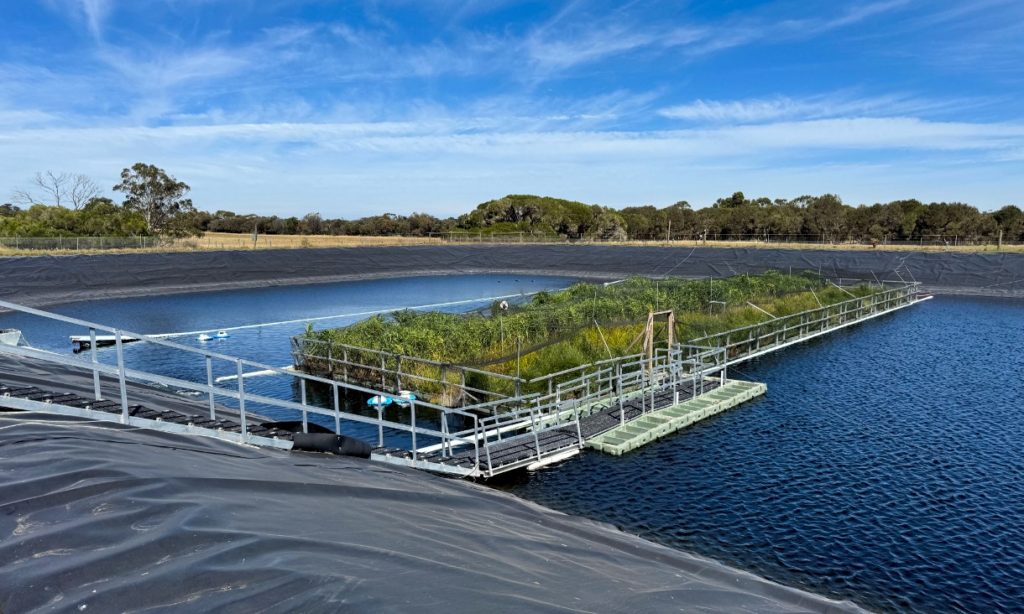
A world-first trial of floating wetland pods in wastewater lagoons shows they cut greenhouse gas emissions by more than a quarter, highlighting their potential as a nature-based solution for decarbonising the water sector.
Wastewater treatment causes around 1.6% of human-induced greenhouse gas emissions globally, but scalable mitigation options remain scarce.
A major two-year trial by RMIT University, Westernport Water and Australia’s national science agency CSIRO measured the impact of floating platforms of native plants on greenhouse gas emissions from a wastewater lagoon in Phillip Island, southeast Australia.
The results published in the Journal of Environmental Management reveal dramatic results, with CO₂ emissions dropping by up to 36%, methane by up to 66% and nitrogen by 18% in the lagoon with a floating wetland installed, compared to the control lagoon with no wetland platform.
Study first author at RMIT University, Dr Lukas Schuster, said floating wetlands are already used to reduce nutrient loads in some wastewater systems, but their potential to reduce greenhouse gas emissions at full operational scale was unknown, until now.
“This is the first time we’ve had evidence on this scale that supporting microbial communities in the root systems of wetland plants can reduce wastewater emissions without relying on high-tech solutions,” Schuster said.
“It’s a strong demonstration of how nature-based approaches can transform wastewater treatment into part of the climate solution.”
How it works
Wastewater treatment plants contribute millions of tonnes of greenhouse gas emissions annually, due to the high nutrient concentrations in wastewater creating ideal conditions for the microbes that produce these gases.
This poses a challenge to the water sector’s efforts to achieve emissions reductions.
In the floating wetland trial, a platform the size of one-and-a-half tennis courts (330m2) was filled with native reeds and sedges whose roots dangled in the water. Maintenance, including weed control and bird deterrents, helped the plants establish and thrive.
“These plant roots in the water create ideal habitats for microbes that consume nutrients and pollutants and potentially also greenhouse gases, with emission reductions becoming apparent after only four months into the trial,” Schuster said.
Emissions from the wastewater ponds with and without the floating wetland were continuously monitored over two years using ‘Pondi’, a solar-powered sensor developed by RMIT and partners including Leading Edge Engineering Solutions, Deakin University and The University of Queensland.
A practical solution to an industry challenge
Managing Director at Westernport Water, Dona Tantirimudalige, said the findings are encouraging for water corporations, because the floating wetlands can be retrofitted into existing lagoons, offering emissions reductions without major changes to existing infrastructure.
“The outcomes provide a strong foundation for further work to test performance across additional lagoon types and operating conditions,” Tantirimudalige said.
”Building this evidence base is important for utilities as we continue to develop credible and cost-effective emissions abatement pathways.”
This technology is currently being developed and applied by CSIRO through its nature-based solutions program.
CSIRO Research Scientist Dr John Awad said it was providing a practical and scalable approach to enhancing water quality while delivering broader environmental benefits.
“As well as mitigating greenhouse gas emissions, floating wetlands also help tackle contaminants, improving water quality before it’s discharged into downstream ecosystems,” he said.
Floating wetlands trial boosts Bass Coast farms
Building on the success of the Westernport Water project, RMIT researchers are now trialling floating wetlands in farm dams along the Bass Coast in southeastern Australia in partnership with Melbourne Water and Bass Coast Landcare Network.
That trial is investigating the impact of floating wetlands on water quality and biodiversity as well as emissions reductions.
If successful, floating wetlands could potentially be used to transform the health and productivity of Australia’s 1.8 million farm dams (video), and internationally.
Both the wastewater and farm dam trials are being led by RMIT’s Centre for Nature Positive Solutions.
‘Constructed floating wetlands cut greenhouse gas emissions from wastewater lagoons’ is published in Journal of Environmental Management (DOI: 10.1016/j.jenvman.2026.130663)
Contact details:
Michael Quin
0499 515 417