- Rock Posters, founded in 1986 by John D'Aquino, his brother Frank, and Joe Di Natale, is celebrating its 40th anniversary in 2026, having spent four decades printing and installing street posters that have defined Melbourne's cultural landscape.
- The company's Thornbury factory houses a vast archive of tens of thousands of posters featuring iconic artists including Cold Chisel, Midnight Oil, Kylie Minogue, the Rolling Stones, and Nick Cave, forming a physical timeline of Melbourne's music and cultural history.
- Originally producing hand screen-printed posters — a labour-intensive process that encouraged bold, striking design — Rock Posters now combines traditional screen-printing with digital and offset production, capable of producing approximately 10,000 posters per week.
- While music once accounted for around 95 per cent of its work, Rock Posters now serves a broad range of clients across arts, festivals, theatre, film, sport, government, and major brands, though music remains central to the company's identity.
- As it marks its anniversary, Rock Posters is exploring how its culturally significant archive can be catalogued, preserved, and shared more widely, whilst continuing to support Melbourne's creative community for the next 40 years.
From Cold Chisel and Midnight Oil to Kylie Minogue, the Rolling Stones and generations of emerging artists, Rock Posters has spent 40 years putting Melbourne’s cultural life on the street.
Behind an unassuming factory facade in Thornbury sits one of Australia’s great living archives of music, art and popular culture.
Rock Posters is celebrating its 40th anniversary in 2026, marking four decades of printing and installing the street posters that have announced Melbourne’s concerts, festivals, exhibitions, films, theatre productions, political campaigns and defining cultural moments.
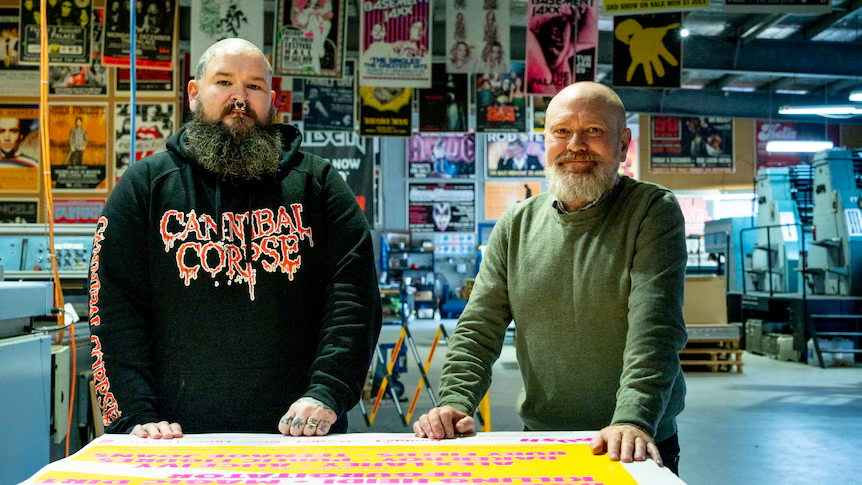
Inside the factory, Kylie Minogue hangs alongside the Rolling Stones. Posters for Nick Cave and the Bad Seeds, Midnight Oil, AC/DC, Kiss, the Sex Pistols, Cold Chisel, Foo Fighters, Oasis and countless emerging artists fill the walls and are stacked throughout an archive containing tens of thousands of works.
Together, they form a physical timeline of the soundtrack to Melbourne’s life.
The late Michael Gudinski, one of Rock Posters’ earliest and most steadfast supporters, captured the relationship between music and visual culture when he said:
“Music without the art is like the rock without the roll.”
Gudinski and Rock Posters founder John D’Aquino worked closely together over decades, finding increasingly creative ways to use the street poster as both advertising and art. D’Aquino had worked at Gudinski’s Premier Artists before establishing Rock Posters with his brother Frank D’Aquino and Joe Di Natale in 1986. Their first posters were produced from a Victorian-era shopfront on Johnston Street in Fitzroy.
Rock Posters General Manager Marcus Seal said the relationship between D’Aquino and Gudinski helped create something distinctly Melbourne.
“John and Michael understood that the poster was not simply an advertisement. It was part of the experience, part of the anticipation and part of the memory of seeing an artist live. They helped establish a street poster culture that is more visible and prolific in Melbourne than almost anywhere else in the world.”
A history told through ink and paper
For much of its early history, almost every Rock Posters job was screen-printed by hand. Producing 100 posters could take half a day, with every additional colour adding time and cost.
Those limitations encouraged boldness and collaboration. Artists and musicians regularly came into the factory to work directly with the printers and designers. Posters were often built around two or three striking colours, creating images designed to be understood in the few seconds available as a tram, car or pedestrian passed them.
The results remain vivid decades later.
Midnight Oil’s famous yellow hand is still almost as bright as the day it was printed. A fluorescent Sex Pistols poster continues to blaze in pink and yellow. A 1994 Nick Cave and the Bad Seeds poster reduces the singer’s face to dark hair and eyes against a wash of pink. Screen-printed ink can be many times thicker than its modern digital equivalent, giving the works a texture and intensity immediately recognisable to the factory’s printers and designers.
Rock Posters Art Director Luke Stewart said the principles of an effective street poster had remained remarkably consistent.
“People might only have a couple of seconds to see it, so it needs to be bold, clear and artistic enough to catch their attention. The technology has changed, but the job of the poster is still the same: make someone look, make them curious and make them want to be there.”
From hand printing to 10,000 posters a week
The Thornbury factory now combines its traditional screen-printing heritage with large-scale digital and offset production.
Modern equipment enables Rock Posters to produce approximately 10,000 standard posters in a week, while enormous screen-printing presses and a rare industrial offset printer remain on the factory floor. The printing operation has attracted devotees
including Dave Grohl, who asked for the production process to be documented for a Foo Fighters album campaign.
The business has also evolved beyond its original concentration on live music. Where music once represented around 95 per cent of its work, Rock Posters now delivers campaigns across arts and culture, festivals, theatre, film, sport, government, education, community causes and major brands.
But music remains at the heart of the archive and the company’s identity.
Among the collection is the famous poster for Cold Chisel’s Last Stand tour, featuring Jimmy Barnes apparently soaked in sweat and holding a bottle on stage. The image, Marcus Seal says, may not be quite what it appears: the photograph was reportedly staged early in the morning, with water thrown over Barnes to create the appearance of a performance.
The tour itself also proved not to be Cold Chisel’s last stand.
“Every poster has a story behind it,” Seal said. “They bring back memories of seeing a show, hearing an album for the first time or discovering an artist before anyone else knew who they were. They capture not only the event, but the work, ambition and creativity that went into making it happen.”
Unskippable, unblockable and unmissable
Despite the growth of social media, digital advertising and influencers, Rock Posters continues to offer something a screen cannot: a physical presence within the life of the city.
Artists still stop in front of their billboards to photograph themselves. Posters become landmarks, meeting places and part of the streetscape. They introduce people to events they were not searching for and artists they did not yet know.
“An artist does not usually take a photograph of their digital advertisement to send to their mum,” Seal said. “But they will stand in front of a street poster or billboard with their name on it. It feels real. It says that they have arrived.”
The next 40 years
Rock Posters’ anniversary is an opportunity to celebrate an independent Melbourne business, but also to recognise the cultural value of the archive it has created.
The company is now considering how the collection can be catalogued, preserved and shared more widely, while continuing to develop new partnerships with artists, festivals, venues and cultural institutions.
“The posters were created to be temporary,” Seal said. “They were printed, pasted onto a wall and eventually covered by the next campaign. But taken together, they have become an extraordinary cultural record.
“This anniversary is about recognising everything John, Frank and the Rock Posters team have built, while ensuring the business continues to support Melbourne’s creative life for the next 40 years.”
About us:
Established in Melbourne in 1986, Rock Posters is a specialist street poster, outdoor media and printing company based in Thornbury in Victoria and Marrickville in Sydney.
For 40 years, Rock Posters has worked with artists, promoters, festivals, venues, cultural institutions, community organisations, government and major brands to create highly visible campaigns across Melbourne.
Its archive of tens of thousands of posters provides a unique record of Australian music, arts, entertainment and public life.
Unskippable. Unblockable. Unmissable.
Contact details:
Interviews and factory access are available with:
John D’Aquino, Founder
Marcus Seal, General Manager
Luke Stewart, Art Director
Media enquiries:
Guy Ross – 0416095031 – [email protected]