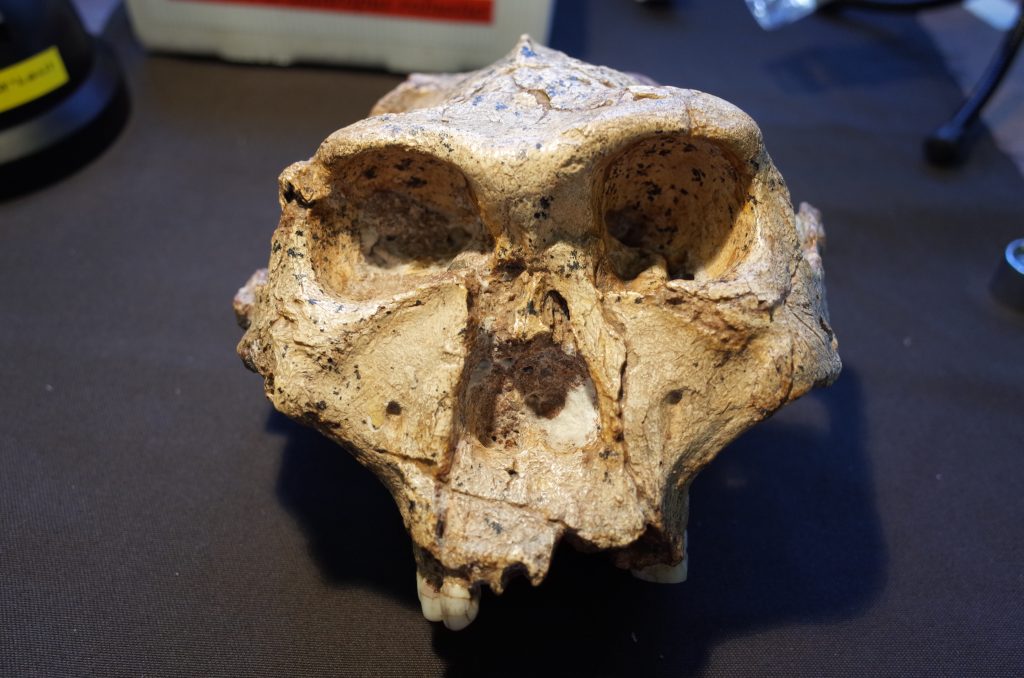

Recent advances in our understanding of human evolution challenge the way we currently name and classify our ancestors, according to new research from Monash University.
The research, published in the American Journal of Biological Anthropology, argues that we need a rethink, and proposes reclassifying all species of humans and our closely related fossil relatives that have lived in the past 4-5 million years as part of the Homo genus.
Human evolution is often presented as a straightforward progression through distinct species, from ape-like ancestors, through Australopithecus and earlier members of Homo, culminating in Homo Sapiens that live today.
But the fossil record tells a much more complex story, with new discoveries repeatedly blurring the characteristics once thought to define us and our close relatives.
Lead researcher Dr Ian Towle, a Research Fellow at the Monash Biomedicine Discovery Institute, said recent discoveries are eroding the usefulness and accuracy of current classification, including the current species in our own genus Homo, but also in Australopithecus and Paranthropus, who all lived within the past 5 million years.
“Recent fossil discoveries and advances in evolutionary and genetic analysis make this an ideal time to reconsider whether our traditional taxonomy still accurately reflects human evolution,” Dr Towle said.
“These groups do not necessarily represent distinct evolutionary branches, or ‘clades’, and differences in behaviour and ecology once used to distinguish them have also become increasingly difficult to maintain.
“I propose expanding Homo to include these other groups to provide a more accurate and stable way to represent the complex evolutionary relationships revealed by the growing fossil record.”
In the past 50 years, a growing understanding of evolution has transformed how scientists classify the natural world.
Modern taxonomy, the science of naming and classifying organisms, increasingly aims to reflect genuine evolutionary relationships, grouping species according to their shared ancestry.
But when it comes to our own evolutionary history, scientists have been slower to make the transition.
Recent decades have seen a trend to represent a genuine evolutionary group, or clade, of a common ancestor and all of its descendants.
The Homo group have historically been defined by having large brains, sophisticated tool use and particular aspects of anatomy and behaviour.
But there are now very small-brained members of our genus, and complex behaviours were likely in Paranthropus and Australopithecus.
Dr Towle argues reclassifying Australopithecus and Paranthropus species under the category of Homo will provide a more coherent understanding of our evolutionary history and avoid continual redefinition as we discover new fossils and learn more about our ancestors.
“The more we learn about our ancestors and close fossil relatives, the more we realise how complex and non-linear our family tree is,” Dr Towle said.
“Expanding the Homo genus to also include species of Australopithecus and Paranthropus will allow us to account for differences without regularly reclassifying particular groups.”
Read the research paper: https://doi.org/10.1002/ajpa.70344
ASSETS AVAILABLE
MEDIA ENQUIRIES
Toni Brient
Media and Communications Manager
P: +61 423 964 191
E: [email protected]
GENERAL MEDIA ENQUIRIES
Monash Media
P: +61 3 9903 4840
E: [email protected]
For more Monash media stories, visit our news and events site