Rural and regional communities are on the front lines of climate change. They are particularly vulnerable to the worsening drought, bushfires, heatwaves and floods driven by rising temperatures only set to intensify as the burning of coal, oil and gas continues to heat our planet. Recent polling shows some 32% of regional Australians are more concerned about climate change than they were a year ago.
Rapidly phasing out fossil fuels and switching to clean energy is one of the fastest ways to cut climate pollution and protect our communities, environment and economy. This shift also presents opportunities for farmers and rural communities. Farmers hosting wind and solar projects can diversify their income and earn tens of thousands of dollars a year, while regional communities benefit from new jobs, community benefit funds, and investment flowing into local businesses and infrastructure.
RENEWABLES AND AGRICULTURE - THE FACTS
-
There is majority support for renewable power in regional communities and the broader Australian population
Polling consistently shows that most Australians support the shift to clean energy – including people living near renewable energy zones (REZs). A 2026 survey of nearly 2,000 REZ residents across NSW, QLD and Victoria found 63% support the shift to clean energy, while just 17% oppose.
-
Renewables can happily coexist with agriculture and boost farm business resilience
Renewables give farmers an opportunity to diversify their incomes, which is becoming increasingly valuable as climate change fuels more frequent, intense extreme weather. Payments to landholders hosting infrastructure are made regardless of how much electricity is generated, providing a reliable income stream through drought, poor harvests, or downturns in commodity prices. Typical payments to farmers are around $40,000 per wind turbine per year, and around $1,500 per hectare per year for solar – comparable to a beef farmer's income per hectare in a good year.
-
We can protect our agricultural production and biodiversity while delivering clean, affordable energy
Importantly, renewable power projects can happily coexist with farming: transmission lines and wind turbines have been sharing paddocks with cows and sheep on Australian farms for decades, while well-designed solar can even improve farm productivity and biodiversity. For example, the New England Solar Farm in NSW was carefully designed to successfully integrate more than 6,500 sheep. The panels provide shade for the sheep in the heat, and protect them from frost in the winter. They also help to retain moisture and encourage growth of the grass beneath, providing plenty of food for the resident lawn mowers.
At the same time, analysis by the University of Melbourne and the Australian Conservation Foundation has confirmed that there are plenty of already cleared areas with strong sun and wind resources – we can build enough clean energy to power Australia without impacting biodiversity.
-
Renewables do not increase fire risk or hinder firefighting
Fires at renewable energy facilities are rare, and strict safety guidelines already apply across wind, solar and battery projects in Australia. Modern renewable generation and storage projects are built with detection systems, fire suppression technology, and clear emergency protocols developed with fire authorities.
Fire authorities have found wind farms are not expected to increase fire risk or affect fire behaviour. Large-scale battery fires are similarly rare – only two have occurred at Australian battery storage facilities to date – and the global failure rate for battery storage systems has dropped 98% since 2018 as safety design has improved.
-
Supplying all of Australia’s domestic energy needs with renewables would use just 0.02% of our land mass
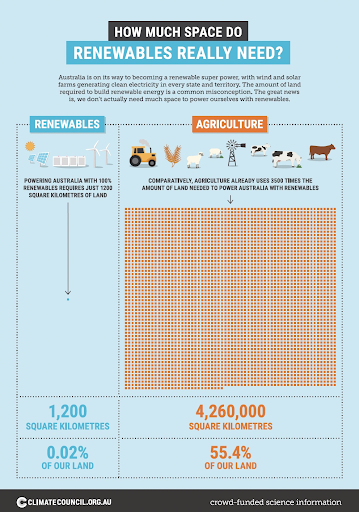
Renewables use far less land than most people realise: we will need just 1,200 square kilometres of land to provide all Australia’s energy needs – equivalent to just 0.02% of Australia’s landmass. For comparison, agriculture already uses 57% of Australia's land mass, while national mapping reveals that 37.3% of Australia is covered by coal and gas licences and applications. That amounts to 285 million hectares – a larger area than the whole of Western Australia.
-
Transmission is the backbone of the shift to clean energy - and most people in regional communities support it
The buildout of new transmission across Australia is a crucial piece to replacing unreliable, ageing and failing coal power. Any delay to the rollout of new transmission causes every Australian to pay more than they need to on their power bills by prolonging our reliance on coal and gas. And, surveys show that around three quarters of people in regional cities and rural towns would be OK with living near transmission lines.
Importantly, the Australian Government has developed national guidelines for engaging with communities and sharing benefits of transmission projects, including avoiding and reducing environmental impacts. State governments offer payments to landholders – often farmers – for hosting transmission lines in recognition of the critical role they play in the transition.
-
The shift to renewables is creating new employment opportunities in regional communities
The switch to renewable power is creating more jobs and employment opportunities, particularly for people in regional Australia. We will need an energy workforce of around more than 60,000 by 2030, more than double the size of the workforce in 2024, to build new infrastructure, and maintain and operate our clean energy system. Many renewable projects have initiatives to train and employ local residents, and they also support regional economies by sourcing goods and services from local suppliers.
CMC TALENT LIST: RENEWABLES AND AGRICULTURE
For interviews please contact the Climate Media Centre on 0493 442 307 or [email protected]
Karin Stark - Narromine, NSW based Consultant, mixed cropping farmer
Karin's passion lies at the intersection of agriculture and energy, where she empowers rural communities and farmers to navigate the evolving energy landscape. She founded the National Renewables in Agriculture Conference and Expo in 2019, to help farmers take advantage of the benefits renewables provide. Karin has an interest in driving innovation in agrivoltaics, floating solar, battery storage and hydrogen in the farming world.
Peter Holding - Harden, NSW based farmer and member of Farmers for Climate Action
Peter is a third-generation farmer and works on his family property in Harden, south east New South Wales. As well as growing crops, such as canola and wheat, Peter runs sheep for wool and lambs. Has solar and a battery powering his workshop.
Maggie Jarrett - Vigneron based in Orange, NSW
Sustainability manager at the family business See Saw Wines which is a certified organic, integrated wine business located just outside of Orange. Alongside the vineyards they have solar panels and they run Dorper lambs through the system to support mid-row management and keep their non-vineyard paddocks healthy.
Peter Coy - Merino and mixed cropping farmer in Victoria’s Western District
In addition to his agricultural pursuits, Peter hosts a Grampians sandstone quarry and a 13-turbine, 54-megawatt wind farm on the property. These enterprises have been operating for approximately eight years and have proven to be valuable assets, providing income streams that are not dependent on rainfall or fluctuating agricultural commodity prices. Peter and his family also take great pride in a scholarship they established to support country students attending university. The scholarship is matched dollar-for-dollar by the wind farm company and now provides $37,000 annually to assist regional students in pursuing higher education.
Nick Cameron - Chair of the Board and CEO, Melythina Tiakana Warrana Aboriginal Corporation
Nick has worked closely with Musselroe Windfarm in northern Tasmania which has collaborated with the local community to create a visitors/education centre, Ranger program and provided land access for the Tebrakunna people with a long-term vision of the freehold title being returned to them.
Contact details:
For interviews please contact Gabrielle Platt, Media Advisor at the Climate Media Centre on 0493 442 307 or [email protected]