
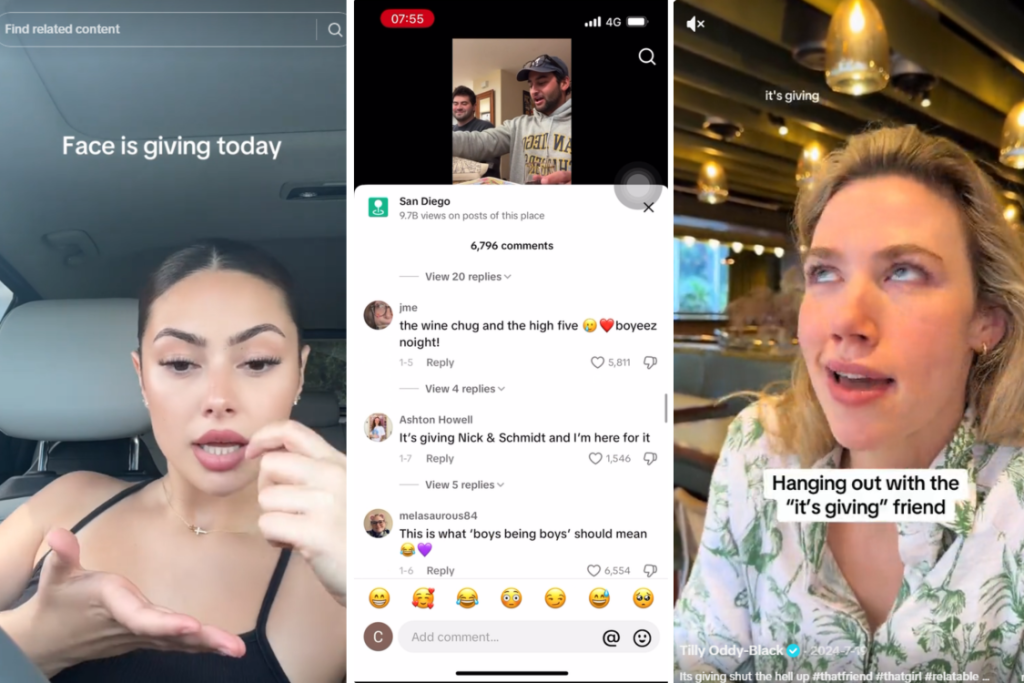
Give, eat, cook and serve are everyday English words. On TikTok, they’re doing something different.
In its usual sense, “give” means transferring something from one person to another - a present, some advice or a piece of information. But on TikTok, “it’s giving” has become a way to describe the feeling, impression or energy something creates.
A person wearing a green top and brown pants might be “giving tree”, a confident person could be “giving main character” or an outfit might be “giving Regency era”. In each case, the phrase means something like “it resembles”, “it evokes” or “it has the feel of” – but without saying any of those things directly.
UNSW Sydney researcher Cathy Xu from the School of Humanities & Languages says this is more than a passing internet catchphrase. It is an example of English changing in real time.
“TikTok is accelerating language change because it used to take decades for new phrases and expressions to move into everyday use, but now you can see it happen in a couple of years,” she says.
The beginning of ‘it’s giving’
Xu is researching how TikTok users play with language and how new forms spread through the platform. Her study of “it’s giving” shows users developing new ways to structure sentences and new meanings for familiar words.
“It has its own very sophisticated kind of syntactic structure,” she says. “It didn’t come out of nowhere. It has a natural derivation from an existing form.”
The phrase probably developed from expressions such as “giving off a certain vibe”. Over time, users dropped “off” and then “vibe”, leaving the shorter form: “it’s giving”.
The result is a new use of the verb “give”. In standard English, “give” often relates to a tangible object – as in “she gave him a present” – or describe delivering something, as in “she gave a speech”.
On TikTok, “give” can be followed by an adjectival phrase (which is often disguised as a noun phrase) or an independent clause, explains Xu:
- “It’s giving Nick and Schmidt.”
- “She’s giving equestrian.”
- “This is giving enlightened.”
- “It’s giving someone’s been hitting the gym.”
The phrase can also appear as “it gives”, “definitely giving” or simply “giving”. It can mean that something resembles or evokes something else, but it can also work as a kind of conversational marker.
Beyond TikTok
People now use “it’s giving” beyond TikTok, including in podcasts, comedy and television.
“And, in fact, the phrase is now used in everyday conversation, especially among younger people,” she says.
The spread of the expression is partly connected to the way TikTok serves up content to its 1.59 billion monthly users. Videos can reach large audiences within hours, due to the platform’s algorithm and default For You Page which automatically plays videos without a user having to select anything.
“A video can go viral overnight, and language can be picked up by other users in their content quickly. Then suddenly this word is all everybody can be talking about,” says Xu.
TikTok also gives users space to test and refine new expressions.
“They may never learn formal rules for “it’s giving”, but many users recognise when it sounds right – and when it does not,” says Xu.
Xu found TikTok users correcting others when the phrase was used incorrectly. One person complained that a reality television program had overused “it’s giving”, while others pointed out that the expression works best when it creates an analogy rather than simply describing what is happening.
Their shared understanding points to an intuitive grammar developing around the expression.
“There’s no explicit grammar rules or rule book on this new variety of English on TikTok,” Xu says. “But everybody just knows what’s right, what’s wrong, how you should use it.”
TikTok and new cooking lingo
TikTok users are also transforming the meanings of words associated with food and cooking.
To “eat” or “ate” no longer necessarily refers to consuming food. It can mean that someone has done something particularly well. If someone “ate”, they succeeded or impressed.
“Cook” has a similar double meaning. In its active form – “you cook” or “you cooked” – it can mean that someone has done something well.
But “you’re cooked” means something very different: you are finished, ruined or in serious trouble.
“Serving” can also express praise. Someone might be “serving” a particular look or attitude when they appear confident, stylish or impressive.
Even “tea” has expanded beyond its familiar meaning as a drink or gossip. Xu says it can also be used to describe an attractive physique or body.
These expressions illustrate what Xu calls language play: users take familiar words and move them into new contexts, creating meanings that other users learn to recognise.
How TikTok is changing language in real time
Xu’s research looks at how TikTok users play with sounds, words, sentence structure and meaning. “It’s giving” shows how users reshape grammar and meaning (specifically syntax and semantics), while food-related expressions show how familiar words can take on new meanings.
Xu says TikTok’s language is not random or evidence that English is deteriorating. Instead, users are actively experimenting with the language and developing conventions that then spread rapidly through the platform.
The speed of that process means language change can now be observed almost as it happens.
For Xu, the question is not whether these expressions are “correct” according to prescriptive rules of English. It is how they are being used, how their meanings develop and whether they move beyond TikTok into everyday speech.
“'It’s giving' may eventually fade, change again or become established in a broader variety of English. But for now, it offers a glimpse of a language system being built collectively – one video, comment and conversation at a time," says Xu.
Contact details:
For enquiries about this story and interview requests please contact Samantha Dunn
Phone: 0414 924 364
Email: [email protected]