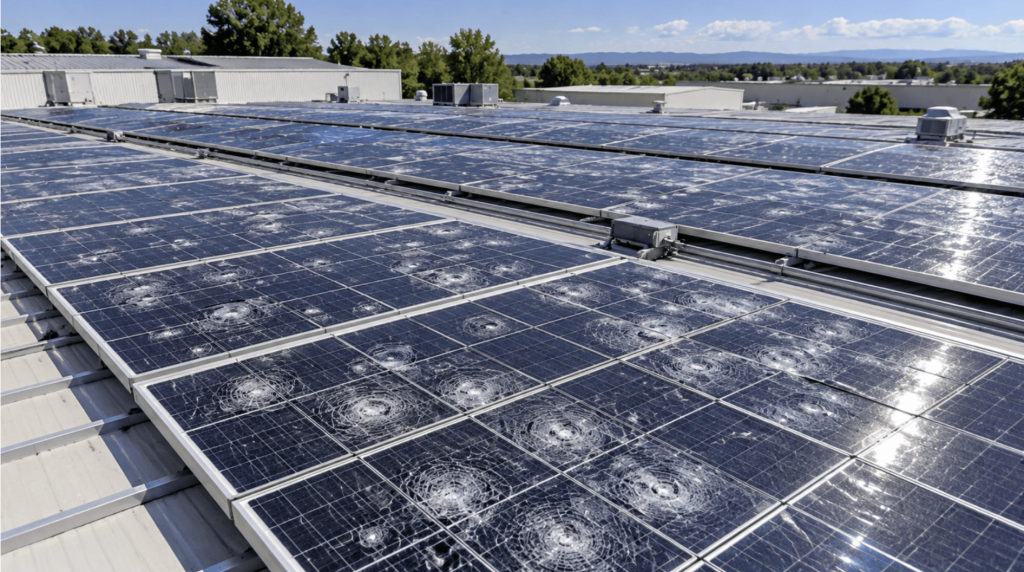
- Severe hailstorms in Italy's Marche region caused highly localised damage to photovoltaic systems in July 2026, illustrating that partial damage to solar plants presents a distinct recovery challenge distinct from full repowering scenarios.
- When only part of an array is damaged, replacement modules must remain compatible with existing electrical parameters, dimensions, frame design and mounting-hole positions, meaning newer high-power modules are not always the most suitable option.
- The decision between targeted replacement and wider repowering depends on factors including damage concentration, remaining asset life, system compatibility, downtime, procurement requirements and project economics.
- GBP K.K. develops custom replacement panels matched to legacy module specifications, enabling damaged sections to be restored without structural modification or electrical redesign; in one French case, 300 custom 260 W panels replaced a discontinued model without any structural changes.
- GBP maintains a database of more than 800 legacy module types from over 80 manufacturers, supporting asset owners, EPCs and O&M teams in identifying or developing compatible replacements for damaged or discontinued modules.
Compatible replacement modules can help operating solar plants restore damaged sections without unnecessary redesign or full repowering.
GBP K.K. has highlighted the importance of replacement compatibility when operating solar plants experience partial damage from severe weather, following recent hail damage reported across Italy’s Marche region.
In July 2026, a severe hailstorm affected photovoltaic systems along the Adriatic coast. The impact, however, was highly localised. One operator reported that, among approximately 200 systems under management, only one was damaged, with estimated losses of around €80,000 to €90,000. In another area near Monteroberto, two systems were severely affected while another installation only a few hundred metres away remained untouched.
The event illustrates a challenge that can arise after severe weather: damage does not always affect an entire solar plant equally. One section may require immediate replacement, another may need further inspection, while much of the remaining system can still retain significant operational value.
For asset owners and O&M teams, the recovery question is therefore not simply how much equipment has been damaged, but how much of the existing plant actually needs to be replaced.
Partial Damage Can Become a Compatibility Challenge
Once damaged modules have been identified, procurement can become the next constraint, particularly for older operating plants.
Original modules may no longer be available, while current-generation products can differ substantially from those already installed. Replacement modules may need to remain compatible with existing electrical parameters, including Voc, Vmp, Isc and Imp, as well as module dimensions, frame design, mounting-hole positions and the wider DC system configuration.
This means that simply selecting a newer module with a higher power rating is not necessarily the most suitable recovery option.
Where damage is concentrated in only part of an array, the priority may instead be to restore the affected section while avoiding unnecessary changes to the electrical and mechanical design of the wider system. Compatibility becomes particularly important when the commercial objective is recovery rather than a full technology upgrade.
The decision between targeted replacement and wider repowering also depends on several factors.
Damage concentration, remaining asset life, system compatibility, downtime, procurement requirements, project economics and insurance scope can all influence the recovery strategy. Wider repowering may make sense where damage is extensive, where existing equipment is approaching the end of its economic life, or where new technology can provide a meaningful improvement in project output or economics.
However, the opposite may also be true. Where damage is limited to only part of the plant, the remaining modules, inverters, mounting structures and balance-of-system equipment may still have substantial useful life.
In such cases, replacing more equipment than necessary can introduce additional capital expenditure, downtime and engineering work. The recovery scope should therefore reflect the actual condition and remaining value of the plant.
Restoring What Still Has Value
Access to compatible replacement modules can materially change the recovery options available to operators of legacy solar assets.
Without a suitable replacement, an asset owner may otherwise face structural modifications, electrical redesign or broader repowering simply because the original module is no longer available.
GBP develops replacement panels for this type of requirement, matching existing module specifications rather than requiring the wider plant to adapt to a current standard module format.
In France, GBP supplied 300 custom-manufactured 260 W replacement panels for an operating solar plant where the original module had been discontinued. The replacement panels were matched to the original dimensions, electrical specifications and mounting-hole positions, enabling the plant to be restored without structural modification.
GBP maintains a database covering more than 800 legacy module types from over 80 manufacturers, while GBP Direct provides access to more than 400 legacy models for international customers.
For partially damaged plants, the objective is not necessarily to rebuild the system around the newest module available. Where the existing asset remains technically and commercially viable, the more appropriate approach may be to preserve that value by replacing only the equipment that can no longer remain in service.
For solar asset owners, EPCs and O&M teams dealing with damaged or discontinued modules, GBP can support the identification or development of replacement panels matched to the electrical and mechanical requirements of the existing system.
About us:
Based in Japan, GBP K.K. offers end-to-end renewable energy solutions — from solar component manufacturing and system design to construction and O&M. Feel free to reach out to us for anything renewable energy related!