17 September 2026
New report reveals the hidden cash in your trash
A new report released today reveals that up to $330m could be unlocked from the nation’s garbage each year with simple changes to Australia's recycling system.
The report found that aligning the nation’s patchwork of kerbside recycling and packaging design to the needs of the manufacturing sector would generate a consistent stream of higher quality recycled material for use in the nation’s factories and export markets, saving cost and stimulating up to $2.6 billion investment each year.
Economist Stephen Koukoulas, who did the economic analysis for the Soft Plastic Stewardship Australia Efficiency, productivity and resilience: Further integrating recycling into the broader manufacturing supply chains report, said that recycling was not just good for the environment, but the economy too.
“The report makes it clear that the cost of doing nothing is not zero,” Mr Koukoulas said.
“There’s a real opportunity to drive extensive productivity gains through a unified, synchronised approach to both packaging design and recycling, aimed at delivering higher volumes of recyclable materials for manufacturers.
“Better recycling means better remanufacturing, opening up investment, jobs and profitability and strengthening Australia’s sovereign capability.”
The report also found that making it mandatory for business to pay to manage waste from key products like bedding, clothing, batteries and soft plastic would unlock the funding needed to boost collection and processing beyond current niche programs.
Mr Koukoulas said that despite all efforts, voluntary schemes for these products had not driven the change needed.
“The surprising outcome of the analysis was that its recommendations would increase household costs by just 9 cents a week, compared to productivity gains of between 28 and 55 cents per household.”
The report comes as the federal government cited cost of living pressures as the main reason for pulling back from plans to introduce reform that business, recyclers and environmental groups alike hoped would standardise packaging, recycling and remanufacture.
Independent Member for Curtin Kate Chaney MP said the report shows the patchwork of different rules in every state and council is the cost of living problem.
"Walking away from reform isn't a saving,” Ms Chaney said.
"Sophie Scamps MP and I set out a plan for this. Our joint policy ‘The Plastic Problem’ shows the Government doesn't need new legislation. The power is already in the existing legislation. The Minister just has to use it. Environment ministers meet on Friday, and that's the moment for the Government to reverse its decision."
Independent Member for Mackellar Dr Sophie Scamps MP said that the report makes the case for action crystal clear.
“Policies that deliver higher productivity, lower costs, more products made in Australia and greater supply-chain resilience should be an easy yes. The Government should seize this opportunity rather than delay again,” Dr Scamps said.
“Voluntary action has not delivered the scale or certainty Australia needs. A nationally consistent, mandatory scheme would reward responsible businesses, prevent free riders and give recyclers and manufacturers the confidence to invest.”
"In the current climate of oil price volatility, plastic will become increasingly valuable. It is essential that Australia maintains capacity to recycle and manufacture plastic products to cushion against potential supply chain shocks."
SPSA CEO Barry Cosier said that the move was disappointing given the investment in recycling that was now at risk Australians’ confusion over the nation’s fragmented bin system.
“People see different coloured bins and different rules at home, at work, on the go, and between their local council and other councils,” Mr Cosier said.
“We know Australians appreciate recycling, as they see it as a simple step they can take for the environment, but it shouldn’t be this hard.
“At the same time, we know many are glad to have soft plastic recycling back – but tell us they want collection to be more accessible. We want to deliver that, but until it’s mandatory for businesses to participate, our hands are tied.
“These changes – which would be welcomed by consumers, brands, recyclers, and environmental groups alike – are good for the economy, good for the environment and good for the community.”
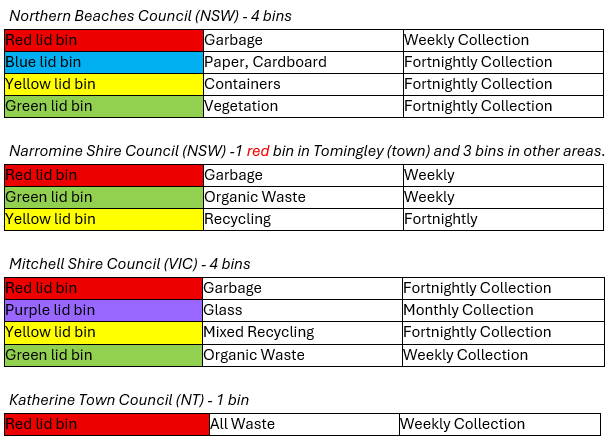
Australia’s confusing bins: different colours, different contents, different communication
Without national standards, Australia’s 537 councils are left to determine their own recycling. Here’s just a few examples.
Report highlights
-
Australia’s packaging, food and grocery, retail and recycling supply chain is worth $644 billion, yet recycling remains governed by fragmented and inconsistent rules across states, territories and councils.
-
National alignment of packaging design, labelling, kerbside collection and recycling standards could deliver $115 million to $277 million in net annual productivity gains.
-
The reforms could stimulate $1.6 billion to $2.6 billion in capital investment per year, strengthening domestic manufacturing and sovereign capability.
-
Soft plastics represent Australia’s largest recycling market failure, with 94% landfilled, equating to an estimated $900 million in lost material value and $154 million in landfill costs annually.
-
35.5% of recyclable packaging is not currently recovered, reducing economies of scale and increasing avoidable costs across the recycling and manufacturing sectors.
-
Community confusion is a major economic issue: 32% of Australians don’t trust recycling, 25% find it confusing, and inconsistent rules across Australia’s 537 councils directly reduce recycling yields and increase contamination.
-
But public appetite for reform is strong: 83% want nationally consistent recycling rules, 94% would use a new soft plastics scheme, and 87% want a national solution prioritised.
-
Modelling indicates fragmented regulation adds avoidable administrative costs, including $25–$47 annually for duplicated council education programs and $9–$11 million for duplicated container deposit scheme reporting.
-
Underutilisation of existing recycling infrastructure due to inconsistent volumes is costing Australia $30–$89 million per year in lost efficiency.
-
Landfill costs can be reduced by $78–$146 million annually with improved recycling, representing direct cost‑of‑living relief for households and councils.
-
Producer‑funded stewardship for priority problematic materials (soft plastics, batteries, mattresses, textiles) would cost $55.4 million per year, a fraction of the productivity gains unlocked by national alignment.
Contact details:
For interviews: Bonnie Marshall
0435 790 925
[email protected]
For the full report: Margaret Stuart
0407 411 174
[email protected]