What the Beckham family headlines can teach us about family estrangement, one of the most talked about issues of the moment
As headlines continue to swirl around Brooklyn Beckham's reported estrangement from his famous family, it's tempting to dismiss the story as just another celebrity fallout, but beneath the public fascination lies a reality affecting thousands of Australian families.
Family estrangement – where parents and adult children have little or no contact – has become one of the most talked-about relationship issues of the past decade, driven by changing attitudes around mental health, personal boundaries and emotional wellbeing.
According to relationship experts at Interrelate, while the conversation is becoming more visible, the reality is rarely as simple as the headlines suggest. Interrelate’s Glen O'Hara, Senior Counsellor & Clinical Lead, said celebrity stories often encourage people to see family conflict as a matter of choosing sides, when the truth is almost always far more complicated. "It’s never a clear heroes and villains situation, family relationships rarely work that way," Mr Davy said. "When someone reaches the point of cutting off contact with a parent or child, it's usually the result of significant hurt that has developed over many years. These situations are deeply personal and incredibly complex."
While conversations about "going no contact" have become increasingly common across social media, Mr O’Hara said online advice can sometimes oversimplify difficult family dynamics.
"Platforms like TikTok and Instagram have opened important conversations around mental health and boundaries, but they can also encourage very black-and-white thinking. We've moved from seeking guidance from professionals and evidence-based information to increasingly looking for answers in opinion-driven online spaces."
Interrelate has worked with Australian families for 100 years and, over that time, has witnessed extraordinary changes in the way people build, maintain and navigate relationships. From post-war households and traditional family structures to dual-income families, blended families, same-sex relationships, long-distance love and today's digital-age intimacy, the shape of Australian families has evolved dramatically.
"So much has changed over the past century," Mr O’Hara said. "We're talking more openly about mental health. We have a much greater understanding of emotional wellbeing. We're encouraging people to establish healthy boundaries and recognise unhealthy relationship patterns. Those are all incredibly positive changes."
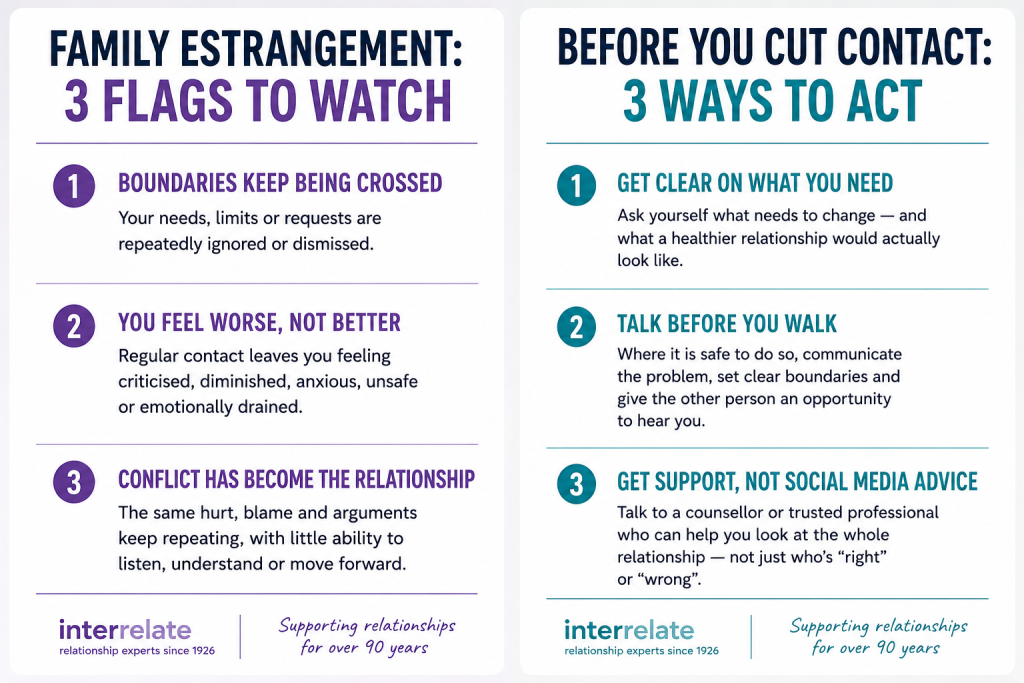
However, he cautioned that not every difficult relationship should automatically end in estrangement. "Every family experiences conflict. Every relationship has challenges. The important question isn't whether conflict exists. It's whether the relationship has become harmful, whether attempts have been made to repair it, and whether there remains something meaningful that can be rebuilt. Sometimes what people need first is space to reflect, honest conversations about what they're experiencing, and support to understand what's happening beneath the conflict."
He encouraged both parents and adult children to move beyond blame and towards curiosity. "If you're the parent, ask yourself what your son or daughter may have experienced that brought them to this point. If you're the adult child, ask yourself what you're truly hoping for from the relationship and whether those needs have been clearly communicated."
"Understanding another person's experience doesn't mean dismissing your own. It simply creates the possibility for conversations that blame alone can never achieve."
As celebrity family disputes continue to dominate headlines, Interrelate hopes Australians use those stories not to choose sides, but to reflect on their own relationships, because while not every family relationship can—or should—be repaired, every family deserves the opportunity to be understood.
After 100 years supporting Australian families, one lesson has remained constant: the hardest breakups are often not between partners, they're between the people we expected to love us for life.
INTERRELATE Counselling, Support, Mental Health & Education Services
Interrelate marks 100 years of being a trusted leader in relationship education and support services in Australia in 2026. The organisation has grown and evolved to meet the changing needs of families and communities across Australia.
INTERRELATE Counselling, Support, Mental Health & Education Services
Interrelate is a not-for-profit provider of relationship services, supporting healthy human connection across all stages of life. For 100 years, Interrelate has worked alongside individuals, families and communities to strengthen relationships, build resilience, and navigate life’s challenges with care and confidence.
Each year, Interrelate reaches more than 169,000 people across over 30 locations and 450 schools in NSW, Victoria and Queensland, as well as nationally online. Their services span mental health, parenting and separation support, counselling, relationship and sexuality education in schools, and targeted community programs for people experiencing vulnerability. Grounded in research, evaluation and evidence-based practice, Interrelate is committed to addressing complex social issues in ways that are practical, inclusive and effective.
Guided by a belief that healthy relationships are the foundation of individual and community wellbeing, Interrelate continues to evolve by adapting services, embracing innovation and working in partnership to ensure children, young people and adults have the skills, understanding and support needed to build respectful, healthy and lasting relationships.
Contact details:
GLEN O’HARA is available for interview - contact Kath Rose on 0416 291 493 or email [email protected]