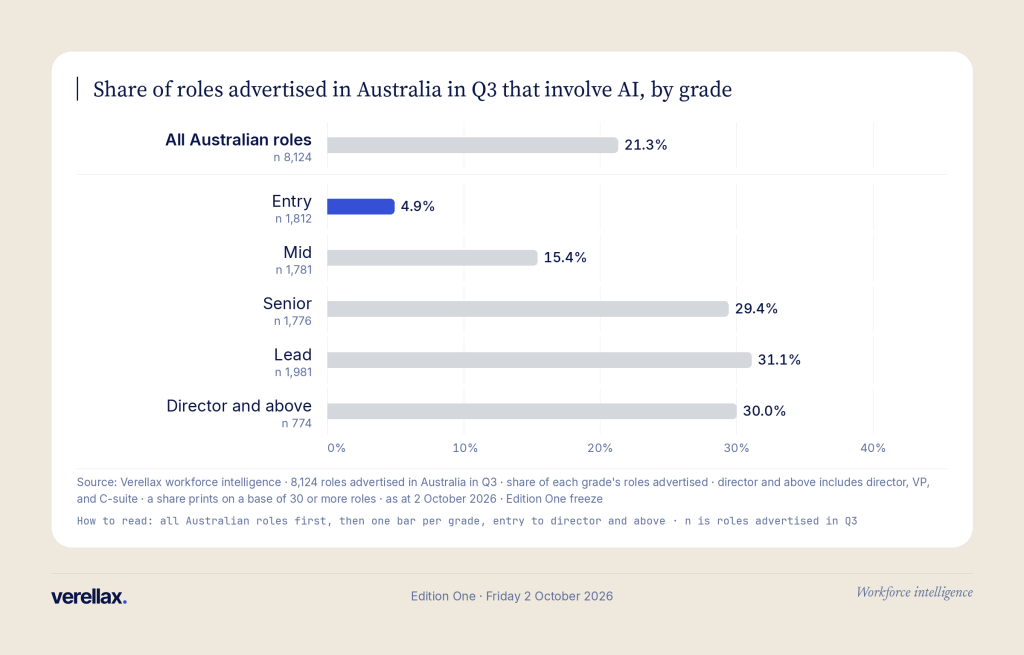

- 4.9 per cent of Australian entry-level roles advertised in Q3 2026 involve AI (89 of 1,812).
- 31.1 per cent of Australian lead-level roles involve AI (616 of 1,981).
- 21.3 per cent of all Australian roles involve AI (1,734 of 8,124).
- Of the 28 Australian employers with ten or more entry-level ads, 14 have no entry-level role that involves AI.
- Source: Verellax Index, Edition One freeze, as at 2 October 2026. The index analysed 57,134 roles advertised by 284 employers across seven markets.
Sydney, Wednesday 14 October 2026
Of the entry-level roles that Australian employers advertised in Q3 2026, 4.9 per cent involve AI (89 of 1,812). For lead-level roles, the figure is 31.1 per cent (616 of 1,981).
Australian employers advertised 1,812 entry-level roles from July to September 2026, and only 89 involved AI. The data is from the Q3 2026 freeze of the Verellax Index, Edition One. The edition read 57,134 roles that 284 employers advertised in seven markets.
Verellax reads each job specification on three measures: whether the role involves AI, whether AI is central to the work, and whether the role is accountable for what the model produces. Verellax does not survey anyone. Every figure is read from what an organisation has already published and carries its date, and every projection names the measures it is built on.
Australian lead-level roles involve AI more than six times as often as entry-level roles. Across all seven markets, 15.6 per cent of entry-level roles involve AI (1,186 of 7,591).
AI is central to the work in 29 of the 89 Australian entry-level roles that involve AI. Only two of those 29 roles say who is accountable for what the model produces.
The result does not come from a small number of large employers. Of the 28 Australian employers with ten or more entry-level ads, 14 have no entry-level role that involves AI.
"Graduates hear that AI will change their first job," said Joseph Tague, founder of Verellax. "In Australia, employers have not yet written AI into that first job."
"I built a workforce intelligence platform that analyses how companies are redesigning their operations around AI, and the skills people need to stay ahead," Tague said. "A graduate reads the job ad first. In Australia, more than 95 in every 100 entry-level roles do not involve AI."
The Senate inquiry into Australian university graduates is due to report on 20 November 2026. Its terms of reference include AI's effect on graduate jobs.
The full edition and its method are at https://verellax.com/index/edition-one. Verellax offers interviews and, on request, a sector figure that the edition does not print.
Source: Verellax workforce intelligence · 57,134 roles advertised in Q3 2026, posting-date basis · October 2026 · as at 2 October 2026, Edition One freeze
Notes to editors
- Population and basis. The figures are for roles posted from 1 July to 30 September 2026, open or closed. All figures use the posting-date basis and come from the Edition One freeze, as at 2 October 2026. The edition does not print the Australian figures by grade. Verellax gives the full table on request.
- Grades. Verellax reads a grade for each role from its specification. All 8,124 Australian roles in the edition have a grade. By grade, the shares of Australian roles that involve AI are: entry 4.9 per cent (89 of 1,812); mid 15.4 per cent (275 of 1,781); senior 29.4 per cent (522 of 1,776); lead 31.1 per cent (616 of 1,981); director and above 30.0 per cent (232 of 774). Director and above includes director, VP, and C-suite.
- Involved, central, accountable. A role is involved when its specification includes AI in the work. A role is central when AI is at the centre of the work. A role is accountable when its specification says that the holder is accountable for what the model produces.
- The four tests. Every AI-central role is then read on four tests. Accountable is one of them. The tests are: works with the model; can overrule it; is accountable for what it produces; keeps decisions over it.
- Large employers. Without the five employers with the most Australian entry-level ads, 7.8 per cent of entry-level roles involve AI (62 of 792).
- What the figures show. The index reads how job specifications are written. A specification can be silent about something that an organisation does well. No figure is a verdict on an organisation's governance.
- No employer is named.
About us:
Verellax measures the gap between what organisations say about AI and how they design work around it. It reads three public records side by side: the job specifications employers publish; what their executives say in results, interviews, and keynotes; and the corporate signals in their filings and investments. Each role is read on three measures: whether the role involves AI, whether AI sits at the centre of the work, and whether the role is accountable for what the model produces. Verellax does not survey anyone. Every figure is read from what an organisation has already published and carries its date, and every projection names the measures it is built on. Organisations use the Verellax Diagnostic to see where their roles stand against their sector, and against the minority that has designed the work furthest, before they redesign it.
Measure the work before you redesign it.
Contact details:
Joseph Tague, Founder, Verellax
[email protected]
0401840052
Interviews are available from Wednesday, 14 October 2026.