Wednesday 7 October 2026
PRESS CONFERENCE: 11am today, NSW Court of Appeal, Law Courts Building, Queen's Square, 184 Phillip Street, Sydney.
The High Court of Australia has ruled in favour of a Hunter Valley community group in the nation's first ever climate change case to reach Australia’s apex court, finding that planning authorities are legally required to consider the local climate impacts of a coal mine's downstream emissions before granting approval.
Video content of press conference available here (footage will be uploaded after press conference is complete)
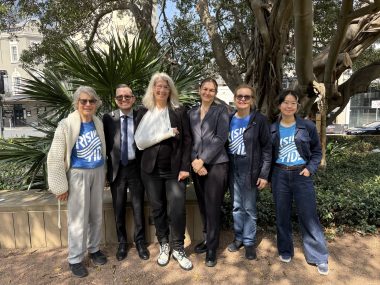
Images of press conference available here (content will be uploaded after press conference is complete)
In a landmark judgment handed down today, the High Court upheld the unanimous NSW Court of Appeal ruling that the Independent Planning Commission had failed a mandatory legal obligation under s.4.15(1)(b) of the Environmental Planning and Assessment Act 1979 when it approved the expansion of MACH Energy’s Mount Pleasant coal mine without considering how pollution from coal the mine exports (Scope 3 emissions) would affect the region through increased bushfire risk, drought, flooding and extreme heat.
The ruling sets a binding national precedent across the NSW planning system, requiring decision-makers to properly consider the local consequences of climate change associated with a project's emissions. It directly affects 17 coal proposals currently in the NSW planning pipeline, and establishes a legal template that is expected to be applied in other states and in future climate litigation across Australia.
The judgment means the approval of the Mt Pleasant coal mine expansion remains invalid and will need to be referred back to the NSW Land and Environment Court or Independent Planning Commission to properly assess the project’s contribution to local impacts of climate change.
The case was brought by the Denman Aberdeen Muswellbrook Scone Healthy Environment Group Inc (DAMS HEG), a grassroots community organisation from the Upper Hunter Valley, represented in the Court of Appeal and High Court by environmental law firm Johnson Legal. The community group has fought the case through three levels of court over four years.
To interview the spokespeople below, please contact Sean Kennedy at the Climate Media Centre — 0447 121 378 — [email protected] *Aside from the legal team and plaintiffs below, Climate Media Centre has independent scientific and legal experts to comment on the significance of the case.
Wendy Wales, President, DAMS HEG
Wendy Wales is a retired science teacher and the president of the Denman Aberdeen Muswellbrook Scone Healthy Environment Group — the community group that brought this case. She and her partner Tony Lonergan live on a farm in the Upper Hunter Valley, adjacent to the Mount Pleasant mine. She has driven this case through three court levels over four years.
"Today the High Court has said what we have always known: we cannot dig up coal, ship it overseas, watch it drive climate change, and then pretend the consequences have nothing to do with us and won’t be felt by us. The droughts, the bushfires, the floods — are directly connected to greenhouse gases, and massive fossil fuel projects like Mt Pleasant Optimisation simply “add fuel to the fire”. We can't ignore physics, chemistry and biology. We must live within Nature's limits and this ruling endorses that.
“Lawmakers now need to turn their full attention to finding unity of purpose in explaining and addressing climate change. It is not in our interests that our coal is burned anywhere.
“The NSW government should be looking long term for the people of NSW as we face the consequences of climate change.
“This ruling acknowledges that many Australian communities have already suffered extreme weather devastation. Now the true and complete long term costs of export coal on Australians, via the climate impact from burning that coal, must be considered.
“People in the Torres Strait, Pacific nations and countries like Nepal, which are not significantly contributing to greenhouse gas emissions, are already being seriously impacted by climate change. The International Court of Justice has determined they are within their rights to seek full reparation from states “acting wrongfully.”
Tony Lonergan, Treasurer, DAMS HEG
Tony Lonergan is a retired science teacher and farmer whose family has worked land in the Upper Hunter Valley for generations. His property sits adjacent to the Mount Pleasant mine.
"Wendy and I have seven grandkids between us. We did this for them, and for all the kids across the Hunter who are going to grow up in a world shaped by the decisions being made right now. Today, the highest court in the country agreed that those decisions have to account for the damage they cause. That matters more than I can say.
"This isn't the end of coal overnight. But it is the end of coal mine approvals that look the other way on climate. Every planning authority in Australia now has to take this seriously. That is a fundamental change."
Anita O'Hart — Principal Lawyer, Johnson Legal.
Anita O’Hart is Principal Solicitor at Johnson Legal, the firm that has represented DAMS HEG through the NSW Court of Appeal, and now the High Court of Australia.
"This is an historic ruling for Australian environmental law and for the communities who have been fighting for accountability in the fossil fuel approvals process. The High Court has confirmed that planning authorities cannot ignore the chain of causation from a project's emissions through to real, local climate harm. The Independent Planning Commission was required to consider those impacts — and that obligation is now binding across the NSW planning system.
"The implications extend well beyond Mount Pleasant. This ruling will be applied by courts and planning authorities across Australia, and it will be studied internationally as one of the most significant domestic climate law decisions in the world."
Nic Clyde – NSW Coordinator, Lock the Gate Alliance
“This is a momentous win for the climate, with the High Court confirming that planning authorities must consider the local climate impacts of polluting coal projects.
“NSW’s coal export industry is worsening the climate crisis and driving up the cost of living, yet our government has approved 14 coal projects since the last state election. Just last week, it approved an enormous, decades-long expansion of the HVO coal mine. The decision was outrageously out of step with what we need for a safe future.
“There are currently 17 coal projects in the NSW planning pipeline. Today’s decision sends a strong message to the planning system: the price households and communities are paying for coal pollution must be weighed properly in the planning system. It's no longer okay to ignore the climate cost of coal revenues.
“The NSW government can no longer ignore the fact that to keep its communities safe, the chapter of never-ending coal approvals has to end.”
Tessa Khan, Executive Director, Uplift; International Climate Change Lawyer (in London, so on GMT)
Tessa Khan is an international climate change lawyer. Tessa has first-hand experience of the implications of a case of this nature, having been closely involved in the outcomes of the comparable Finch case in the UK. Tessa is the Founder and Executive Director of Uplift, which supports efforts to create a rapid and fair transition away from oil and gas production in the UK. She previously co-founded and co-directed the Climate Litigation Network, which supports groundbreaking strategic climate litigation around the world.
"Today's judgement proves that Australia and the state of NSW can no longer wash their hands of the climate harm of their decisions by simply shipping the problem overseas. Governments need to contend with the fact that there is no space in the atmosphere for emissions from more coal mining if we are going to have a livable climate."
"The ramifications of the High Court's judgement will be far reaching. Australian governments should heed the example set by the UK and pause fossil fuel project approvals while policies are brought into alignment with the law."
Professor David Karoly, Climate Scientist & Climate Council Councillor
Professor David Karoly is an internationally recognised leader in climate dynamics, atmospheric science, and climate change variability. He serves as a Councillor on the Climate Council and is a Professor Emeritus at the University of Melbourne. Professor Karoly was a Lead Author for the Intergovernmental Panel on Climate Change (IPCC) during the 4th Assessment Report cycle, contributing to the work awarded the Nobel Peace Prize in 2007. A Fellow of the Australian Academy of Science, his career spans senior academic and research leadership positions across the University of Melbourne, Monash University, University of Oklahoma, and CSIRO.
Amanda McKenzie, CEO and Co-Founder, Climate Council
Amanda McKenzie is the Chief Executive Officer and Co-Founder of the Climate Council, Australia’s leading climate science communications organisation. One of the country's most prominent public commentators on the climate crisis, she led the independent crowdfunding campaign that established the Climate Council following the abolition of the Australian Climate Commission in 2013.
—ENDS—
BACKGROUND
-
The Mount Pleasant open-cut coal mine sits 3km upwind and northwest of Muswellbrook in the Upper Hunter Valley, NSW. It is owned by MACH Energy Australia Pty Ltd, a subsidiary of Indonesia's Salim Group. MACH Energy sought to double the mine's output to 21 million tonnes per year and extend its life to 2048 — generating an additional 870 million tonnes of CO₂, 98% of it as Scope 3 emissions from coal burned overseas.
-
The NSW Court of Appeal ruled unanimously on 24 July 2025 that the Independent Planning Commission had failed a mandatory obligation under s.4.15(1)(b) of the Environmental Planning and Assessment Act 1979 to consider the local climate impacts of the mine's emissions. MACH Energy was granted special leave to appeal before the Australian High Court on 4 December 2025.
-
The ICJ Advisory Opinion on climate change obligations of states was handed down on 23 July 2025 — on the eve of the NSW Court of Appeal ruling — finding that fossil fuel production, export licensing and subsidies can constitute internationally wrongful acts.
-
Four institutions were granted leave to intervene in the High Court with evidence which supported DAMS HEG: Melbourne Law School Climate Futures (Prof. Jacquie Peel), Cambridge Centre for Climate Engagement, Sabin Centre for Climate Change Law (Columbia University), and the Union of Concerned Scientists (Dr Christopher Callahan). Melbourne Climate Futures and the Union of Concerned Scientists made oral submissions at the hearing on 13 May 2026.
-
DAMS HEG is represented by Johnson Legal. Lead barrister at the High Court hearing was Naomi Sharp SC, with Matthias Thompson and Stephanie Patterson of counsel.
-
Johnson Legal case page: www.johnsonlegal.au/newsfeed/mach-energy-v-denman-high-court-of-australia
Contact details:
Sean Kennedy, Senior Media Advisor, Climate Media Centre — 0447 121 378 — [email protected]