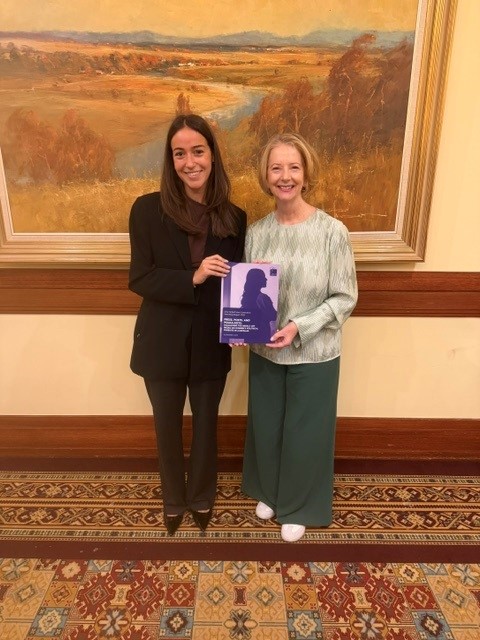

- EMILY's List Australia has launched a new report titled *Press, Posts, and Polka-Dots*, researching how media representation, scrutiny, and online misogyny affect women's political participation in Australia, coinciding with the 14th anniversary of Julia Gillard's landmark Not Now, Not Ever speech.
- The report was researched and written by Alex Cowen, the 2025/26 Julia Gillard Next Generation Intern, and was launched at an event attended by more than 100 guests, including former Prime Minister Julia Gillard.
- The research highlights that cultural barriers — including biased media treatment and online abuse — continue to discourage women from entering, participating in, and remaining in political life, even where numerical gender gaps have narrowed.
- A key recommendation of the report is that online misogyny should be recognised as a form of hate speech, with calls to examine law reform to federal anti-vilification laws and online safety frameworks to better protect women in public life.
- EMILY's List Australia, which has supported more than 800 women seeking political office since 1996, said the report underscores the need to address both structural and cultural barriers to ensure women can participate safely and equally in Australian democracy.
Former Prime Minister Julia Gillard joins more than 100 guests to celebrate the launch of EMILY’s List Australia’s 2025/26 Julia Gillard Next Generation Internship report, coinciding with the 14th anniversary of her landmark “Not Now, Not Ever” speech.
EMILY’s List Australia’s 2025/26 Julia Gillard Next Generation Intern, Alex Cowen, has released new research examining how women are treated in the media and the impact of media representation, scrutiny and online misogyny on women’s political participation.
Titled PRESS, POSTS, AND POLKA-DOTS: EVALUATING THE IMPACT OF MEDIA ON WOMEN’S POLITICAL PURSUITS IN AUSTRALIA, the report explores the different ways women in politics are portrayed and treated across traditional and digital media, and considers how these experiences can influence women’s willingness to enter, participate in and remain in political life.
The report was officially launched at an event attended by more than 100 guests, with former Australian Prime Minister Julia Gillard in attendance to celebrate Alex’s work and the contribution of emerging leaders to gender equality.
The launch coincides with the 14th anniversary of Ms Gillard’s landmark “Not Now, Not Ever” speech, delivered in Parliament on 9 October 2012. The speech became a defining moment in Australia’s national conversation about sexism and misogyny.
Fourteen years on, Alex’s research highlights the continued challenges women face in public life and the importance of addressing the culture, media treatment and online abuse that can undermine women’s political participation.
Ms Gillard said she was delighted by the report and proud to see the work being undertaken through the internship established in her name.
“I’m delighted that Alex is the Julia Gillard Next Generation Intern and congratulate her on her exceptional report. It was wonderful to be present as Alex launched her research in Melbourne today.”
Reflecting on the report’s findings, Ms Gillard said the research demonstrated how many of the challenges women in leadership faced in the past continued to affect women today.
“Her extensive research and analysis lays bare that so many of the things I experienced while in politics, unfortunately continue to be regular occurrences for women today.”
Ms Gillard also highlighted the importance of recognising the leadership of young people, saying:
“There is real hope in our world as young people show us the way and claim their leadership. They’re not the leaders of tomorrow, they’re the leaders of today, making a huge impact in their communities and on the global stage.”
Alex Cowen said that addressing women’s underrepresentation in politics required looking beyond the numbers to examine the cultural barriers that continue to shape their experiences.
“When numbers no longer represent gender inequality in politics, but we still know it to exist, we have to look at culture instead.”
Ms Cowen said it was important to create an environment where women not only felt able to enter politics, but knew they belonged there.
“We can inspire the next generation of women … to not just see politics as an environment that they can exist in, but one that they belong in.”
The report also identifies the treatment of online misogyny as an important issue for policymakers to consider.
“The characterisation of online misogyny as hate speech is a vital step in systemically addressing this threat,” Ms Cowen said.
EMILY’s List Australia CEO Pamela Anderson said the report made an important contribution to understanding the barriers women face in public life and the changes needed to support their participation.
“One of the most important recommendations in Alex’s research is the need to investigate law reform that would recognise online misogyny as a form of hate speech and strengthen protections against gender-based abuse.
“The report recommends examining how federal anti-vilification laws and online safety frameworks could better address misogyny and gender-based hatred online.
“Women should be able to participate in public life, stand for election and express their views without being driven out of the conversation by misogynistic abuse.
“Alex’s research highlights that achieving gender equality in politics is about more than numbers. It is also about creating a culture where women are accepted as leaders and can participate safely and equally in our democracy.”
Developing the next generation of women leaders
The Julia Gillard Next Generation Internship is sponsored by Slater & Gordon and the Australian Workers’ Union, whose support helps EMILY’s List Australia invest in emerging women leaders and provide opportunities for young women to develop their skills, undertake meaningful research and contribute to public policy and political debate.
The internship reflects a shared commitment to building women’s leadership, strengthening women’s voices and addressing the barriers that can prevent women from fully participating in public life.
Since its establishment in 1996, EMILY’s List Australia has supported more than 800 women seeking political office, with almost 400 going on to be elected.
Ms Anderson said the internship was an important part of ensuring the organisation’s work extended beyond supporting individual candidates.
“Supporting women to run for office is at the heart of what we do, but we also need to understand and address the barriers that discourage women from stepping forward in the first place.
“We are incredibly proud of the work Alex has delivered. This research contributes to an important conversation about how we create a political and media environment where women can lead, participate and make their voices heard.
“We thank Slater & Gordon and the Australian Workers’ Union for supporting this important initiative and helping develop the next generation of women leaders.”
ENDS
About us:
Established in 1996, EMILY’s List Australia is one of Australia’s most established and influential organisations dedicated to increasing women’s representation in politics. We have supported more than 800 women to run for office, with almost 400 going on to be elected.
As a membership-based organisation, we welcome women and men who share our commitment to women’s political representation and leadership. Membership is open to all supporters and allies who believe in building a more equal and representative democracy.
Contact details:
Pamela Anderson
CEO
EMILY's List Australia
0420 981 508