

Skip to content
Information Technology, Mental Health

Want to feel upbeat? How emotion-aware algorithms can help

University of Melbourne, Faculty of Engineering and Information Technology 2 mins read

New research from the University of Melbourne has found that playlists curated by algorithms can help people regulate their emotions up to 69 per cent of the time. With emotional distress on the rise, the research holds promise for using algorithms to improve emotional well-being.

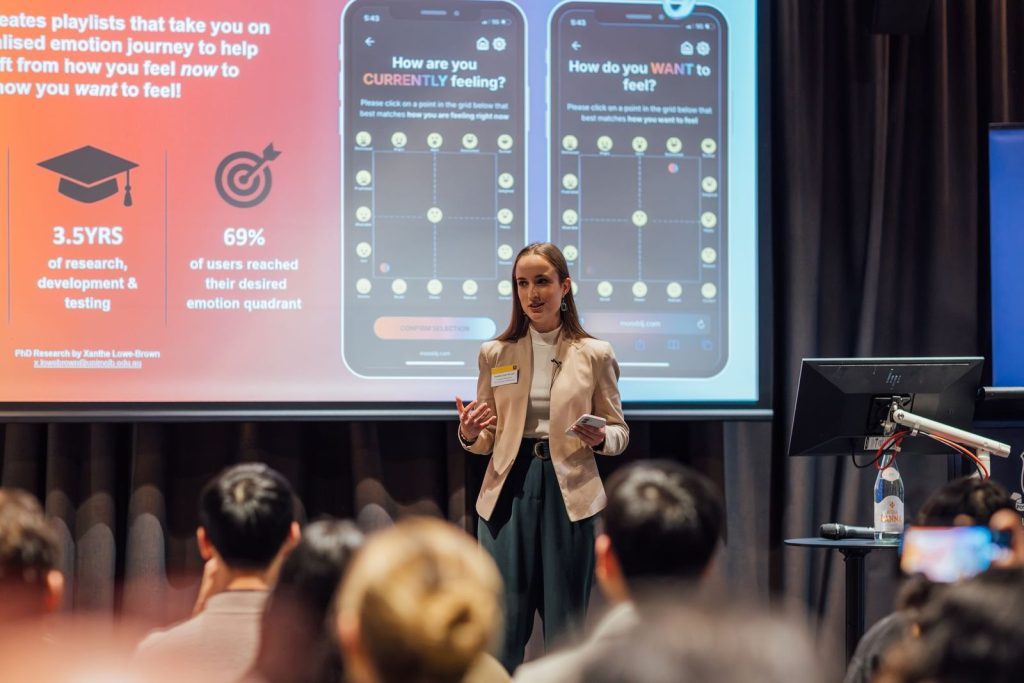
With music streaming apps such as Spotify being used by millions of people every day, algorithms are increasingly shaping how people listen to music. Dr Xanthe Lowe-Brown, who recently completed her PhD in the School of Computing and Information Systems, investigated whether algorithms informed by psychology and ethical principles could guide users towards desired mood states.

She found that curated playlists were significantly more effective at helping users reach their desired state than self-ordered playlists.

"Music streaming platforms provide an almost infinite selection of music available at the click of a button. We want to find a way to harness this power to help brighten listeners' mood," Dr Lowe-Brown said.

She and her collaborators built a pilot app, MoodDJ, for a field trial, which worked as a web app connecting to volunteer trial participants’ Spotify.

Users would input their current and their desired mood using two factors – their ‘arousal’ (how much energy they had), and their ‘valence’ (how positively or negatively they felt).

MoodDJ then drew on users' music libraries to curate playlists using Spotify’s data on a song’s energy and valence, aiming to bring users from their current state to their desired state.

The app showed short-term benefits, with many users appreciating how the app prompted them to reflect on their emotional state when using it.

“Our initial findings highlighted that while people reported feelingthat the benefits of an app like MoodDJ outweighed the risks, it’s crucial that this kind of technology considers privacy and transparency concerns,” said Dr Lowe-Brown.

“Algorithms in Spotify and Apple Music are increasingly used to curate mood-based playlists, but they need to be informed by psychology if they want to have the impact they claim to have.

“Equally, it’s important to consider questions regarding how user data on emotions-based listening is being stored and used, to be sure vulnerabilities aren’t being exploited.”

Now, with $15,000 in funding through the Faculty of Engineering and Information Technology’s PhD Lab to Launch Program, Dr Lowe-Brown is using findings from the pilot app to develop MoodDJ into an app for public use, opening doors to a range of applications in both personal listening sessions such as to energise oneself on the morning commute and in public spaces such as waiting rooms and gyms.

Read more here.


Contact details:

Lily Petrovich (Communications Officer) | [email protected] | +61 405 406 900

Media

More from this category

  • Information Technology
  • 15/10/2026
  • 09:22
Exalate

Exalate launches Australian hosting for Exalate Cloud, giving organisations the option to run integrations in-country

Local hosting on Google Cloud in Sydney is available now, across every Exalate connector.ANTWERP, Belgium, Oct. 15, 2026 (GLOBE NEWSWIRE) -- Exalate, the integration solution for synchronising work across Jira, ServiceNow, Azure DevOps, Salesforce, Freshdesk and other platforms, announced Australian hosting for Exalate Cloud. Companies in Australia can now run their integrations on Google Cloud infrastructure in Sydney, with all Exalate connectors supported.For many Australian businesses, particularly in regulated and public-facing industries, data hosting location is a requirement, not a preference. That was the case for a complex ServiceNow-to-Jira Cloud migration brought to Exalate through an implementation partner. Australian hosting…

  • Mental Health
  • 15/10/2026
  • 09:00
ReachOut

ReachOut spokespeople available to speak about AI safety and youth mental health

Right now the news cycle and our feeds are flooded with stories about the dangers of AI, however research shows that young people in Australia are rapid adopters of this technology. ReachOut’s CEO (Gary Groves) and the organisation’s Clinical Lead (Linda Williams) are in Perth this week (Mental Health Month) presenting on safe AI mental health support for young people in WA and across the country at the Global Mental Health Summit. Interviews Groves and Williams are available for interview about: how young people are using AI in their daily lives and when it comes to their mental health Ask…

  • Information Technology
  • 15/10/2026
  • 00:07
BrainChip Holdings Ltd.

BrainChip Launches Sequora: Edge AI That Doesn’t Just Recognize — It Understands and Responds

Sequora extends BrainChip’s proven ultra-low-power, always-on sensing advantage to generative AILAGUNA HILLS, Calif., Oct. 14, 2026 (GLOBE NEWSWIRE) -- BrainChip Holdings Ltd. (ASX: BRN, OTCQX: BRCHF, ADR: BCHPY), a global leader in ultra-low-power, fully digital, event-based neuromorphic AI, today announced BrainChip Sequora™ Core IP, a processor IP core that runs generative AI, including large language models (LLMs), directly on battery-powered edge devices.The next step in BrainChip's edge AI roadmap, Sequora builds on the strengths of the company's Akida™ platform. Its efficiency comes from model structure: a state-space design keeps memory use fixed no matter how long the data stream or…

Media Outreach made fast, easy, simple.

Feature your press release on Medianet's News Hub every time you distribute with Medianet. Pay per release or save with a subscription.