
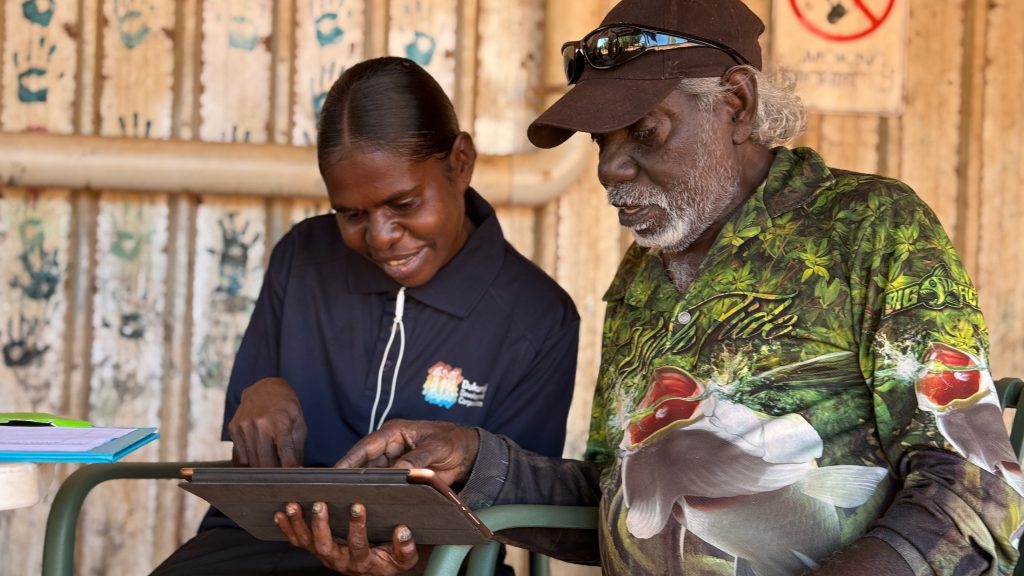

Almost two in three respondents surveyed in remote First Nations communities did not have working free-to-air television, a study has found.
The 2026 Mapping the Digital Gap report by RMIT University and Swinburne University of Technology found 63% of respondents did not have a working service at home.
The finding was recorded across remote and very remote communities reliant on the Australian Government-funded Viewer Access Satellite Television service, known as VAST.
Researchers said the switch from local television broadcasting to direct-to-home satellite services had left households responsible for maintaining their own equipment, without a coordinated system of maintenance and technical support.
Set-top boxes can be damaged by power surges and are expensive to replace, while smart card activation problems and the cost of bringing technicians from regional centres can leave services out of action.
As a result, failing television services and the growing need to access essential services online are changing how people use the internet, researchers said.
Associate Professor Daniel Featherstone from RMIT, a co-investigator on the project, said increased streaming was changing household data use in remote communities.
“People were already using the internet for banking, government services and staying connected, but now they’re also using significant amounts of data to stream digital media and television content,” Featherstone said.
“That adds to household costs and puts further pressure on mobile networks in remote communities.”
Community Wi-Fi and household broadband expand
Community Wi-Fi is helping reduce reliance on prepaid mobile data, with 64% of respondents reporting they had used a public Wi-Fi service in the previous six months, up from 47% in 2025.
Twenty-three remote communities have received new Wi-Fi networks since 2024, with another 53 expected to come online over the next two years.
First Nations co-investigator Professor Lyndon Ormond-Parker from RMIT said community Wi-Fi was helping make internet access more affordable.
“Community Wi-Fi is making a real difference because people can connect without having to use their prepaid mobile data,” Ormond-Parker said.
Thirty-two per cent of respondents reported having fixed broadband at home in 2026, with Starlink uptake rising from 4% in 2025 to 24% in 2026.
Researchers said promotional offers and discounted equipment had contributed to the sharp rise in Starlink uptake, along with growing demand for household internet.
However, Featherstone said it was too early to know how many households would be able to sustain the ongoing monthly costs.
“Starlink is providing better household connectivity in many communities, but the challenge will be whether households can afford the service over the longer term,” he said.
“Previous postpaid internet services have had high payment default rates in remote communities, where households have low incomes and many competing expenses.”
Internet access rises but affordability remains a barrier
Ninety-eight per cent of respondents reported having internet access, while 86% had used the internet in the previous day, significant improvements on previous findings.
Online services have become part of daily life, with 83% of respondents reporting they had used online banking and 72% government services in the previous month.
Lauren Ganley, Head of Telstra’s First Nations Strategy & Engagement, said the findings showed encouraging progress, while reinforcing the need for continued action.
“Connectivity can be transformational for remote First Nations communities, but access alone is not enough. It needs to be affordable, reliable and designed around the needs of communities,” she said.
“This research helps us understand where progress is being made and where the gaps remain. Telstra is proud to support this important work and, most importantly, to listen to communities as we work together to improve digital inclusion.”
Despite these gains, affordability remains a significant barrier, with surveyed households spending an average of $345 a month on mobile and internet services.
Eighty-three per cent of respondents reported sacrificing or cutting back on essentials to afford internet access, while 69% compromised on data allowances or connection speeds to manage costs.
Ormond-Parker said the findings exposed the difficult choices facing many remote households.
“Better connectivity is bringing clear benefits, but families should not have to cut back on essentials to afford internet access,” he said.
“Closing the digital gap requires long-term solutions developed with communities that reflect their needs and circumstances.”
The 2026 research was conducted across nine remote and very remote First Nations communities, including seven of the nine sites surveyed in 2025.
Researchers worked with local First Nations organisations and community co-researchers to survey residents and examine how they access and use digital and media services.
Mapping the Digital Gap is an RMIT and Swinburne research project tracking digital inclusion and media use in remote First Nations communities across Australia, supported by Telstra.
The Mapping the Digital Gap: 2026 Outcomes Report is published by the ARC Centre of Excellence for Automated Decision-Making and Society, RMIT University, Swinburne University of Technology and Telstra. (DOI: 10.60836/ggns-vm61)
Contact details:
Images available:
https://spaces.hightail.com/space/BqWvVSbKjQ
Interviews:
Associate Professor Daniel Featherstone, report co-investigator, RMIT University: [email protected].
Media enquiries:
RMIT External Affairs and Media, 0439 704 077 or [email protected].