-
About 2-3 per cent of people aged over 65 have Parkinson's disease, but how exactly the disease starts is poorly understood.
-
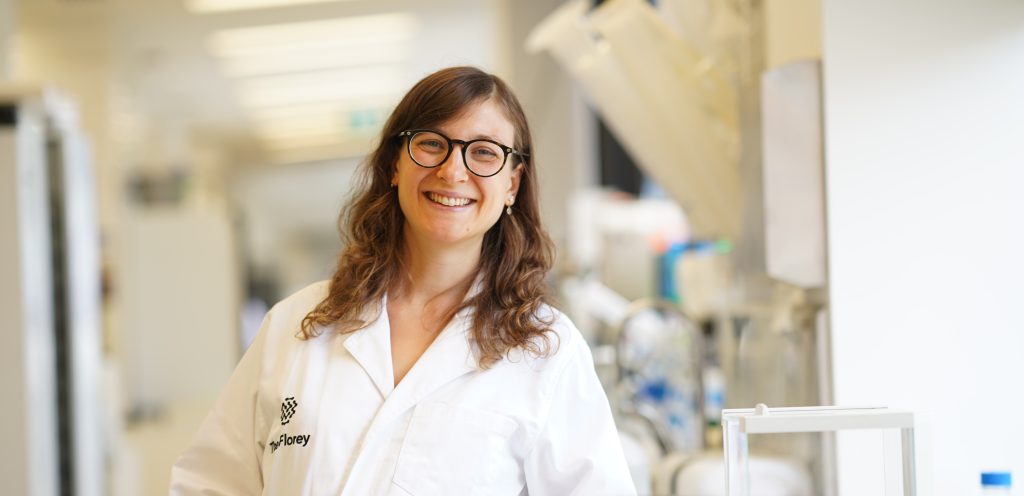
Using a unique stem-cell based ‘human-mouse' model, Florey researcher Chiara Pavan is investigating what initiates and drives Parkinson’s disease.
-
Studying the earliest stages of the disease could help slow or prevent progression.
Media Release
24 November 2026
Novel stem cell model developed to investigate mystery of how Parkinson's disease starts
Key points
-
About 2-3 per cent of people aged over 65 have Parkinson's disease, but how exactly the disease starts is poorly understood.
-
Using a unique stem-cell based ‘human-mouse' model, Florey researcher Chiara Pavan is investigating what initiates and drives Parkinson’s disease.
-
Studying the earliest stages of the disease could help slow or prevent progression.
By the time most people have been diagnosed with Parkinson's disease, the neurological disorder has taken hold and the best window for treatment may have already passed.
Parkinson's researcher Dr Chiara Pavan from The Florey Institute of Neuroscience and Mental Health hopes the adoption of multiple cutting-edge technologies applied to a novel ‘human-mouse’ model will provide new insight into the onset and progression of Parkinson’s disease.
The emerging researcher has been awarded an early career medical research grant from the Jack Brockhoff Foundation to support her innovative research.
"Most of what we know about Parkinson's disease comes from studying brain tissue after death, which only shows the very end of the disease," Dr Pavan said.
"Growing human brain cells in a dish doesn’t solve the problem either, because the cells do not live long enough or behave realistically enough for the disease to develop."
In a unique approach, Dr Pavan has used stem cells from people with mutations that cause Parkinson's disease to create human brain cells. By implanting these brain cells into mice, she hopes to watch Parkinson's disease as it starts and progresses.
"These particular mice do not have immune systems, which means the implanted human brain cells are not going to be rejected.
"The aim is to create a living piece of tissue that we can study for months, unlike cells in a dish that have a limited lifespan. This will be achieved by interrogating the human diseased tissue using a ‘toolbox’ of experimental technologies.
"Watching the disease begin in human cells could help us understand what goes wrong first and to potentially find drugs that could stop or slow down this process."
Dr Pavan said she was honored to receive the Jack Brockhoff grant to develop tools to improve her model.
"Parkinson's is a bit like a black hole: we know it's there; we see what it does and how detrimental it is, but we can't still see inside. I hope this helps us change that or at least get a step closer to it.”
-ends-
About us:
The Florey is an independent medical research institute devoted to tackling brain and mental health conditions. Our mission is to improve lives through research. We envisage a world where early detection and timely intervention mean these conditions are preventable or treatable, so that we can all live full and healthy lives.
Our expert teams are devoted to discovery and health improvement in: Dementia, Neurodegeneration and Immunology, Stroke and Critical Care, Epilepsy and Neurodevelopment, and Mental Health.
Animals are used in some of our research to better understand, prevent and treat brain and mental health conditions. Our use of animals in research is conducted with strict ethical oversight, applying the 'three R's' (Replacement, Reduction and Refinement), and the highest standards of care and welfare.
Find out more here: Animal Use at The Florey
Contact details:
Anastasia Salamastrakis, Media and Communications Manager
[email protected] | 0456 666 271