
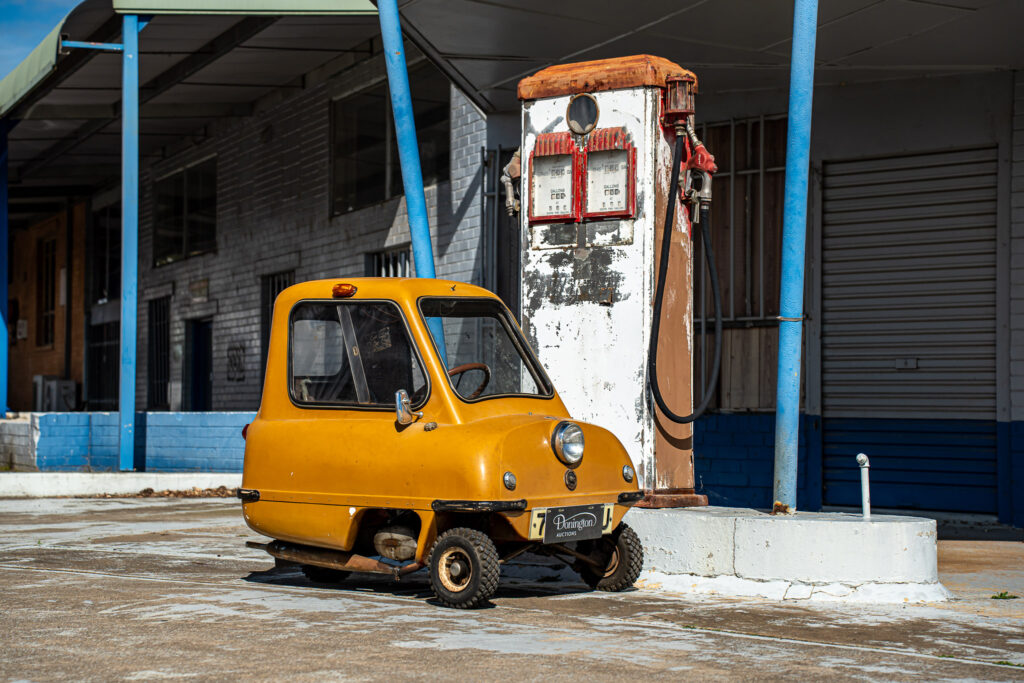
- Two rare microcars from single-family ownership - a 1964 Peel P50 (est. $50,000-70,000) and 1962 Messerschmitt KR200 (est. $20,000-25,000) - discovered after five decades in storage
- A 1908 M.A.B. with 27-litre Liberty V12 aero engine, estimated at $320,000-360,000, is being offered from the Binalong Motor Museum collection
- A 1921 Rolls-Royce Silver Ghost 40/50 hp with Australian coachwork is available with an estimate of AUD$220,000-260,000
- A newly restored 1929 Packard Model 626 Speedster is offered at AUD$200,000-250,000
- Peter Sellers' former 1971 Aston Martin DBS V8 is available with an estimate of $260,000-280,000
From flame spitting monsters of the Edwardian era to quirky microcars of the Swinging Sixties, Donington Auction’s latest Collector & Competition Car Auction features an eclectic selection of collectible automobiles appealing to enthusiasts with an appreciation for things less ordinary.
Headlining the collection are two extraordinary microcars that have recently emerged from long-term storage, having enjoyed a remarkable five decades of single family ownership.
Purchased in London back in the mid-1970s when microcars were a rapidly fading fad, the 1964 Peel P50 and 1962 Messerschmitt KR200 were later brought to Australia when the owner emigrated to live on the Gold Coast and have been hidden from view ever since.
Nicknamed the Kabinenroller, the Messerschmitt is powered by a Fichtel & Sachs single-cylinder engine mounted behind the tandem seats and comes with everything needed to complete its restoration back to fully operational condition, while the similarly unrestored Peel P50 is arguably one of the most important microcar finds of recent years. Officially listed in the Guinness Book of Records as the smallest production car of all time, with only 27 of the 49 built estimated to survive it’s unlikely another genuine P50 will be discovered any time soon.
Both cars come with plenty of documentation, including their precious buff UK logbooks and are ripe for restoration, with the Messerschmitt estimated at $20,000-25,000 and the Peel P50 at $50,000-70,000.
Donington Auctions are also pleased to offer a small selection of cars formerly on display at the renowned Binalong Motor Museum, most notably the magnificent 1908 M.A.B. powered by a 27-litre Liberty V12 aero engine. This chain-driven monster was built forty years ago in the style of aero-engined cars that pounded the banking of Brooklands in the Heroic Age of Motor Racing over a century ago and has proven itself in the 1988 Australian Bicentennial World Rally, Targa Tasmania and other events. Estimated between $320,000-360,000, the M.A.B. is eligible for the S.F. Edge Trophy at the Goodwood Revival and would be the centrepiece of any serious collection of pre-war cars.
Representing the finest in British and American vintage motoring, Donington are proud to offer a pair of outstanding cars from a private NSW collection. The Rolls-Royce Silver Ghost is a name that needs no introduction and this 40/50 hp is unquestionably one of the finest examples in Australia. Bodied by local coachbuilder Jackson, Jones & Collins in 1921 for Sydney motoring identity Charles Bennett on an Alpine Eagle specification chassis, chassis 56NE received a concours-level restoration some years ago and is offered from long-term ownership with an estimate of AUD$220,000-260,000).
Benefiting from a freshly completed world-class restoration by David Ford of Stanthorpe is a 1929 Packard Model 626 in Speedster configuration. The Speedster was a factory ‘hot rod’ incorporating the largest 384.4 cubic inch displacement engine shoehorned into the shortest 126.5-inch wheelbase chassis. Throw in a high lift camshaft, high compression head and some fine tuning, plus a muffler cut-out and high-speed vacuum pump and the Speedster was good for 130 horsepower and a top speed of 100 miles per hour flat out. Never shown or exhibited and estimated between AUD$200,000-250,000, the fortunate new owner will have the pleasure of displaying the Packard at any high level concours event.
Further highlights of the October sale include a 1971 Aston Martin DBS V8 originally owned by revered comedian and serial car owner Peter Sellers (estimated at $260,000-280,000), a 1960 Elfin Streamliner (estimated at $70,000-80,000) and a 1987 Holden/HDT VL Commodore Group A Plus Pack (one of just 173 made) offered without reserve.
Bidding opens on October 10 and closes on October 19, 2025: for a full listing please visit the online catalogue https://online.doningtonauctions.com.au/m/view-auctions/catalog/id/261
Contact details:
For further information please contact:
Melbourne:
Robbie Richards
+61 (0) 419 393 932
Sydney:
Damien Duigan
+61 (0) 449 128 392