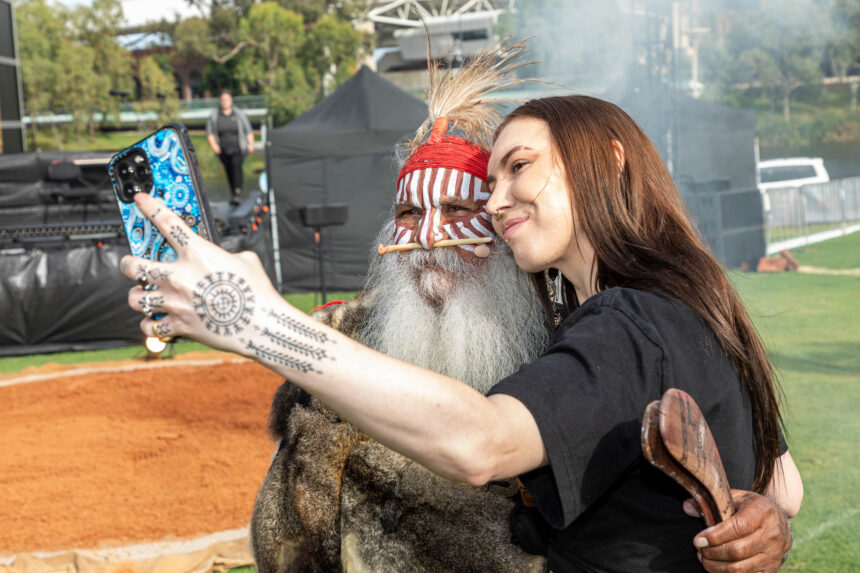
21 January 2026: Australia Day in South Australia will begin with Mourning in the Morning, a First Nations-led ceremony that places truth-telling, reflection and cultural continuity at the start of the national day on Monday 26 January 2026 at Elder Park/Tarntanya Wama.
Shaped collaboratively with the Australia Day Council of South Australia and led by South Australian First Nations community leaders, Mourning in the Morning offers a culturally safe platform for First Nations voices and perspectives.
Jan Chorley, Chief Executive Officer of the Australia Day Council of South Australia said for many Aboriginal and Torres Strait Islander peoples, 26 January is not a day of celebration.
“We created an open circle group with our First Nations community a few years ago and each year it has evolved to be increasingly meaningful. Mourning in the Morning is 100 per cent led by First Nations people and provides a space for truth-telling, reflection and respectful listening,” she said.
The ceremony opens with a Welcome to Country and smoking ceremony, followed by keynote addresses, panel conversations and performances by First Nations artists and cultural leaders. It centres intergenerational leadership and community-led dialogue, inviting Aboriginal and Torres Strait Islander peoples and non-Indigenous South Australians alike to gather, listen deeply and reflect together.
Letisha Ackland, Director of Balya Productions and event lead for Mourning in the Morning, said she rarely works on events held on 26 January unless they are First Nations-led and culturally safe.
“Being engaged by the Australia Day Council of South Australia to lead the curation of speakers and performers for Mourning in the Morning has been grounded in genuine respect, trust and support,” Ackland said. “The process has centred First Nations voices and community leadership, demonstrating what meaningful collaboration can look like when our voices are trusted to lead.”
Eminent barrister Anthony McEvoy SC, who will deliver the keynote address, said the ceremony is a vital act of honesty.
“Mourning on this day acknowledges the reality that Australia was founded on the dispossession of First Nations peoples,” McEvoy says. “Truth-telling is not about blame. It’s about honesty which is essential if we are serious about justice and understanding.”
A Wirdi man from Central Queensland and Australia’s first Indigenous Senior Counsel, McEvoy has worked extensively at the intersection of native title, land rights and environmental law, including as Co-Senior Counsel assisting the Royal Commission into the Protection and Detention of Children in the Northern Territory, commonly known as the Don Dale Review, and more recently the Yoorrook Justice Commission in Victoria.
“Our continuing journey is about recognising that Indigenous law, culture and connection to land were never extinguished,” he says. “They persist. They inform who we are as a nation today. Most people in Australia understand and respect those fundamental truths. The real question is how we give the ongoing relationships between people and Country the legal and moral respect that is due.”
Guided by the theme Our Continuing Journey, Mourning in the Morning acknowledges that people arrive at Australia Day with different experiences and perspectives, and calls for respectful dialogue grounded in listening, reflection and dignity. As the opening bookend of South Australia’s Australia Day program, the ceremony creates space for truth and recognition in the morning, before the evening community event.
Ms Chorley said the structure of the day reflects the complexity of Australia Day itself.
“Australia Day is not a simple day, and it never has been,” Chorley said. “Beginning with Mourning in the Morning ensures space for truth, respect and recognition. The evening program then provides opportunities for people to come together through shared community experiences. Together, these events reflect the many stories that shape who we are, and ensure there are multiple ways for people to engage with the day in a way that feels right for them.”
Aus Lights on the River starts at 5pm in Elder Park/Tarntanya Wama. It includes the much-loved Aus Lights Parade, a vibrant street procession celebrating South Australia’s communities, featuring more than 1,300 participants from over 55 community and multicultural organisations. The program continues with the official ceremony featuring Diana Rouvas, winner of The Voice Australia (2019), followed by a fireworks finale and large-scale light installations along the River Torrens / Karrawirra Parri.
Mourning in the Morning will be held from 7.30am to 8.45am on Monday 26 January at Elder Park / Tarntanya Wama. The event is free and open to Aboriginal and Torres Strait Islander peoples and non-Indigenous South Australians.
Full program details are available at: https://australiadaysa.com.au/aus-lights-2026/#smokingceremony and
www.australiadaysa.com.au/aus-lights-2026
Australia Day in South Australia is supported by the Australian Government through the National Australia Day Council and the City of Adelaide and is supported by the Government of South Australia. Mourning in the Morning Smoking Ceremony key event partner SA Power Networks community support partners Adelaide PHN, Adelaide University, Credit Union SA, Sarah Constructions, SDA , and Sofitel Adelaide. Aus Lights Parade community support partners South Australian Aquatic & Leisure Centre , Galipo Foods and Altus Traffic.
FACT SHEET
EVENT: AUSTRALIA DAY IN SOUTH AUSTRALIA 2026
Mourning in the Morning: 7.30AM – 8.45AM
Aus Lights on the River: 5:00PM – 11.00PM
PRESENTED BY: Australia Day Council of South Australia (ADCSA)
DATE: Monday 26 January 2026
LOCATION: Elder Park/Tarntanya Wama & King William Street, Adelaide
THEME: Belonging to Nature (under the overarching Respect. Reflect. Celebrate.)
CONTEXT: Our Continuing Story – acknowledging the diversity of stories that shape our national identity & what Australia means to you
MEDIA ASSETS: here
CONNECT WITH US:
Website – https://australiadaysa.com.au/aus-lights-2026/#smokingceremony
www.australiadaysa.com.au/aus-lights-2026
LinkedIn - https://www.linkedin.com/company/australiadaysa
Facebook - https://www.facebook.com/AustraliaDaySA/
Instagram - https://www.instagram.com/Australiadaysa/
YouTube - https://www.youtube.com/user/AustraliaDaySA
SPOKESPEOPLE:
|
NAME |
TITLE |
TOPICS |
|
Jan Chorley |
Australia Day Council of South Australia CEO & official spokesperson |
Event Program & Australia Day Topics |
|
Anthony McAvoy |
Eminent barrister specialising in native title, land rights and environmental law |
Mourning in the Morning Keynote |
|
Deb Moyle |
Justice Lead Australian Red Cross Tiraapendi Wodli Program Manager Member JRNA Justice Reinvestment Network SA Voice member - Kumangka Warrarna Wangkanthi Ngarrindjeri Mimini
|
Mourning in the Morning and Panel |
PROGRAM OVERVIEW:
Mourning in the Morning
Time: 7.30am – 8.45am
Location: Elder Park/Tarntanya Wama
A respectful and inclusive First Nations–led ceremony shaped by South Australian Aboriginal leaders.
Event includes:
- Welcome to Kaurna Country and Smoking Ceremony conducted by Elder Uncle Moogy Sumner
- First Nations speakers
- Contemporary music and dance
21 Gun Salute
Time: 12.00pm – 12.15pm
Location: Torrens Parade Ground
A traditional 21 Gun Salute
Aus Lights on the River
Time: 5.00pm – 11.00pm
Location: Elder Park/Tarntanya Wama
- Aus Lights on the River is a free, vibrant and inclusive evening celebration featuring multicultural cuisine, family activities, immersive light and sound experiences and staged performances.
- Large-scale bird installations, shadow-puppet storytelling, creative workshops for children, roving performers, immersive light and sound experiences and multicultural food offerings.
- The Official Ceremony, Fireworks Finale and Northern Bank Lighting Display are all part of this major evening program.
From sunset - Lighting display along the northern bank
6.00pm – 7.00pm - Aus Lights Parade
7.15pm – 8.15pm - Community performers on the main stage
8.30pm – 9.30pm Official Ceremony featuring Diana Rouvas (2019 winner of The Voice Australia), Festival Statesmen Choir, Young Adelaide Voices and musical collaborations with the Adelaide Youth Orchestra
9.30pm – 9.40pm - Fireworks Finale over the River Torrens/Karrawirra Parri and an illuminated northern bank light show
9.40pm – 11.00pm - DJ set closing the event
Contact Gabrielle Leonello from littlelion PR for interviews or more information: [email protected] or 0425 554 454
Contact details: