MEDIA RELEASE
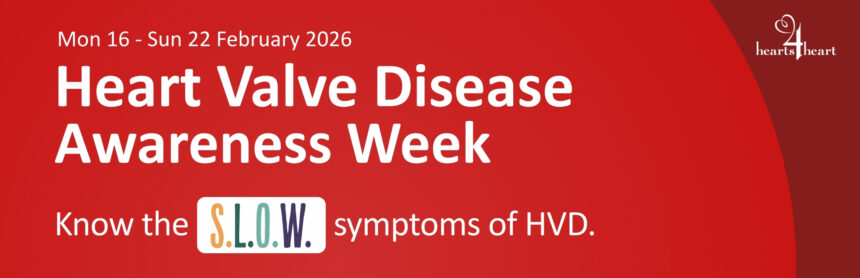
Monday, 16 February 2026: Australia’s response to heart valve disease is moving dangerously slowly, putting hundreds of thousands of lives at risk. To help change that, leading heart charity, Hearts4heart is launching the nation’s first ‘SLOW Symptoms’ campaign during Heart Valve Disease Awareness Week (16–22 February 2026).
In 2021, an estimated 600,000 Australians were living with diagnosed heart valve disease, with a further 254,000 people unaware they had the condition, meaning an estimated 850,000 Australians may already be affected.1,2
Australian and global heart health advocates now warn heart valve disease is “the next cardiac epidemic”, driven by an ageing population and persistently low awareness. Global projections suggest the number of people living with heart valve disease will double by 2040 and triple by 2060. Applied to Australia, this could mean up to 1.7 million Australians living with heart valve disease by 2040 if urgent action is not taken.2-4
Despite its growing prevalence, a persistently slow response to heart valve disease is sustaining low public understanding driving the tendency to misattribute symptoms as signs of ageing. This leads to delayed diagnosis, missed treatment opportunities and avoidable complications such as heart failure, stroke, arrhythmia and premature death.3,5
This week, Hearts4heart is launching the SLOW Symptoms campaign in Australia, a simple and memorable tool developed by UK charity Heart Valve Voice. With their support, the campaign is being introduced locally to help Australians recognise the red-flag symptoms of heart valve disease and seek early medical advice.
SLOW stands for:
- Shortness of breath
- Lightheadedness on exertion
- Feeling Older than your years
- Weary or unusually fatigued
Much like the FAST campaign for stroke, SLOW aims to embed these warning signs into everyday language, while also reflecting the slow pace of Australia’s response to the disease.
Hearts4heart CEO and Founder Tanya Hall said the SLOW campaign was a critical step in closing Australia’s awareness gap.
“Too many Australians are living with heart valve disease without knowing it, and by the time they do, it can be too late,” said Ms Hall.
“The SLOW campaign gives people the language to recognise symptoms, start a conversation with their GP and ask for a stethoscope check. If we don’t speed up Australia’s response, the human and health system costs will be enormous.”
If detected early, heart valve disease can be effectively monitored and treated, significantly improving quality of life and survival. However, outcomes for people with untreated, severe heart valve disease are poor, with more than half of symptomatic patients with severe aortic stenosis dying within two years if left untreated.
“Heart valve disease is one of the most under-recognised and under-diagnosed heart conditions we see,” said Professor David Playford, Professor of Cardiology at the University of Notre Dame.
“Heart valve disease gets worse before symptoms develop, and early symptoms such as breathlessness may be ignored or assumed to be due to age or lack of fitness. A simple stethoscope check followed by an echocardiogram is the best way to diagnose heart valve disease. Earlier detection saves lives.”
Throughout February, Hearts4heart will also deliver free heart health checks in select locations in Melbourne and Perth, helping Australians identify early warning signs and access timely specialist care.
Australians are encouraged to learn the SLOW symptoms, attend a free screening event if eligible, and speak to their GP about a stethoscope check, particularly if they are over 65 or experiencing unexplained breathlessness or fatigue.
For more information about Heart Valve Disease Awareness Week, the SLOW Symptoms campaign or free screening events, visit www.hearts4heart.org.au.
ENDS
Media contacts:
|
Roberta Sowden Palin Communications 0418 842 104
|
Kerry Jung Palin Communications 0435 753 618 |
About Hearts4heart
Hearts4heart is a non-profit organisation that supports, educates, and advocates for people with heart disease in Australia and New Zealand. Hearts4heart works to eliminate stroke and preventable deaths and improve the quality of life for patients and caregivers.
Bringing together patients and healthcare professionals to reduce the burden of heart disease, Hearts4heart provides targeted educational programs, resources, and services to improve diagnosis, treatment, and quality of life. To find out more visit www.hearts4heart.org.au
References
- Playford D, Stewart S, Harris SA, et al. Mortality associated with moderate and severe mitral regurgitation in 608 570 men and women undergoing echocardiography. Heart 2024:heartjnl-2024-324790. DOI: 10.1136/heartjnl-2024-324790.
- Hearts4heart. Heart Valve Disease.
- Global Heart Hub. HEART VALVE DISEASE: Harnessing Innovation to Save Lives, Mitigate Costs, and Advance the Healthy Aging Agenda. March 2023. Available at: https://globalhearthub.org/wp-content/uploads/2023/03/Position-Paper-on-HVD-and-the-Healthy-Aging-Agenda.pdf
- Playford D, Ihdayhid AR, Guilbert-Wright P. Identifying Gaps in Detection of Heart Valve Disease in Australia: A Population Survey. Heart Lung Circ 2025;34(2):162-172. (In eng). DOI: 10.1016/j.hlc.2024.10.019.
- Strange G, Scalia GM, Playford D, Simon S. Uncovering the treatable burden of severe aortic stenosis in Australia: current and future projections within an ageing population. BMC Health Serv Res 2021;21(1):790. (In eng). DOI: 10.1186/s12913-021-06843-0.