
Video, interviews and stills here: https://dams.wwf.org.au/resourcespace?c=6402&k=e9ab39314b
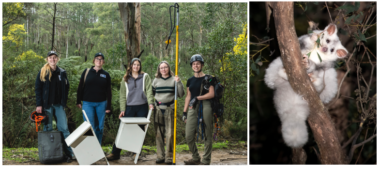
A mix of highly skilled and amateur carpenters in New South Wales and Canberra are improving their lives by helping to save an endangered animal – a species most of them didn’t even know existed.
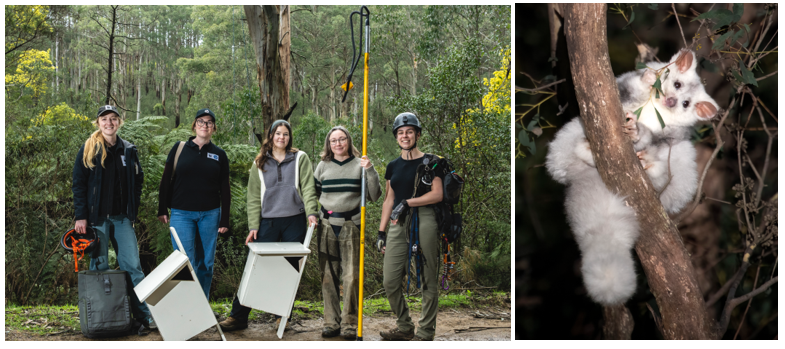
Greater gliders face a crisis. They need multiple tree hollows to survive. But in much of their range, hollow-bearing trees are in short supply because of bushfires, logging and land clearing enabled by weak nature laws.
So volunteers are building hi tech nest boxes to help the species repopulate degraded areas. It’s a mission not just benefiting greater gliders. Participants enhance their wellbeing through social connection, camaraderie, and a sense of purpose.
The project is a partnership between the World Wide Fund for Nature Australia and the Australian National University, with funding support from global tech company HP Inc.
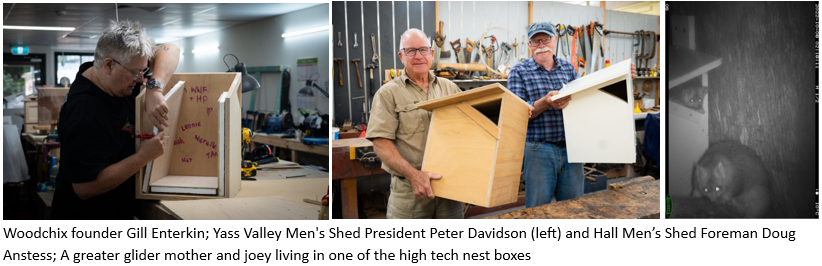
Hall Men’s Shed in Canberra, Yass Men’s Shed in the NSW Southern Tablelands, and Woodchix in Sydney have so far produced 166 insulated nest boxes. Compared to older designs, the ANU nest boxes are warmer in winter and cooler in summer because of insulation, air gaps, fireproof sealer and heat reflective paint.
Over the next few months these greater glider homes will be installed at dozens of sites across the Victorian Central Highlands, ranging across Toolangi, Yarra and Powelltown.
While these sites escaped the recent bushfires in Victoria, other areas of greater glider habitat were damaged, putting the species under additional pressure. Projects like this hope to boost populations.
Gill Enterkin, Founder of Woodchix, said:
Woodchix is a way for women to come together, socialize, and learn at the same time. And we’re doing something for the environment.
We’ve had dozens and dozens and dozens of women from all over Sydney volunteer to do the greater glider nest boxes and they’ve had a terrific time.
I saw a photo of a greater glider family in the bottom of a nest box looking up, and they were gorgeous. That says everything. That's why I'm here. That's why we're doing it. That's why every woman who volunteered here came to do it.
Doug Anstess, Foreman of the Hall Men’s Shed said:
The Men's Shed is a place for men to come and be with other men. Some fellows come along meek and mild to start with, but after a few months, they start to talk, they start to get interested, and it gives them a purpose in life. And that's what a men's shed is about.
We hadn't heard of the greater glider. It wasn't until we started looking at the research documents that we realized “oh gee, these greater gliders are something else. We better do a good job”.
Peter Davidson, President of the Yass Valley Men's Shed said:
Men’s sheds were first thought of in Australia, and now they’re a worldwide movement. Men of any age can gather and exchange stories, experiences or just be themselves. A lot of guys might be lonely because they've lost their wife or partner. It's a way of finding support.
By building nest boxes we feel we're contributing to a very worthwhile research project. Hopefully it’s something that distributed at scale helps greater gliders which are fascinating creatures. It also focuses on the importance of forests.
Dozens of volunteer-constructed nest boxes have already been installed so far in the Victorian Central Highlands. Mountain Ash trees, the tallest flowering plant in the world, were once abundant in the area. But only about 1% of the remaining Mountain Ash forest in the Central Highlands is old growth, the rest is often highly degraded.
Dr Kara Youngentob, ANU senior research fellow and project lead, said:
We have a lot of forests that have lost hollow bearing trees because of logging and fire. There are trees that greater gliders can eat, but there's no place for them to sleep. It's kind of like having a bed and breakfast without the bed. So we need to bring the beds back into the forest to try to bring the gliders back and we’re doing that with the help of nest boxes.
Dr Kita Ashman, a WWF conservation scientist, said:
We returned to a site in Tallaganda State Forest after logging and there was one tree left in this entire area of forest. And I watched a glider come out and not have anywhere to go. To see an endangered species come out of a tree hollow and just stare into the distance because there's nothing left, that's devastating, that's gut wrenching.
But I am really hopeful that collaborations like this, and the amazing work that so many people are doing, can turn the tide for greater gliders.
A trial of the ANU nest box design began in Tallaganda State Forest and National Park in 2022. Greater gliders rapidly moved into the artificial homes. ANU scientists are studying whether nest boxes boost population recovery following the 2019/2020 megafires. Early indications are that greater glider numbers are increasing since the 2019/2022 fires, especially at sites augmented with nest boxes.
In another study, ANU research fellow Dr Ana Gracanin recorded a greater glider inspecting a nest box just six hours after it was put up. Dr Gracanin said:
That was a fluke, but it was so cool. On average it took about a month, but greater gliders moved into every nest box. I got so excited to see babies being raised in the nest boxes. We're really hopeful that we'll have greater gliders using the nest boxes in Toolangi soon.
Katherine Best is monitoring the project as part of her PhD at ANU. She said:
Greater gliders are unique. Gliding as a function has only evolved in a small number of species worldwide. They used to be all throughout the Central Highlands. We’re hoping we'll boost their population by providing nest boxes and show that it is a scalable, financially viable solution. There are large areas of forests that need urgent restoration work.
Olivia West, HP Inc. sustainability manager, said:
Our partnership with WWF isn’t just about forests, it’s about the future we all share. Healthy forests give us clean air, protect biodiversity, and help fight climate change. At HP, we believe technology and sustainability go hand in hand, innovation should serve people and the planet. Supporting nature has no downsides; it creates benefits that ripple across communities and generations. Being part of this work is truly meaningful because it’s about making a lasting difference for both the environment and society.
Contact details:
Mark Symons
Senior Media Officer, WWF-Australia
m 0400 985 571