
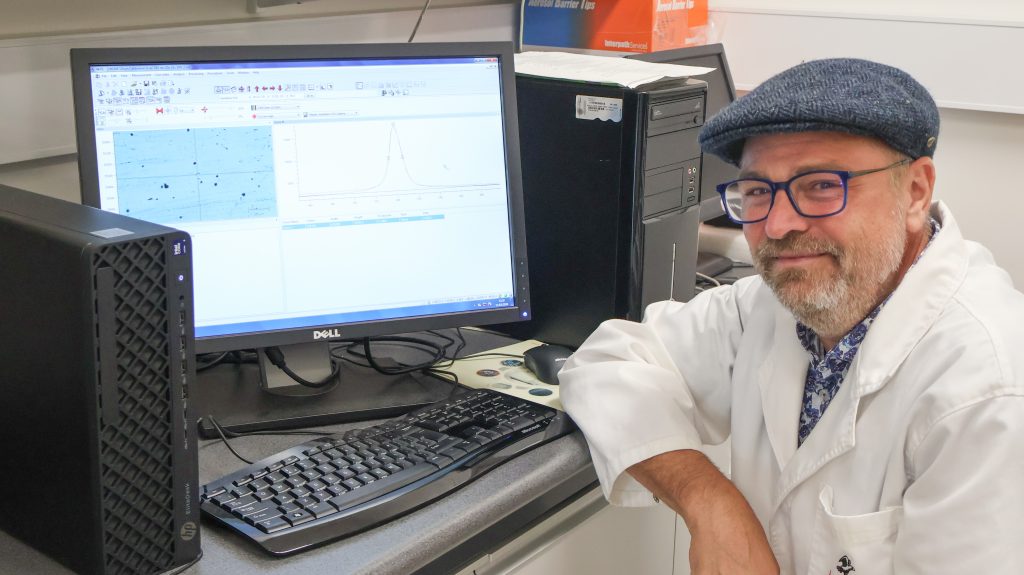

A team led by La Trobe University has drawn inspiration from nature to develop a breakthrough sensor that can rapidly track tiny molecular changes in blood, paving the way to real-time, personalised medicine.
The discovery overcomes one of the biggest barriers in blood testing: that blood quickly clogs most sensors, making accurate instant readings almost impossible over long periods of time.
Working in collaboration with CSIRO, the team combined a natural protective coating called lubricin, fast-responding receptors and an ultra‑sensitive, light‑based detection method known as Surface‑Enhanced Raman Scattering (SERS) to mimic the way real cell surfaces protect themselves and sense molecules.
In a world-first, the team used SERS to detect the antibiotic Vancomycin in unprocessed blood samples without any loss in sensitivity over more than 10 hours of continuous exposure.
“Blood is one of the hardest substances to measure anything in,” La Trobe University Associate Professor and research lead Wren Greene said.
"The secret to our sensor is its cell-like structure which filters the molecules from blood, enabling ultra-sensitive SERS detection.”
Research co-leader Dr Mingyu Han from CSIRO said other sensors had detected Vancomycin but this was 100 million times more sensitive, making it the first practical, real-time SERS sensor capable of working inside a fluid like blood.
“It solves long-standing challenges in sensitivity, response speed and surface fouling, opening the door to real-time molecular monitoring for personalised medicine,” Dr Han said.
SERS is an optical technique that reads molecular changes using light. Able to detect a single molecule, its extreme sensitivity is also its weakness, making it susceptible to fouling, or contamination.
To prevent this, researchers created a microscopic shield from lubricin, a naturally occurring molecule molecule – provided by industry partner Lubris Biopharma – that prevents unwanted material from sticking to cell surfaces. Within this protective layer, they placed fast-responding DNA-based receptors called aptamers, which capture molecules.
Associate Professor Greene said the discovery was a significant step towards real-time health systems that could automatically adjust drug delivery or warn clinicians before a patient’s condition became dangerous.
“Our sensor greatly expands the detection range, allowing us to measure hormones, toxins and other biomarkers that appear only at low concentrations. This is critical for early disease detection and monitoring the body's response to treatments.
“This discovery also advances the scientific field itself, demonstrating a way to overcome the long-standing trade-off between high sensitivity and fast response in molecular testing.”
The research, conducted in collaboration with Lubris Biopharma and La Trobe spinout company AlleSense, has been published in the journal ACS Sensors.
The sensor was built on AlleSense's NanoMslide, demonstrating the potential application of the technology.
La Trobe Distinguished Professor Brian Abbey said AlleSense is in the process of establishing clinical-scale manufacturing at the University and, in the future, the team hopes to prototype an inexpensive, mass-produced ‘test strip’, similar to a blood-glucose test.
The research was conducted with the support of the ARC Research Hub for Molecular Biosensors at Point-of-Use (MOBIUS).
DOI: 10.1021/acssensors.6c00192
Contact details:
Robyn Grace – [email protected], 0420 826 595