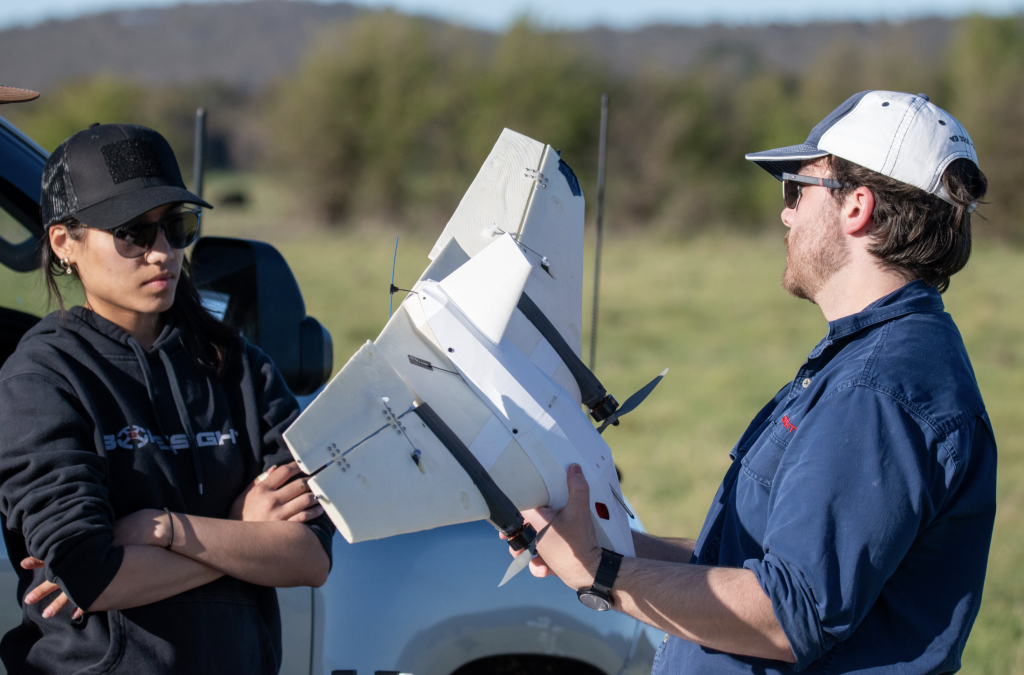
Charlize D'Souza, an Aerospace Research and Design Engineer at Boresight, traces her interest in engineering to her father.
“All my life he’s been tinkering and fixing things and he’s a huge inspiration because of that,” she says. “He’s very hands on with his job so I learned a lot of the basic mechanics while shadowing him as I grew up.”
School built on that. At Cerdon College Merrylands she found strong STEM courses that were, in her words, “not only taught really well but was also super engaging and fun to do.”
The choice of aeronautical engineering over mechanical was less of a grand plan.
“I’ve always thought planes are pretty cool and it interested me more than Mechanical Engineering,” she says. “It was just the one that stood out to me the most and it was a really good choice because I ended up loving it.”
A small field, and a student team
She studied a Bachelor of Aeronautical Engineering (Honours) at the University of Sydney and graduated at the start of 2025. While there she joined SUAVE (Sydney UAV Engineering), a student team, and its Design Build Fly group, which designs and builds competition aircraft.
She knew she wanted to stay in aviation, and she knew that wouldn’t be easy.
“There are really not a lot of jobs for aeronautical engineers within Australia,” she says, “but I was really hoping to do something that allowed me to contribute directly to the aviation industry in some meaningful way.”
The link to Boresight came through SUAVE, which the company sponsors. Earlier in the year she applied, she went to a Boresight open night. She toured the facility and spoke with Chief Technology Officer Dr Alexander Hall and others on the team.
“[It] seemed like the dream job,” she says, “the exact mix of calculations and hands on work that I wanted.”
She plays down how she got the role. “Not really anything special,” she says. “I was a fresh graduate and applying for everything.” She hoped her years of designing and building competition planes would make her a good fit.
Engineering the adversary
Boresight builds the drones that play the enemy. Drones are changing how modern wars are fought, so militaries need realistic ways to train operators and test counter-drone systems without putting high-value aircraft at risk. Boresight’s answer is a full ecosystem: aerial target drones plus the mission planning and ground control systems that go with them.
The company manufactures in Fyshwick in the ACT and is building up manufacturing in Huntsville, Alabama. It has teams in Australia, the US and Europe, and its customers include the Australian Defence Force and US Army training facilities.
Starting at a small company with big ambitions felt like “big shoes to fill”, she says. Being given an entire project to create from scratch, the BF100, was a different kind of pressure.
When it gets real
“(It) seemed a little daunting initially,” she says. “Not because I hadn’t designed a plane before but now it seemed ‘real’.”
For a young engineer, it’s an unusual brief. Most aircraft are designed to avoid detection and come home safely. Target drones are built to be found, tracked and engaged.
She credits the people around her. “Everyone in the company is extremely supportive and have really helped me to learn and grow as an engineer,” she says. “We have a good support system within our office, and I was able to get good feedback for my work as well which was really needed.”
She was given requirements and nothing else, and had to “take it from there”. The result is an aircraft she has seen through from first concept to working flight.
The first BF100 prototypes didn’t come out of a 3D printer.
That was a break from how things are usually done at Boresight. So far the ASX-listed defence technology company has built its aerial target drones with additive manufacturing (FDM and SLS printing), a method that suits aircraft designed to be flown hard and lost. When D'Souza started work on the BF100, she worked out quickly that printing wouldn’t do the job.
It would be “too fragile and extremely time consuming to manufacture, among other reasons,” she says.
So, with some help, she began experimenting with expanding foams. She built a manufacturing process from scratch before she could make a single prototype component. Then came the harder part.
“Getting to a good physical prototype was a huge process but it also needed to fly,” she says.
Next came a long run of flight tests. Each one fed changes back into the design, until the BF100 was flying and working.
“This plane is pretty much my child,” she says. “Seeing how much went into it and having an opportunity to be at a demonstration and represent Boresight with something I’ve designed means a huge amount to me.”
The BF100 is being demonstrated around the world with international militaries showing great interest in the newest product from Boresight. For a young girl who watched her father tinker in the back shed, to now being a key part of a world leading team designing drones, it’s a an exciting time for Charlize D’Souza.
About us:
About Boresight: Boresight delivers an integrated aerial target drone ecosystem that enables realistic C-UAS training and testing for government and industry. The company’s systems combine attritable aerial target drones, mission planning software and scalable ground control systems to support threat emulation and operational readiness. Boresight’s platform range includes quadrotor and fixed-wing aerial target drones designed to replicate evolving drone threats and enable repeatable testing and training scenarios without risking high-value ISR assets. With teams in Australia, the United States and Europe, Boresight supports customers globally with scalable C-UAS training solutions, integrated engineering and production capabilities.
Contact details:
JMM Investor & Media Relations, Wilamina Russo: [email protected]