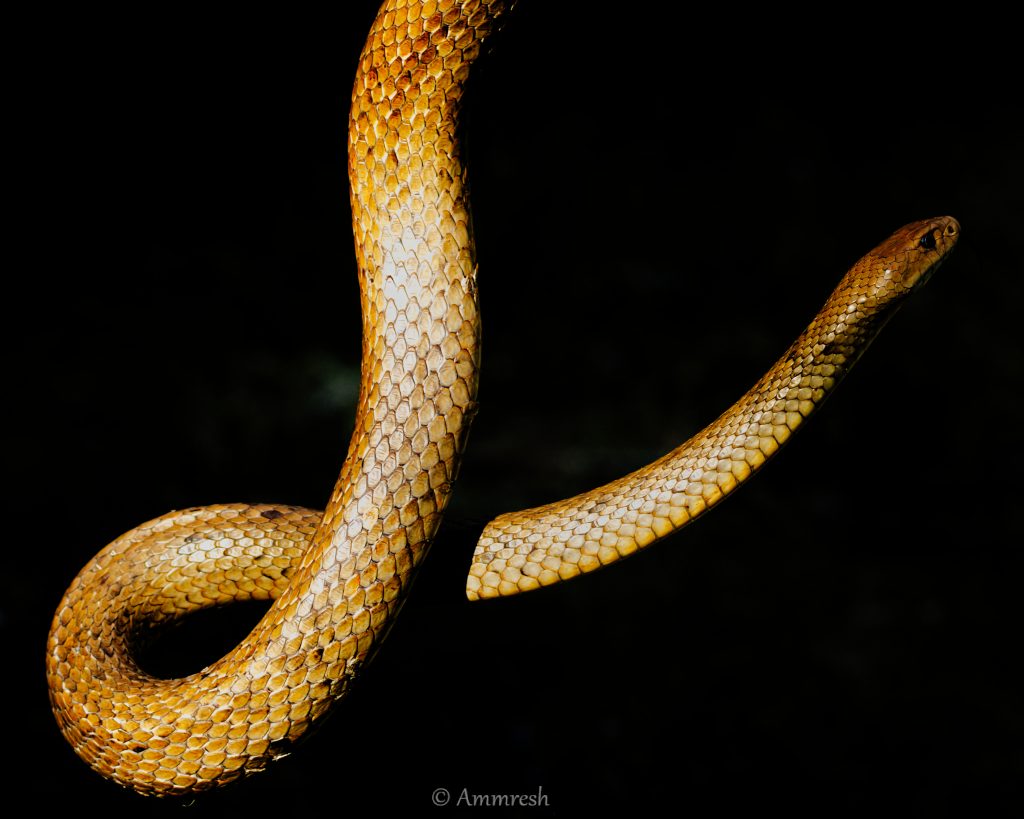

Snakes have always been perceived as a long body with a head attached. Now new research from Monash University has revealed that they are more complex creatures, having some of the most intricate spines in the reptile class.
Led by PhD candidate, Ammresh, from Monash University’s School of Biological Sciences, the study, published in the Journal of Morphology, used three dimensional Geometric Morphometrics (3DGM) on three Australian snake species: the eastern brown snake, copperhead and tiger snake. 3DGM is a biological tool used to provide an in-depth investigation of morphological change, in this case looking in depth at each vertebra’s shape, to study how it changes along the body.
“By looking at the 3D shape change in every single vertebra, we get to see a never-before-seen picture of how shape change happens throughout the column,” Ammresh said.
Instead of a long, simple tube the snakes’ bodies revealed a short cervical and lumbar region, with most of the elongation happening in the thoracic region and three modules detected within the thoracic region.
According to Ammresh, the elongated form of the snake “is one of the most striking examples of deviation from the basic tetrapod body plan, evolving independently multiple times across the vertebrate tree – for example caecilians, skinks, geckoes, amphisbaenians, and snakes in response to a wide range of ecological pressures and locomotory demands,” he said.
In humans the spine is divided into three regions; a cervical region, or neck, which supports the head and gives mobility to look around. After that is the thoracic region, with ribbed vertebrae to protect the internal organs. Finally, we have the lumbar region in the lower region, designed to support our upper bodies.
According to Ammresh, vertebrae have distinct shapes based on the functions they serve, and we can see this in a host of different animals. “When it comes to snakes, however, the story becomes a bit more complicated. Snake vertebrae similarly change shape throughout the column, but the boundaries between these regions aren’t as clear cut,” he said.
In 2015 a seminal paper in Nature came out, finding snakes’ vertebra do in fact have regions – four, in fact: the cervical, anterior thoracic, posterior thoracic and lumbar regions.
What the researchers found was not a uniform gradient of change along the vertebral column, but rather some areas of rapid change and some areas without, finding that snakes do in fact have regions within their bodies, where there are sections of vertebrae that have a similar regional shape, then a rapid transition zone into the shape of another region.
“By looking at this much detail, we found five regions within a snake’s body – not four. We also found that snake necks are shorter than once thought. While previous research thought of the neck as long, up to 15 per cent of the body, we show it’s more likely to be around five per cent of body length,” Ammresh said.
“This means snake necks are around 7 to 12 vertebrae long, similar to their lizard cousins. This suggests that while snakes elongated other parts of their body, their necks retained a more ancestral form, remaining short throughout evolution.”
Importantly the researchers also found a previously undescribed region, which they coin the middle thoracic region, nestled in between the anterior and posterior and thoracic regions.
Ammresh said that this finding contributes to an emerging theory, where limbless animals have undergone shifts in their vertebral columns. Basically, if you don’t have any limbs, the only way for you to adapt to your environment is by changing your entire body.
Read the research paper: https://doi.org/10.1002/jmor.70147
MEDIA ENQUIRIES
Hande Cater
Media and Communications Manager
P: +61 456 428 906
GENERAL MEDIA ENQUIRIES
Monash Media
P: +61 3 9903 4840
For more experts, news, opinion and analysis, visit Monash News.