

Skip to content
Oil Mining Resources

Study shines light on overlooked step in battery recycling

Monash University 2 mins read

New research shows pre-treatment in lithium-ion battery recycling drives environmental impact and recovery of valuable metals - yet it is often overlooked in recycling strategies. 

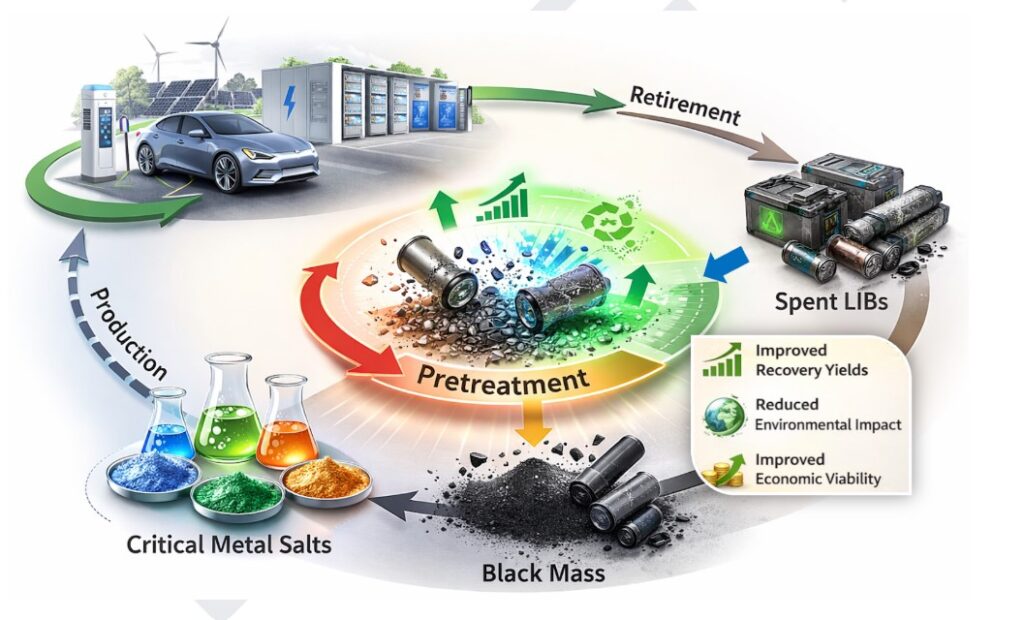
Published in Nature Sustainability, the Monash study found the pre-treatment stage can account for up to 38 per cent of the environmental impact of recycling and significantly affects material losses, depending on battery type and processing method.

Pre-treatment is the first processing step, turning spent batteries into “black mass,” before valuable metals such as lithium, nickel, and cobalt can be extracted, yet it is often ignored in recycling strategies, according to the study.

As countries around the world build new battery recycling systems, the insights provide critical guidance for policymakers and industry, helping ensure recycling systems are efficient, effective and sustainable. 

The study, by the Department of Civil and Environmental Engineering, compared three main industrial approaches - mechanical, thermal and chemical pre-treatments - identifying clear trade-offs between environmental performance, recovery efficiency and operational complexity. 

Professor Victor Chang, Deputy Head, Department of Civil and Environmental Engineering, said the findings show that choices made at the start of recycling can affect how well the system works and how much waste or metals are lost over time.

“While many countries are planning to invest in and scale up battery recycling industries, our work highlights an important aspect of the process - the pre-treatment stage. This step is often overlooked, but it can be critical in determining the efficiency, safety, and overall effectiveness of downstream recycling processes,” Professor Chang said. 

“Lithium-ion battery recycling is not just a technical challenge - it’s a system design challenge. Pre-treatment shapes both recovery efficiency and environmental outcomes. Decisions made at this stage will affect system performance for decades, so it’s vital that they are guided by robust evidence.”

Read the research: https://doi.org/10.1038/s41893-026-01767-1

MEDIA ENQUIRIES 

Courtney Karayannis, Media and Communications Manager

Monash University

P: +61 408 508 454

E: [email protected]

GENERAL MEDIA ENQUIRIES

Monash Media

P: +61 3 9903 4840

E: [email protected]

For more experts, news, opinion and analysis, visit Monash News.

Media

More from this category

  • Building Construction, Oil Mining Resources
  • 09/03/2026
  • 09:00
RST Solutions

COMPAK-T DELIVERS FASTER COMPACTION, LOWER WATER DEMAND AND IMPROVED SOIL SEALING PERFORMANCE FOR LANDFILL AND EARTHWORKS OPERATIONS

A new Australian-developed compaction aid is helping landfill and earthworks operators achieve stronger, more reliable compaction by improving how fine particles behave during moisture…

  • Contains:
  • Manufacturing, Oil Mining Resources
  • 06/03/2026
  • 12:37
Liberty Bell Bay

Liberty Bell Bay statement

Attributable to a Liberty Bell Bay spokesperson:Liberty Bell Bay has faced a challenging 20 months due to the force majeure declared by its main ore supplier, a significant deterioration in market conditions worldwide, and rising costs. Production is currently paused.Workers remain on site on regular shift rosters completing maintenance and commissioning work, and all employees continue to be paid.LBB remains committed to finalising the submission of its financial statements to ASIC as soon as possible.It continues to pursue a sustainable future for Australia’s only manganese smelter to protect 216 Tasmanian jobs and will resist any application to wind up the…

  • Indigenous, Oil Mining Resources
  • 06/03/2026
  • 10:11
House of Representatives

Critical minerals: have your say

TheHouse of Representatives Standing Committee on Primary Industriesis conducting an inquiry into factors shaping social licence and economic development outcomes for critical minerals projects across Australia and is seeking written submissions to guide the inquiry’s findings. The inquiry has already received over fifty submissions from a range of stakeholders, but the Committee is keen to hear from more individuals and organisations, especially those operating directly in the critical minerals field and communities with an interest in or who are impacted by critical mineral developments. Committee Chair,Meryl Swanson, said: ‘We have heard from miners, farmers, local governments, community organisations, Indigenous organisations…

Media Outreach made fast, easy, simple.

Feature your press release on Medianet's News Hub every time you distribute with Medianet. Pay per release or save with a subscription.